
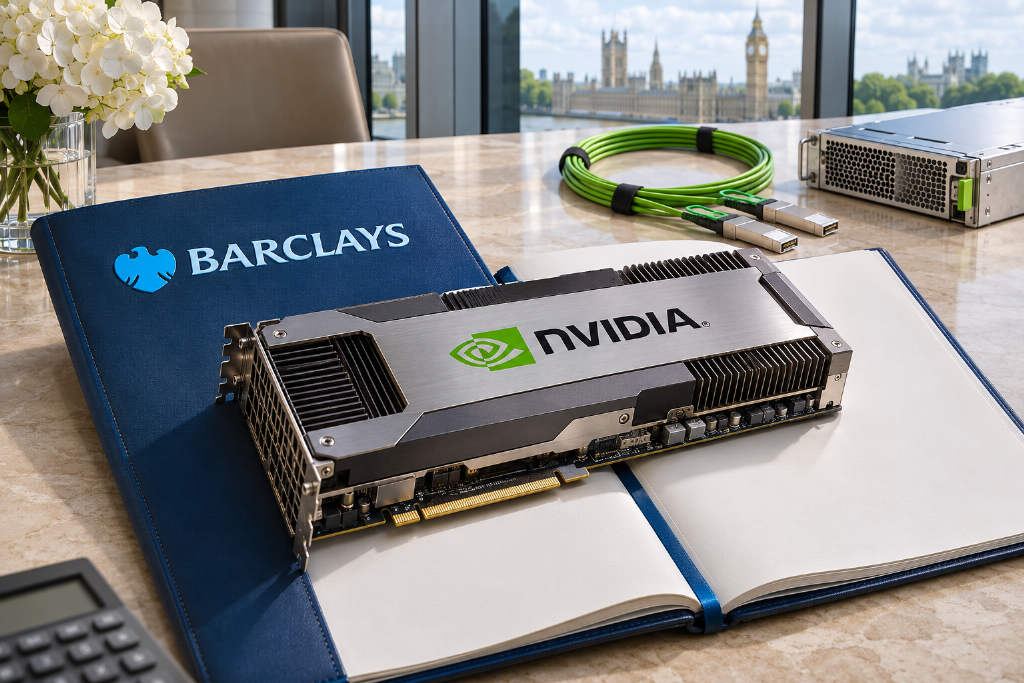
Barclays maintains its long-term AI view
Julian Lafargue, chief market strategist at Barclays Private Bank, said investors should continue participating in the artificial intelligence trade even as several developments test market confidence. Those pressures include the uncertainty over Nvidia CEO Jensen Huang’s position, doubts about returns on AI investment and higher financing costs.
Lafargue said AI is not a bubble. He described it as a technological revolution that will affect every industry, while stressing that its commercialization and the construction of supporting infrastructure cannot happen all at once.
A leadership change at Nvidia would not reset the AI trade
Lafargue described Nvidia as the “central bank of the AI trade.” Even if the company were to replace its chief executive, he said that would not mean the entire AI supply chain would need to be reassessed or renegotiated.
He compared a potential leadership transition at Nvidia with earlier management changes at Microsoft, Alphabet and Amazon. In his view, a successor taking over does not necessarily weaken a company’s value.
Rates and financing remain key risks
Barclays has identified interest rates and financing conditions as the main risks capable of disrupting the market. As investment in AI infrastructure grows, the market’s focus is shifting from whether demand for computing power is real to whether massive capital expenditures can produce adequate returns.
Data-center construction still faces bottlenecks involving power connections, equipment installation and the timeline required to begin commercial operations. Expectations for tighter Federal Reserve policy could also raise corporate financing costs and reduce the valuation of long-term cash flows.
Lafargue said commitments involving trillions of dollars in AI investment could not be converted quickly into delivered computing capacity. Returns on investment would also vary significantly among companies. Tighter financing conditions could change the pace of industry investment and the competitive structure, but would not mean that long-term demand for AI infrastructure had disappeared.
Barclays continues to favor maintaining exposure to AI investments until there is a clear signal that the industry’s growth momentum is slowing materially.



