
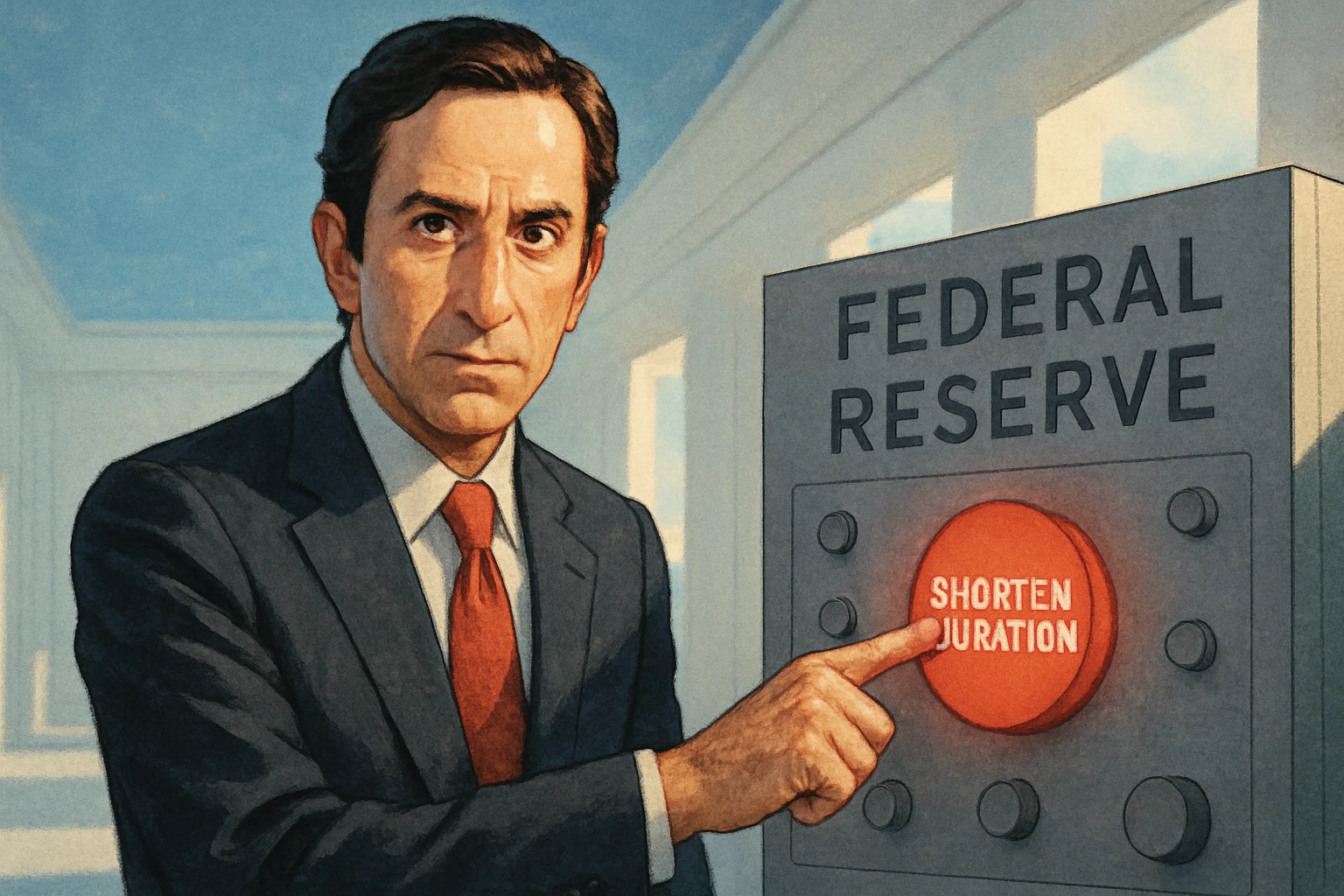
Barclays said in a February 10 rates research report that Kevin Warsh could pursue a different path at the Federal Reserve: keep the balance sheet large for now, but shorten its duration in a major way. The mechanism is simple on paper. As longer-dated Treasuries mature, the Fed would reinvest into T-bills rather than replacing them with similar notes and bonds. In market terms, that is not a neutral swap. It pushes more duration risk back into private hands.
The report argues that Warsh sees the Fed’s balance sheet as too large and too long in maturity profile. By early 2026, the balance sheet stands near $6.6 trillion, compared with $4.4 trillion before the pandemic and $0.9 trillion before the global financial crisis. Barclays also points to structural issues inside that total: reserve balances are close to $3 trillion, or about 12% of bank assets; the Treasury portfolio’s weighted average maturity is about 9 years, versus 3 years before the GFC; securities with maturities beyond 10 years account for 40% of holdings, while T-bills make up only 7%. Before the GFC, that T-bill share was 36%.
Why outright balance-sheet shrinkage could backfire
Barclays does not frame a return to aggressive quantitative tightening as a clean option. Banks now operate in an ample-reserves system, and demand for reserves is not linear. It can look stable for a long time, then tighten abruptly once the system gets too close to a scarcity threshold. The September 2019 repo shock remains the reference point.
If the Fed cuts reserves too far, funding rates can jump without much warning. Deleveraging pressure follows quickly. At that stage, the central bank may be forced to step back in, which would undercut the stated goal of reducing its footprint in markets.
A five-year shift that would remake the portfolio
Instead of selling assets aggressively, Barclays models a gradual duration reset. Over the next five years, about $1.9 trillion of notes and bonds are expected to mature. If the Fed keeps rolling those proceeds into T-bills, its T-bill holdings could rise from roughly $289 billion today to about $3.8 trillion. That would lift the T-bill share of the Treasury portfolio to around 60%.
The maturity profile would change sharply. The portfolio’s duration could fall from 9 years to 4 years, bringing it much closer to pre-GFC norms. For the Fed, that means less direct exposure to interest-rate risk. For the market, it means the duration has to be absorbed somewhere else.
The Treasury’s role in the “new accord”
Barclays says the strategy depends on coordination with the Treasury. If the Fed stops absorbing as much long-dated issuance and the Treasury fills the gap by selling more coupons to the public, private investors would need to take on an additional $1.7 trillion of duration supply on a 10-year equivalent basis. In that case, Barclays estimates the 10-year Treasury yield could rise by 40 to 50 basis points.
A less disruptive version would keep coupon supply to the private sector unchanged while the Treasury increases T-bill issuance to meet the Fed’s new demand. Under that setup, private-sector holdings of T-bills would stay near 24%. The trade-off is a shorter average maturity for Treasury debt overall, moving from 71 months to about 60 months.
Higher term premium, lower policy rate
Barclays cites a 2019 Fed staff study that reaches a result many investors would view as counterintuitive. Shortening the Fed’s portfolio duration acts like a tightening in financial conditions, which means the policy rate may need to be lower to offset it. The study suggests that, holding inflation and unemployment outcomes constant, the federal funds rate could need to run 25 to 85 basis points below the baseline if the Fed adopts a shorter-duration portfolio.
That combination matters. Even with Treasury cooperation, the report says the market could still face higher term premia, a steeper yield curve, and a lower policy-rate path. Barclays’ reading is that a Warsh-led normalization would be a long process, but one with consequences that reach well beyond the size of the Fed’s balance sheet itself.