
Compiled and translated by Foresight News
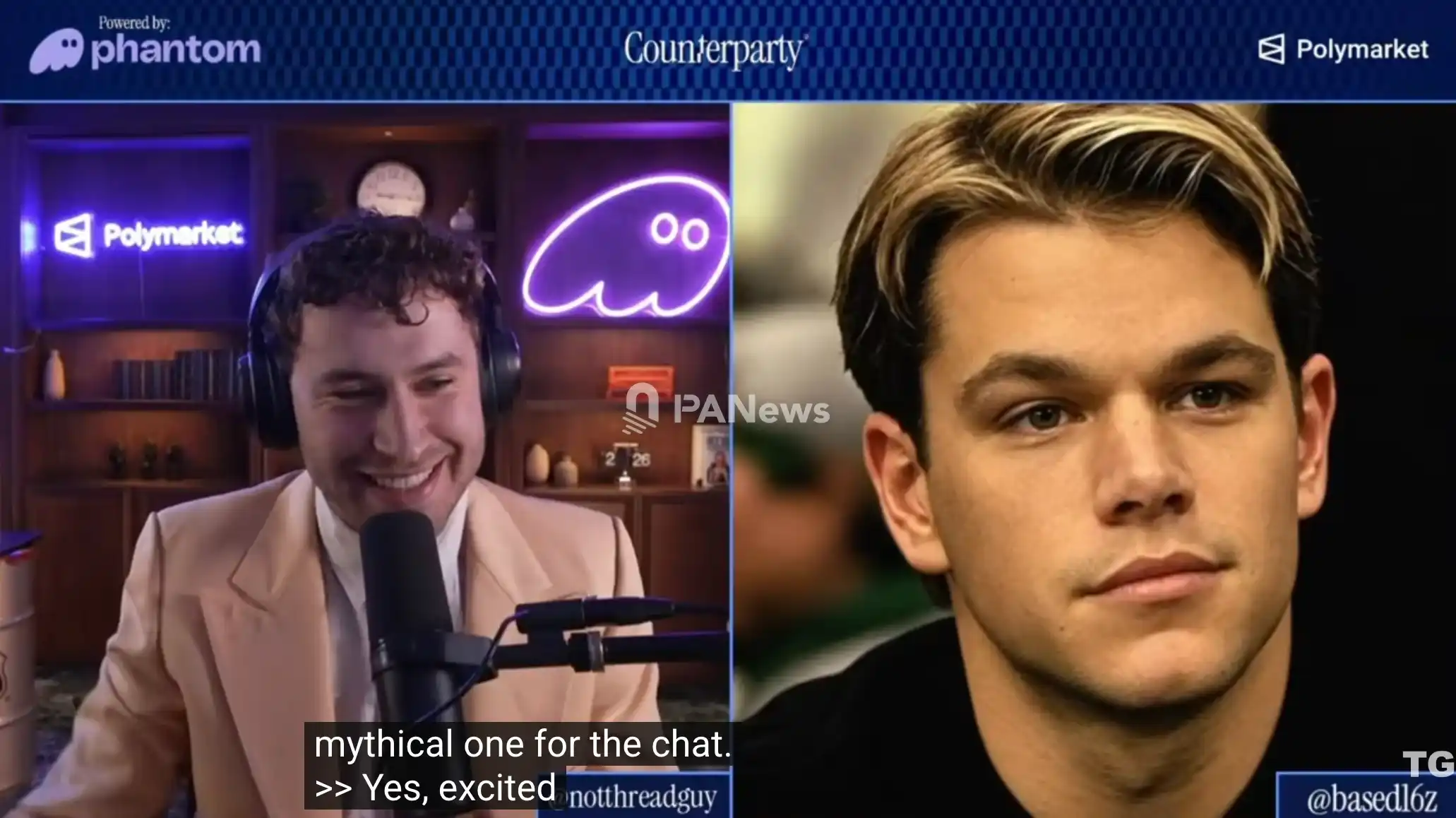
In an October 2026 podcast interview with threadguy, crypto trader based16z laid out the trade he says stands above everything else he has done so far: spotting Hyperliquid early, spending the next year farming activity on the platform, and ending up with what he described as one of the most lucrative airdrops in crypto history.
The conversation ran for more than an hour and moved well beyond the HYPE airdrop. Based16z also spoke about how he evaluates founders, why he prefers concentrated bets over scattered trades, where he has lost the most money, and what changed after he reached financial freedom.
He flagged Hyperliquid in late 2023 and treated it as a rare opportunity
Threadguy recalled that his first call with based16z took place in November or December 2023, when he was living in Los Angeles. He had just come across based16z on Twitter, thought he was interesting, and pulled Frank into a video call. When asked about the market, based16z did not offer a broad macro view. Instead, he mentioned one thing: Hyperliquid looked strong and was worth farming.
At the time, he did not even present it as a fully formed thesis. He described it loosely as a perpetuals exchange and told the host to look into it. That early comment later turned into a story about one of the biggest airdrop outcomes in the sector.
Based16z said Hyperliquid was the best trade he has made so far. He added that he does not think trading or investing should revolve around chasing a large number of low-value setups. In his view, the real work is waiting for the occasional high-quality opportunity and then acting decisively when it appears. Hyperliquid fit that standard for him.
Before that, he had already been active in crypto. He said he made money in 2021, stepped away in 2022 to finish college, then worked as a crypto VC analyst at a large fund while continuing to trade on-chain. One of the opportunities he found in 2023 was Rollbit, which he described as a crypto-native online gambling platform. He liked the product, the gambling demand, the token price, and the revenue story. He also noted that buying it on Solana felt natural because he had traded Solana in 2021 and was already comfortable with the chain and its fees. He called that his only big result in 2023 before Hyperliquid.
He then moved into perpetual futures trading, though he said that is usually a bad idea. He wanted to put on larger positions on-chain, but venues such as dYdX and Vertex did not offer the depth he wanted. He said that even trying to buy 100 BTC could overwhelm those order books, forcing him to split the trade across several platforms and monitor multiple screens at once. He was trading with a U.S. identity at the time, and people told him to stop making life difficult and just open a Papua New Guinea KYC account. He did not do that.
His conviction started with Jeff Yan
Asked how Hyperliquid first entered his field of view, based16z said he was looking for venture investments and on-chain bets at the same time. When Hyperliquid appeared, those two tracks lined up. He tried the product, then immediately reached out to co-founder Jeff Yan to ask whether there was something bigger there.
He said meeting Yan left a strong impression. In his telling, Yan did not feel like a typical crypto founder. He went back and listened to older podcast appearances in which Yan discussed markets and came away thinking he was operating on a different level from most people he had met in the industry. Based16z said he has never met Vitalik Buterin, but Yan was the first early-stage figure he had encountered whom he considered truly top tier.
By late 2023, he had already told people at his fund that they should try to buy into Hyperliquid at a $1 billion valuation before the business was making money, because he believed it could become a major trade. According to him, the fund agreed and prepared to send a term sheet. Yan declined. Based16z said the answer was essentially that Yan wanted a more Bitcoin-like native birth for the project. Once that happened, he felt the path in front of him was obvious: spend the next year treating the airdrop as a full-time job.
Looking back, he said the trade was in large part a bet on the founder. Even now, with Hyperliquid much more established, he said he still likes the team and the product and still sees it as one of the cooler things being built in crypto.
Five days before the airdrop, the computer holding his keys died
When the discussion turned to the airdrop itself, based16z described what he called the funniest part of the whole story. The private keys for all of his airdrop farming wallets were stored on an old MacBook. It had worked fine for a long time. Then, one week before the airdrop, the machine died completely. It would not turn on, and he had not written down the seed phrase.
At that point, only five days remained. He first went to his friend Flood’s house and used Flood’s computer to set up what he described as a legitimate professional VPN in preparation for claiming the tokens. Two days later, when he tried to check again, the screen was black. He started calling anyone with technical connections he could think of, including Shoku, the founder of Trade.xyz. He went to the Apple Store and to authorized repair shops. The answer he got, he said, was that the machine would need something like an Israel Defense Forces-level lab to have any chance of being fixed.
He said he knew what that meant. He had already made enough in crypto in prior years to support himself and he still had a job, but he also knew this airdrop could be a once-in-a-lifetime event. The idea that all of those assets might be lost because of one dead laptop genuinely rattled him.
The break came from a former roommate, who still had an old laptop from based16z’s first apartment in New York’s East Village. Based16z called and asked whether the machine was still around. The roommate said yes, but asked whether he could pick it up in a few weeks because he was with his girlfriend. Based16z said no and asked whether he could come over that day, within two hours.
He rushed to the apartment and found that the old laptop still contained older keys. That saved him. Even so, he missed the first day of the airdrop. Over the next five days, HYPE rose from $3 to $10 while he still had not claimed the tokens. By the time he finally got back into the account, the position made up 90% of his portfolio and the token was trading around $10. The first thing he did, he said, was buy more.
He messaged Shoku and asked whether that idea made sense. Shoku’s answer, as he recalled it, was probably not. Shoku suggested selling some HYPE, moving the money into an S&P 500 index fund, locking in the win, and effectively taking financial freedom. Based16z said that advice was right in hindsight, and he did sell part of the position there. He later sold more in the $30 to $40 range. Looking back now, he said that may have been a mistake driven mainly by impatience.
What comes after life-changing money
From there, the conversation shifted to a harder question: what kind of asset is worth holding forever, how do you capture the tail of a move, and how do you detach psychologically from a position that has become too large?
Based16z said one of his biggest challenges is that he usually either takes a very large position or does not take the trade at all. When a position gets big enough, it occupies mental space all the time. If there are other things in life besides trading and investing, that kind of exposure can start to feel heavy. He said he still has not learned how to truly let go and accept that some assets belong in a permanent capital bucket or a very long-duration allocation.
Threadguy then asked what it felt like emotionally after making life-changing money. Based16z said his relationship with wealth has always been complicated. He grew up in what he described as a relatively affluent family, with parents in the upper-middle range, but his mother was involved in a religious group that emphasized meditation, contentment, and the idea that money was the root of evil. At the same time, he was an intensely ambitious kid. He first pushed toward sports, then shifted to math competitions and the path toward a strong university.
Once he got into a good school, he said he found himself surrounded by some of the wealthiest people in the world, seeing things like free courtside NBA tickets and wondering what system produced that kind of life. He started trading crypto in 2020. In 2022, he dated a girl whose father was a billionaire, and he recalled her saying something like: what are you doing sitting at your computer all day trying to make $10 million? Come spend time with me. At the same time, he was also entering circles of full-time traders from very different backgrounds. That mix left him with a conflicted view of winning. He described it as spending three years of his life, 16 hours a day at the computer, only to move from level zero to level one. Then what?
For a period after the HYPE windfall, he thought he was retired. He spent a few months partying, doing what he called stupid things, spending time with low-energy people, and generally living in a way that did not make him healthier or happier. After that stretch, he concluded he needed to get back into a high-level game. He said he feels extremely lucky and deeply grateful, but after drifting for a few months he still found himself asking what came next.
How his style formed: from NFTs and Solana to concentrated bets
Based16z said his trading can be split into short-term and long-term buckets. When he started in 2020, he had $5,000, money he had earned through tutoring and online poker. He originally entered crypto because he wanted to work at Andreessen Horowitz. As a college sophomore, he was writing in Cairo and won one of the firm’s ZK programming language hackathons. At the time, he said, he was highly ideologically crypto-native and also very much the kind of student trying to build a resume.
The first NFT he minted was Blitmaps. He said he got hooked almost immediately. It started at 0.02 ETH, then moved to 0.1 ETH, and later to 30 ETH. He remembered thinking he had made $200,000, which felt enormous relative to the people around him at the time.
That pulled him deeper into the market. He said he became good at spotting what might work from inside Discord communities, using the perspective he and his friends had on what people actually cared about. Terraforms was one of the projects he highlighted. He also believed early that the Solana ecosystem was an opportunity and said he made good money there. He added that he met Ansem in a Miami strip club in 2021. Looking back, he said one of the most important markers in crypto at the time was simply being early, and he sees Rollbit and Hyperliquid through the same lens: explore new things, then ask two basic questions. Am I early, and is this real?
Over roughly the last year, he said the edge he trusts most is finding asymmetric opportunities, building conviction, and then betting hard, especially through aggressive options structures that other people are unwilling to touch. He said all of his profit for the year came from two trades. One was a large position in weekly BTC call options on what he described as the best headline day possible. The other was Robinhood. If the options are short-dated enough, he said, notional leverage can reach 300x. When the direction is right, the payoff can be huge.
His biggest losses came from perpetuals and S&P 500 puts
Asked where he has lost the most, based16z started with perpetual futures. Because he was farming volume on Hyperliquid, he had to trade constantly. He praised the product itself, saying it makes users want to keep clicking, but he also admitted he has almost no edge in ultra-short-term price action and may even have negative edge there. Even so, the habit of trading for volume left him wanting to run 40x leverage all the time. Looking back at his historical P&L, he said the biggest losses clearly came from perpetuals.
The other major mistake was buying too many S&P 500 put options last year. He said he kept wanting something that looked wrong to finally break. The lesson he took from that trade was blunt: if the first attempt does not work, do not keep trying. Trading is not a matter of failing and then trying again. Stop and think about why the setup is not working.
He gave two reasons for why the S&P 500 put thesis failed. First, he said the S&P 500 is an extremely hard market in which to establish any edge, even for professionals. Second, he argued that the U.S. dollar is not going to appreciate in purchasing-power terms or in any meaningful sense. He cited analyst Good Alexander’s line that shorting equities is effectively a bet on owning more dollars, which he called a very stupid proposition. At the same time, he admitted he could not explain who exactly was supporting the S&P 500 during that period. What he could say was simple: the market went higher, so the other side was right.
The Snapchat trade: right on the business turn, wrong on management
Threadguy also brought up another well-known trade, Snapchat. Based16z said the setup came from a friend he described as a very strong CEO. Both of them saw an inflection in subscription revenue and believed the company, after years of being beaten down, was finally moving toward positive free cash flow. He also noticed that his much younger brother and many younger users were still active on Snapchat. Put together, those signals looked like a business turnaround that the market no longer cared about.
He said he still thinks there was something real in that view. What he missed, in his own telling, was management. He said Evan was no longer really running things, which meant he was effectively betting on a bad team. He also pointed to S&P 500 inclusion rules, saying Snapchat had no path into the index and therefore no liquidity premium. He recalled writing that there was little reason to bet on the stock because Evan had no incentive to push it higher if it still could not enter the S&P 500.
In hindsight, he said he thought he had found a perfect turnaround story and missed the obvious problem sitting in front of him: one of the worst management teams in the market, no incentive to support the stock, and continued share issuance. That meant the business not only had to improve, it had to improve enough to overwhelm those structural negatives. He said he does not mind being publicly wrong. In fact, he noted that his historical hit rate is only around 25% to 30%, because asymmetry in this industry is so extreme that he is wrong most of the time.
On position sizing, he said the Snapchat trade was too large, around 10% of his portfolio, and he also bought convertible bonds. He now says that was not the right thing to do. Over the last eight months, he has moved 70% of his liquid assets into an account he cannot touch. He said that in earlier periods, including trades like Snap at 1.5x notional leverage, he had already lived through 50% to 60% portfolio drawdowns. During the HYPE farming period, constant futures trading also let fees grind him down. His answer now is to keep part of his money somewhere unrelated to trading, so that even a 40% bet inside the trading account does not threaten his livelihood.
The Sydney Sweeney and American Eagle setup
Threadguy then asked about an essay based16z wrote called Mega Church, and in particular the trade tied to actress Sydney Sweeney and American Eagle. Based16z used that example to explain what he means by a high-conviction setup. For him, the best trades are rarely about one headline. They happen when several pieces of context suddenly line up and create a moment of clarity.
He said that was true in an earlier BTC trade as well. It was not just about comments from U.S. Treasury Secretary Bessent. It was also about an upcoming Trump conference and a series of posts from options traders he respects saying an upside break was coming and call sellers were caught on the wrong side. When all of that converged, he felt ready to size up aggressively.
The American Eagle trade followed the same pattern. He had been following Sleepy Soul on Twitter and said Sleepy Soul had spent three months arguing that American Eagle was a turnaround story with cheap trading multiples and improving business fundamentals. Then the Sydney Sweeney news hit, and he saw Waggy Capital post that it would be a major positive for the company. In that moment, he connected the dots: Sydney Sweeney was one of the hottest names in the world, the ad could spread virally, and the stock was already very cheap according to the work he had seen.
He responded by putting 80% of his portfolio into American Eagle spot shares, a position so large that he said he could move the stock himself. His reasoning was that the downside looked limited because this was a real consumer company, not something that would go to zero the next day, while the upside looked substantial. That, to him, was true asymmetry.
He later concluded that smaller size would have been better. Because the position was so large, he watched the intraday chart constantly and ended up taking profit on most of it after a 40% gain. That was a strong portfolio return, but the stock later went on to triple. He said he failed to capture the move he should have captured because the size distorted his management. The Kelly framework may have justified the upside-downside ratio, he said, but the emotional reality of carrying that much exposure changed the way he traded it.
Twitter as both signal source and market force
On the role of Twitter, based16z said he had only 2,000 followers when he opened his account in 2023. He saw himself as a community participant, someone spending most of his time arguing in other people’s replies. He said that period still had some of the optimistic feel he remembered from the NFT era, when people rallied around the same asset and shared ownership felt exciting.
He singled out Ansem as one of the best talent spotters he has seen. According to based16z, Ansem found him when he had only 3,000 followers and told him he had some good ideas. He compared that ability to venture investing, but applied to Twitter accounts.
He said there are two ways to get ideas from smart people: watch what they post on Twitter, or talk to them directly in chats, group threads, and calls. In his view, those two channels are equivalent. What Twitter adds is a broader feel for the market, or what he called meme DNA, that can be internalized.
He also argued that posting itself can feed back into price action. He said a post from Good Alexander genuinely contributed to a small panic in NVIDIA, with research shop Citrine also playing a role. He said he saw the same dynamic in what he called the DeepSeek trade. As noted in the interview, DeepSeek released its DeepSeek-R1 large model in January 2025, triggering a sell-off in U.S. AI and tech stocks. Based16z said that was one of his best trades of the year. He watched the story go from a low hum to a much louder one, then saw Good Alexander’s post reach 5 million views and concluded it could become the accelerant or turning point for a short.
He added that news often works the same way. A stock may not react much when the headline first appears, but once the story reaches a parabolic peak, the price response can arrive all at once later. He said the DeepSeek trade fit that pattern, and Meta did to a large extent as well.
His advice to younger people: try more things before locking in
At the end of the interview, threadguy asked what advice he would give younger people trying to find their place in a market that often feels dominated by a grab-the-money-and-run mentality. Based16z first thanked the host and said building the show to its current level was impressive.
His answer was straightforward. If you do not genuinely enjoy the game you are playing, you are not going to become elite at it. He compared it to video games: nobody reaches the highest level in Call of Duty without actually loving the game.
That is why, in his view, young people should try many things and avoid locking themselves into one path too early. Test one thing, then another, and keep looking for the work that fits. Early success is useful, he said, but an even better sign is discovering that you are healthily obsessed with something. Once that appears, then it makes sense to push hard.
He used his own path as the example. He tried music production, math research, blogging, venture capital, and poker before finding early success in NFTs and realizing he genuinely enjoyed that world. From there, he kept leaning in to see what would happen. In the end, he said, most people want to compound in one area over time. But if you are truly young, you probably have more time and more optionality than you think. Use that. Figure it out for yourself instead of waiting for someone else to tell you what is cool.



