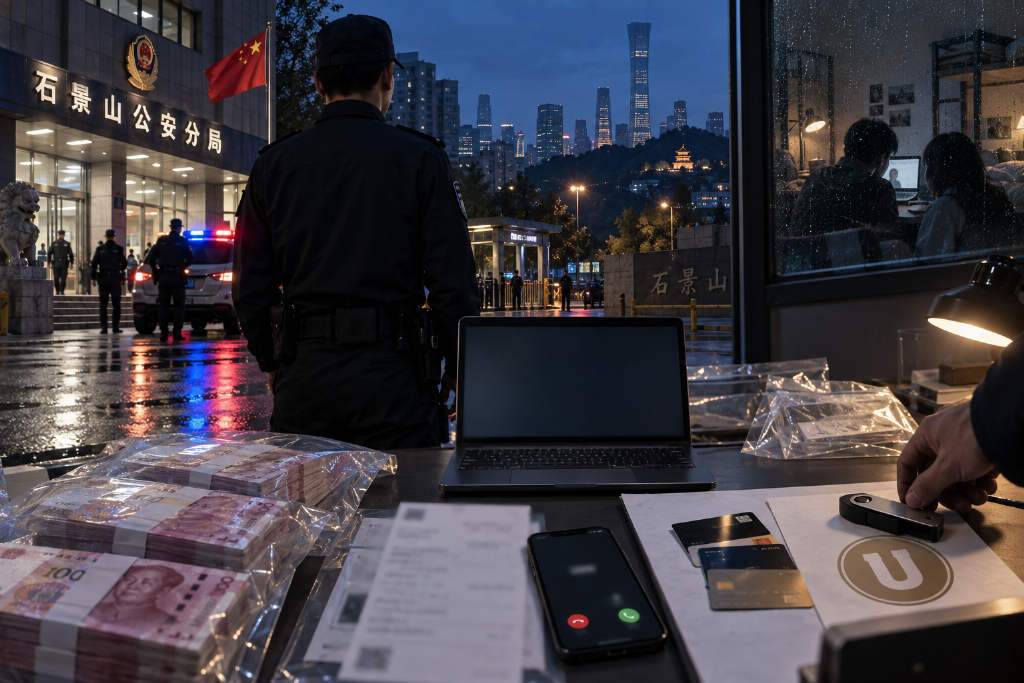
Police in Beijing’s Shijingshan district recently intercepted a new type of cross-border telecom fraud case, freezing 780,000 yuan in funds tied to the scheme and returning the money to the victim, according to ChainCatcher. The case involved a 53-year-old man surnamed Liu, who was staying overseas while accompanying a student, when he received a scam call from abroad. The caller posed as Chinese police and fabricated accusations including money laundering, pressuring him to urgently ask family members in China to send money. Investigators said the funds were later transferred into the accounts of two other Chinese students overseas. Police found that all three were victims of the same fraud ring, in a pattern described as "one case, multiple victims," where victims were turned into money-laundering tools for one another. In some instances, scammers first moved funds into victims’ accounts and then coerced them into converting the money into U coins to help transfer it onward. Police said patient persuasion helped "wake up" the victim and prevented larger losses.
Police in Beijing’s Shijingshan district recently intercepted a new type of cross-border telecom fraud case, freezing 780,000 yuan in case-related funds and returning the money to the victim, according to ChainCatcher.
In the case, a 53-year-old man surnamed Liu was overseas accompanying a student when he received a scam call from abroad. The fraudsters posed as police in China, fabricated false allegations including money laundering, and pushed him to urgently ask his family in China to transfer money.
The funds were later moved into the accounts of two other Chinese students overseas. Investigators found that all three were victims of the same scam group, showing what police described as a pattern of "one case, multiple scams," in which victims became money-laundering tools for one another.
Police said the scammers first transferred funds into some victims’ accounts, then coerced them into converting the money into U coins and helping move it onward. The method was described as highly concealed, with a complicated cross-border transfer chain.
Officers said patient persuasion helped "wake up" the victim and prevented greater losses.
This article was originally published by Bit.Fan. For more cryptocurrency news and market insights, visit www.bit.fan. Disclaimer:
The market information, project data, and third-party content displayed on this platform are for industry information sharing only and do not constitute any form of investment advice or return commitment.
Cryptocurrency trading carries high risks. Users should fully assess their risk tolerance and make independent decisions. All profits, losses, and legal responsibilities are borne by the users themselves.