
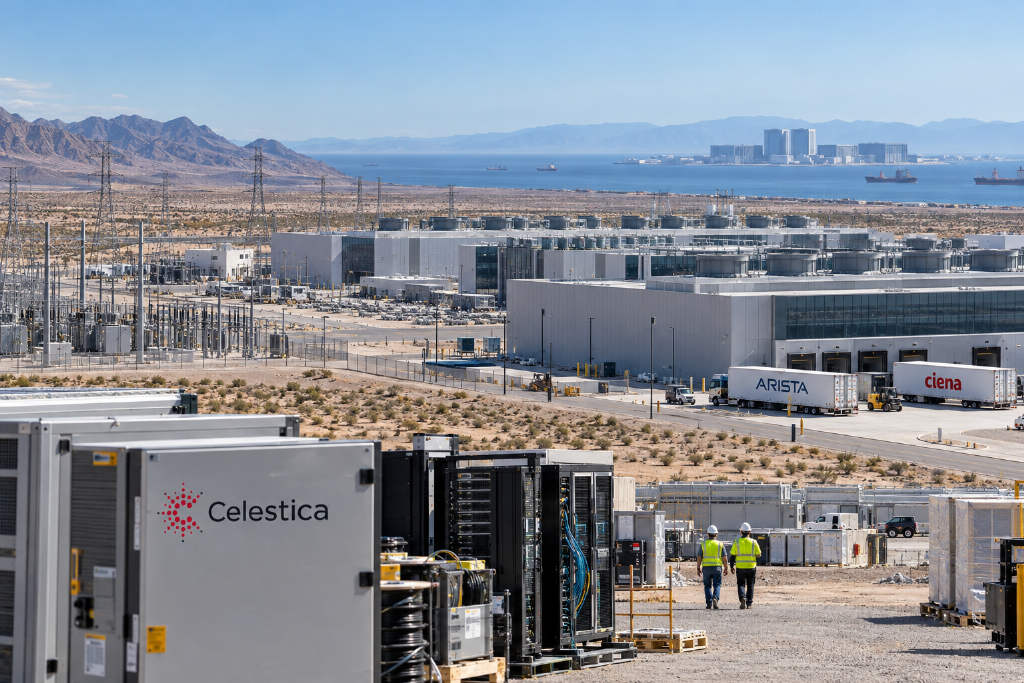
Bernstein said in an Oct. 14 report that it has not changed its positive view on the U.S. networking and communications equipment sector. After speaking with investors, the firm said the debate is centered on several specific issues: whether data center power and land are sufficient, whether Celestica can sustain its margin profile, and when opportunities at companies including Ciena and Arista will start to appear in financial results.
For Celestica, Bernstein estimates earnings per share can reach $36 in 2028. Based on the buy-side expectations the firm said it heard, the stock is trading at about 9.7x 2028 earnings. Earnings forecasts are already high, yet valuation remains compressed. Investors are focused on how many high-value orders Celestica can keep after Google added more suppliers.
U.S. supply constraints do not automatically define the global picture
Bernstein estimates that AI accelerator shipments imply roughly 43 gigawatts of data center rack demand. The market often compares that figure with about 26 gigawatts of new U.S. data center supply expected in 2027 and concludes that supply is severely constrained. The report said that comparison mixes different scopes: demand is global, while the supply figure only covers the United States.
Using the historical assumption that the U.S. accounts for about 70% of global data center capacity, Bernstein calculated that 26 gigawatts of U.S. supply would correspond to roughly 37 gigawatts globally, leaving a gap of about 6 gigawatts. If the U.S. share falls to 60%, implied global supply would be close to 43 gigawatts. Bernstein said international expansion of AI projects could ease the pressure created by power and land shortages in the United States.
That does not remove the timing issue. Overseas projects still need time to be built. If available data hall capacity lags too far behind equipment shipments, operators may delay purchases of servers and networking gear. For hardware vendors, sustained demand growth and on-time order conversion are separate questions, and Bernstein said both still need to be tested.
The firm also offered a return framework: AI end-user spending would need to reach about $700 billion in 2027 for hyperscalers to earn roughly 15% returns on related investment. Bernstein said that spending level is achievable at the current pace of industry growth. The next question is whether user spending can keep up with the infrastructure already being deployed.
Celestica needs to protect the highest-value programs
Bernstein said the main source of investor hesitation on Celestica (CLS) is the durability of its earnings outlook. The firm raised its 2028 EPS estimate to $36 from $35 and kept its 2027 forecast at about $24. The buy-side expectations Bernstein said it heard were around $37 for 2028 and $25 for 2027, close to its own numbers.
Market concern about share loss is tied to Google bringing in additional suppliers for TPU programs. Bernstein’s view is that Google is likely to allocate some mature programs to the new suppliers, while higher-value racks with tighter delivery requirements should remain primarily with Celestica. If that division of labor holds, the profit impact from added competition could be smaller than the market fears.
Revenue growth alone is not enough. It matters which products drive it. Bernstein estimates Celestica’s TPU business carries margins of about 7.5%, while AMD Helios and some 1.6T switch programs are closer to 15%. The spread between programs is wide. Even if total revenue reaches forecast levels, the company still needs a large enough mix of higher-margin business to deliver the earnings targets tied to those revenue assumptions.
That is why the Oct. 27 investor day matters. The market wants clarity on how orders will be allocated, when new programs will scale, and how management views 2027 margins. Bernstein maintained an Outperform rating on Celestica and a $520 price target, saying the current roughly 9.7x valuation shows the market has not fully accepted the company’s long-term earnings outlook.
Ciena’s debate is more about timing than demand
Ciena (CIEN) is facing less disagreement. Bernstein said investors it spoke with broadly accept the long-term need for inter-data-center connectivity, and there is little pushback on valuation itself. The sticking point is timing. The opportunity can be sized, but near-term earnings estimates are still hard to move higher.
Using the Stargate project as a case study, Bernstein estimated the potential market for inter-data-center connectivity equipment at about $10.94 billion. That figure is based on project build targets, and several steps remain before Ciena can capture orders. The firm said the opportunity is more likely to show up in results after supply constraints in pump lasers and ceramic packaging ease and product shipments rise.
Bernstein kept its Outperform rating on Ciena and also said the stock could remain range-bound in the near term. The long-term market size is already part of the discussion. What matters more now is whether supply can keep up and when incremental demand can convert into company revenue.
Arista’s opening depends on the shift toward open networking
Arista (ANET) is dealing with a different competitive setup. Nvidia already holds a strong position in AI networking, while cloud operators want to reduce reliance on proprietary architectures from a single supplier. Bernstein said broader adoption of open Ethernet should create an opening for Arista to win share.
The firm pointed in particular to Arista’s long-running relationships with Meta and Microsoft. Both customers use Arista’s networking products and also help design new solutions. That kind of customer engagement can help Arista enter new programs, though the stock already reflects elevated expectations. How quickly open networking expands, and how many orders Arista ultimately wins, will shape how far the market is willing to support its valuation.
Cisco and Corning stay at Market-Perform
Bernstein took a different view on Cisco and Corning. For Cisco, the firm said market expectations are relatively low, so even a modest beat could help the stock. But when the business is broken down segment by segment, the valuation discount is not as clear as headline numbers suggest.
For Corning, Bernstein said its AI fiber business has room to grow, but weakness in handsets, autos and other businesses could still weigh on overall results. Capacity expansion by other fiber suppliers could also add competition. Bernstein maintained Market-Perform ratings on both companies.
This article is a整理与解读 of a third-party broker research report from Bernstein dated Oct. 14, 2026, combined with public market information. The cited ratings, price targets, earnings forecasts and related views are those of the broker’s analysts and represent only the position of their institution, not the view of the publisher, and do not constitute investment advice.
Markets involve risk, and investment decisions should be made independently. This article should not be used as the basis for buying or selling any security.



