In an Oct. 14 report, Bernstein said it is still bullish on the U.S. networking and communications equipment group. After talks with investors, the firm said the argument has now boiled down to a handful of nuts-and-bolts questions: whether data center power and land are enough, whether Celestica can keep its margin profile intact, and when the opportunities for names like Ciena and Arista will start showing through in earnings.

Written by Rita.
U.S. supply constraints do not automatically define the global picture
Bernstein estimated that AI accelerator shipments point to roughly 43 gigawatts of data center rack demand. A lot of the market stacks that against about 26 gigawatts of new U.S. data center supply expected in 2027, then jumps to the view that supply is badly short. But Bernstein said that is a mismatch from the start: global demand is being compared with U.S.-only supply.
Using the long-running assumption that the U.S. makes up about 70% of global data center capacity, Bernstein said 26 gigawatts of U.S. supply would equal around 37 gigawatts worldwide, leaving a shortfall of about 6 gigawatts. If the U.S. share drops to 60%, implied global supply gets close to 43 gigawatts. So, Bernstein said, growth in AI projects outside the U.S. could take some pressure off the squeeze caused by limited domestic power and land.
Still, that does not solve the timing problem. Overseas builds take time. If available capacity keeps trailing equipment shipments, operators may push back purchases of servers and networking gear. For hardware vendors, stronger demand is one thing. Orders converting on schedule is another. Both questions are still open.
Bernstein also laid out a return framework: AI end-user spending would have to reach about $700 billion in 2027 for hyperscalers to generate around 15% returns on related investment. The firm said that spending level is reachable at the current pace of industry growth. The next thing to watch is simple enough: can end-user spending keep pace with the infrastructure investment already in motion?
Celestica needs to protect its higher-value programs
For Celestica (CLS), the real issue is how durable the earnings forecasts are. Bernstein lifted its 2028 earnings-per-share estimate to $36 from $35 and left its 2027 forecast at about $24. Buy-side expectations the firm heard were about $37 for 2028 and $25 for 2027, which is broadly in line with Bernstein’s own figures.
Using Bernstein’s 2028 EPS estimate of $36, the stock is trading at about 9.7x 2028 price-to-earnings under the buy-side assumptions cited in the report. The earnings bar is already high. Even so, the valuation is still compressed. Investors are zeroed in on how much high-value business Celestica can hold onto once Google brings in more suppliers.
That worry comes back to Google adding vendors for TPU programs. Bernstein said Google could shift some mature programs to new suppliers, while higher-value racks with tighter delivery requirements should stay mostly with Celestica. If that split in work holds up, the damage from new competition to profits may be smaller than the market fears. A lot smaller, maybe.
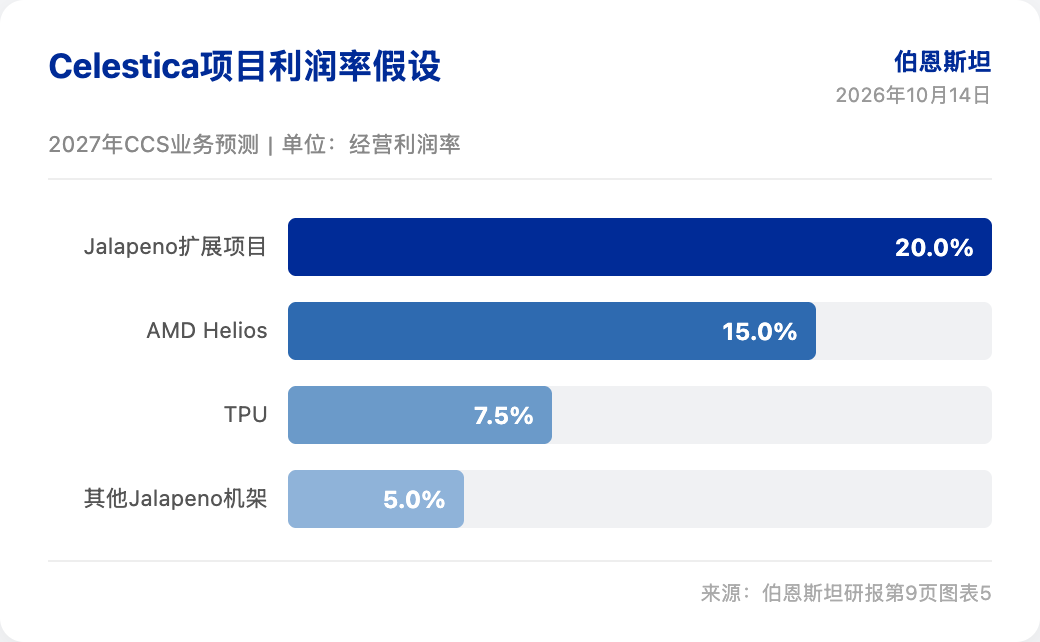
Revenue growth by itself will not do the job. Bernstein said the mix is what matters. It estimated TPU business carries margins of about 7.5%, while AMD Helios and some 1.6T switch programs are closer to 15%. That gap is big. So even if total revenue hits forecast levels, Celestica would still need enough higher-margin business to land the projected earnings targets.
That is why the Oct. 27 investor day matters. The market wants specifics: how orders will be allocated, when new programs will ramp, and how management is thinking about 2027 margins. Bernstein kept its Outperform rating on Celestica and its $520 price target, saying the current roughly 9.7x valuation suggests the market still has not fully bought into the company’s long-term earnings power.
Ciena is waiting for revenue estimate revisions
The debate around Ciena (CIEN) is calmer. Bernstein said the investors it spoke with mostly accept the long-term need for inter-data-center connectivity and do not have big objections to valuation. The hesitation is about timing. The size of the opportunity can be modeled. Near-term earnings forecasts, though, are still tough to push higher.
Using the Stargate project as an example, Bernstein estimated the market opportunity for inter-data-center connectivity equipment at about $10.94 billion. That number is tied to buildout targets, and several things still have to happen before Ciena would actually book orders. Bernstein said it will probably take relief in supply constraints for pump lasers and ceramic packaging, along with higher product shipments, before the opportunity shows up in reported results.
Bernstein kept an Outperform rating on Ciena and said the stock may stay range-bound in the short term. The long-term market opportunity is already part of the conversation. Right now, the better signals are whether supply can catch up and when incremental demand starts turning into actual company revenue.
Arista is trying to capture open networking share
Arista (ANET) is dealing with a different competitive picture. NVIDIA already has a strong grip on AI networking, while cloud operators want less dependence on proprietary architectures from a single supplier. Bernstein said wider adoption of open Ethernet should give Arista room to take share.
The firm singled out Arista’s long-term ties with Meta and Microsoft. Both customers use its networking products, and both also help co-design new solutions. Bernstein said that kind of relationship helps Arista get into new programs, though the stock already carries elevated expectations. How fast open networking spreads, and how much business Arista actually wins, will shape the valuation investors are willing to pay.
Cisco and Corning face different concerns
Bernstein said Cisco and Corning bring up different issues. With Cisco, market expectations are fairly low, so even a small beat could help the stock. But on a sum-of-the-parts basis, the valuation discount is not as big as the headline numbers make it look.
For Corning, Bernstein said AI fiber offers growth potential, but weaker performance in businesses tied to smartphones and autos could still drag on overall results. Capacity expansion by other fiber suppliers could also heat up competition. Bernstein kept Market-Perform-equivalent views on both companies, which the source rendered as "in line with the broader market."
Source note
This article is a compiled interpretation by Chaoxiang Research of a third-party brokerage report from Bernstein dated Oct. 14, 2026, combined with public market information. The ratings, price targets, earnings forecasts, and related judgments cited in the piece are the views of Bernstein analysts and reflect only that institution’s position, not the view of Chaoxiang Research, and they do not constitute investment advice.
The source also said that markets carry risk, decisions should be made independently, and the article should not be used as the basis for buying or selling any security.