
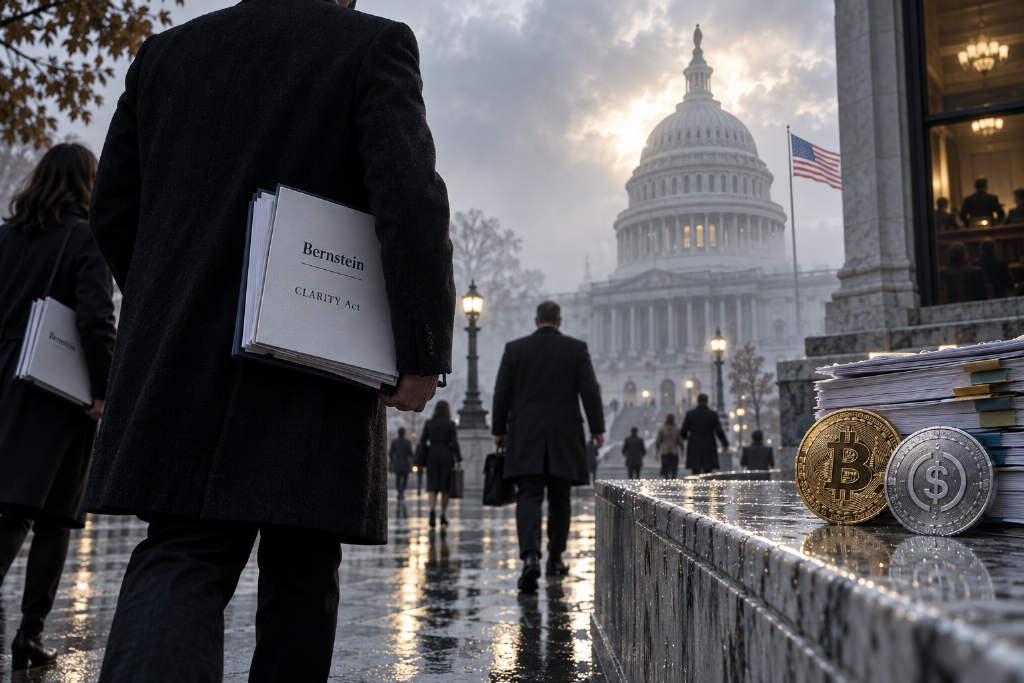
Bernstein said on Sept. 15 that the latest negotiations in the U.S. Senate over the CLARITY Act may be progressing better than the market had been expecting.
The Wall Street firm said market positioning remained cautious ahead of the procedural vote scheduled for Sept. 15 local time in the U.S., and that any positive outcome had not been fully priced into crypto assets or crypto-related stocks.
Latest Republican draft includes 126 substantive Democratic changes
According to the Bernstein team, the newest draft released by Senate Republicans incorporated 126 substantive amendments proposed by Democrats. Those revisions cover several areas:
- conflicts of interest involving officials’ crypto asset holdings
- the enforcement role of state attorneys general
- stablecoin incentive mechanisms
- measures intended to protect community banks from deposit outflows
Bernstein also said the Treasury secretary would be given a stablecoin-incentive “circuit breaker” authority lasting up to 18 months.
Bernstein sees political room for Democratic support
The firm said White House concessions on ethics provisions are close to the upper limit of what remains negotiable. It also argued that some Democratic lawmakers, with midterm elections approaching, may be wary of being labeled “anti-crypto.”
Prediction markets have lifted the probability of the bill advancing this year back above 30%, which Bernstein said points to an improving policy outlook.
Tuesday vote would only open debate, not pass the bill
Bernstein cautioned that Tuesday’s vote is only a procedural step to decide whether formal debate can begin. That motion requires 60 votes. It does not mean the bill has passed, nor would it make the legislation effective immediately.
Even if the procedural motion succeeds, the bill would still have to go through amendments, a final vote, and reconciliation with the House.
Firm warns of downside if the bill stalls
Bernstein said crypto markets could see a sizable pullback if the bill runs into obstacles and a hawkish Federal Reserve decision lands at the same time. If legislative progress comes in stronger than expected, the firm said native crypto assets and crypto-linked stocks could get a short-term boost.