Bernstein said in a report dated Oct. 19, 2026 that the recent correction in optical module stocks has not materially altered the underlying setup for Coherent and Lumentum. The firm kept Outperform ratings on both names and said Coherent is likely to post fiscal first-quarter revenue and earnings per share above consensus, while Lumentum is expected to land roughly in line with Street estimates. Bernstein also said both companies could raise guidance for the second quarter.
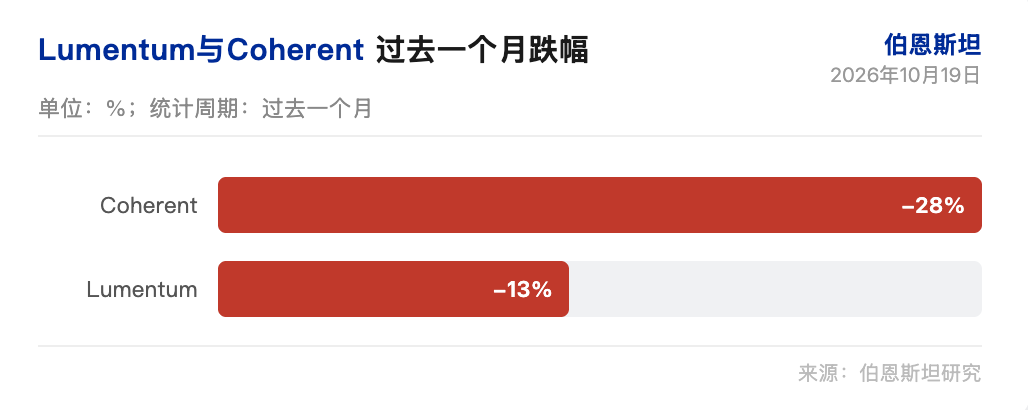
Over the past month, Lumentum fell 13% and Coherent dropped 28%, making both notable laggards during the broader AI pullback. Bernstein said investors have been reacting to several catalysts discussed in the market: softer AI lab revenue, CoreWeave financing trouble, an OCP sell-the-news setup, previews that did not move higher, and a negative macro backdrop. Of those, the first two items and macro conditions were described as the main drivers. Aside from softer AI lab revenue, Bernstein said the other factors did not meaningfully change optical module fundamentals.
Bernstein sees favorable risk-reward ahead of earnings
Coherent and Lumentum are scheduled to report after the close on Nov. 4 and Nov. 5, respectively. Bernstein said the risk-reward profile for both companies remains skewed to the upside and that valuations still look reasonable relative to other long ideas in hardware and semiconductors.
The firm added that as the valuation gap between the two names has widened, its preference has become more balanced. It said the buy side already understands the reasons it had previously favored Lumentum.
Pullback tied to AI de-risking, not a collapse in optical demand
Bernstein said the one-month drawdowns in both stocks were similar to CoreWeave’s move and argued that the retreat was driven mainly by broad de-risking across the AI complex. In its view, supply-demand conditions and earnings trends in optical modules have not deteriorated in parallel.
The report said softer AI lab revenue partly reflects shifts in competitive share and wider adoption of open-weight models. Those trends may weigh on AI lab revenue, but Bernstein said they do not necessarily change industry supply-demand at the AI infrastructure layer or the growth path for optical modules. As long as AI models continue to improve and adoption data remains healthy, the firm said large technology companies are likely to keep investing in training new models, supporting the broader AI infrastructure ecosystem.
Bernstein also described the recent news flow as constructive. NVIDIA has accelerated its co-packaged optics, or CPO, timeline to 2027 and is using CPO for vertical scale-out between racks. Microsoft’s Maia uses an optical layer-2 switch to connect 128 racks into a 12,288-accelerator supercluster. Lumentum and Coherent have demonstrated PCIe over VCSEL optics, and Coherent has launched PhotonLink. Bernstein said those developments could help management teams strike a positive tone on their earnings calls.
Coherent expected to beat consensus on revenue and EPS
For Coherent, Bernstein forecasts fiscal first-quarter revenue of $2.4 billion, above the $2.3 billion consensus estimate, and EPS of $2.05, ahead of the $1.99 consensus. That revenue figure would place results at the high end of the company’s $2.2 billion to $2.4 billion guidance range and above the midpoint implied by consensus.
Bernstein expects revenue to rise about 50% sequentially in the quarter, while industry models point to roughly 60% growth for the full year. Gross margin is projected at 41%, slightly above the midpoint of management’s 39.5% to 41.5% range and about 80 basis points higher sequentially, stronger than the roughly 60 basis point improvement seen in the third and fourth quarters.
Operating expenses are estimated at $415 million, a little above the midpoint of the company’s $400 million to $420 million guidance range. Bernstein said research and development spending should continue to support growth, while selling and administrative expense as a share of revenue is expected to fall from 8.2% to 7.5%.
For the second quarter, Bernstein forecasts revenue of $2.613 billion, above the $2.547 billion consensus estimate, and EPS of $2.28, ahead of the $2.23 consensus. The firm said management could raise guidance.
Still, investors remain dissatisfied with Coherent’s weaker gross margin profile relative to Lumentum, especially because the ramp in 6-inch wafers has not yet produced a more visible margin lift. Bernstein said management may need to quantify that effect more clearly for investors.
The report said Coherent mainly sells full transceivers, while Lumentum sells more modules to Chinese transceiver contract manufacturers. Assembly of full transceivers carries lower gross margins, and Coherent faces a cost disadvantage versus Chinese manufacturers. Lower per-module margins dilute the company’s overall gross margin. With lower incremental margins, Coherent also appears to generate less operating leverage from growth than Lumentum. Bernstein added that the 6-inch wafer ramp is likely to provide a more gradual margin benefit, which has added to investor disappointment.
Lumentum seen roughly in line for the quarter, with upside to next-quarter guidance
For Lumentum, Bernstein forecasts fiscal first-quarter revenue of $1.254 billion, essentially in line with the $1.252 billion consensus estimate. That would place results near the midpoint of the company’s $1.225 billion to $1.275 billion guidance range and imply 135% year-over-year growth.
The firm expects operating margin of 40%, in the middle of management’s 39.5% to 40.5% range. Gross margin is projected at 52%, up 160 basis points sequentially and also higher year over year. Operating expenses are expected to rise about 250 basis points sequentially, but at a slower pace than revenue and gross profit, which Bernstein said points to clear operating leverage.
EPS is forecast at $4.18, slightly below the $4.20 consensus estimate and near the midpoint of the company’s $4.05 to $4.35 guidance range. For the second quarter, Bernstein expects revenue of $1.497 billion, above the $1.477 billion consensus estimate, and EPS of $5.15, ahead of the $5.04 consensus. It said management could raise guidance here as well.
Lumentum has already provided a 2028 EPS target of $40. Bernstein said the market is now more focused on the longer-term debate than on near-term quarterly figures, with discussion around optical circuit switching, or OCS, drawing particular attention.
Based on channel checks cited in the report, Lumentum’s OCS solution costs about $600 per port, and OCS content in a TPU v7 Ironwood rack is about $150,000. Bernstein said that with 2.6 million TPU v7 units in 2026 and 64 TPUs per rack, the OCS opportunity tied to TPUs alone is about $6 billion.
At the same time, the report said Lumentum’s OCS offering is materially more expensive than Google’s in-house design manufactured by Celestica, though margins appear healthy. Bernstein said it is unclear why Google would shift from Celestica to Lumentum, and because the cost gap remains meaningful, the firm lacks confidence on how much share Lumentum can ultimately win.
Bandwidth math remains the core 2028 debate
Bernstein said the central issue in the longer-term debate is bandwidth math, and in its view that math points to substantial upside in 2028 and beyond. Bears, however, argue that the extrapolation assumes economics that are too rich, and that those economics depend on InP, or indium phosphide, supply remaining constrained.
The firm said that debate will not be settled on this quarter’s earnings calls, though the recent news flow has been positive enough that management teams may still sound constructive.
Bernstein cited Asian supply-chain checks showing that the price per unit of bandwidth is broadly similar between 1.6T pluggable optical modules and 3.2T CPO, at about $0.48 per Gbps for the former and $0.44 per Gbps for the latter. In NVIDIA’s Vera Rubin NVL72 architecture, NVLink vertical scale-out bandwidth is 216 TB/s, versus 32.4 TB/s for horizontal scale-out networking, a gap of about 7x.
If that ratio and pricing hold in future rack architectures, Bernstein said the opportunity in vertical-scale CPO would be 6x the size of the current horizontal pluggable opportunity. Even if adoption of vertical-scale CPO is limited, the impact on long-term numbers could still be meaningful.
Bears counter that this framework assumes stable pricing, while pricing has historically trended lower. In their view, a more favorable pricing environment depends on an InP supply bottleneck. They argue that if InP supply ramps sharply, while VCSEL and microLED divert demand, or if continuous-wave laser designs require less InP content, the supply-demand balance could reverse and economics could weaken materially. In that case, Lumentum and Coherent could fall short of elevated expectations. Bernstein said that issue will not be resolved this quarter and will require more work before investors gain confidence.
Valuation gap has narrowed, leaving Bernstein more balanced
On valuation, Lumentum currently trades at 32.37x forward earnings, according to the report. Bernstein compared that with a post-2016 average of 19.50x plus or minus 10.64x, a three-year average of 32.62x and a five-year average of 24.96x.
Coherent trades at 21.54x forward earnings. Its post-2016 average is 19.26x plus or minus 6.87x, with a three-year average of 26.47x and a five-year average of 21.49x.
Bernstein maintained a $1,220 price target on Lumentum, based on about 35x fiscal 2028 EPS of $35. It also maintained a $350 price target on Coherent, based on about 22x fiscal 2028 EPS of $16.
The firm said that after the valuation gap narrowed, its preference between the two names became more balanced. Near term, it expects Coherent to beat consensus on first-quarter revenue and EPS, while Lumentum should come in roughly in line. For the second quarter, both companies could raise guidance. Longer term, the debate still centers on 2028 bandwidth math, InP supply constraints and the direction of pricing.
This article is a summary and interpretation of a third-party brokerage research report from Bernstein dated Oct. 19, 2026, combined with public market information. The ratings, price targets, earnings forecasts and related judgments cited in the report are the views of Bernstein analysts and represent the position of that institution, not investment advice.