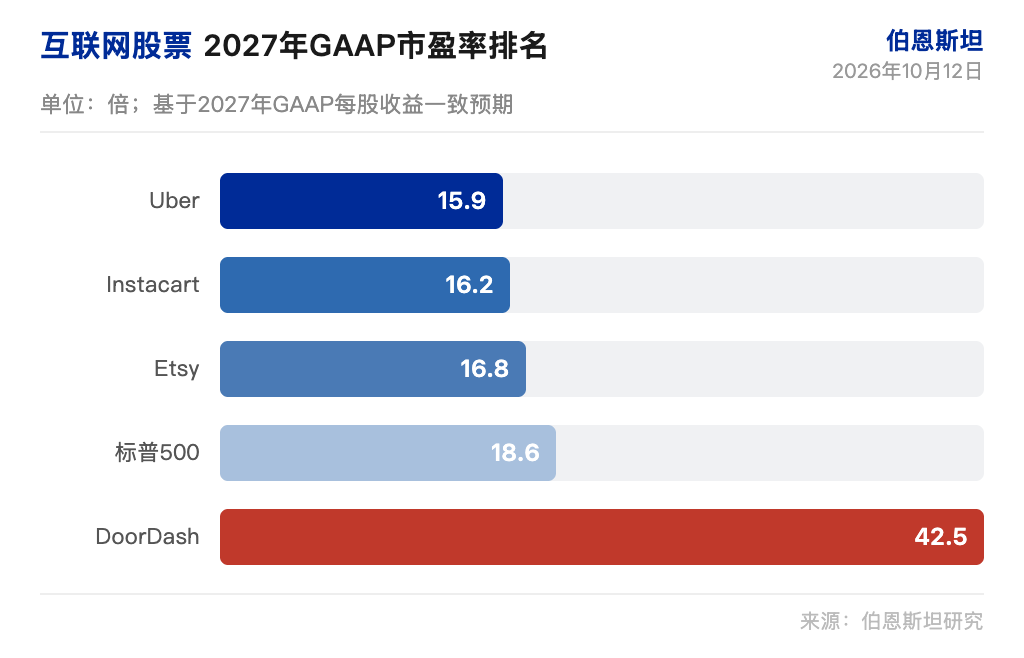
Bernstein said the market may have become too negative on consumer internet companies, arguing that online aggregators are being priced as losers in the age of AI agents even though several assumptions behind that view remain unsettled.

In its U.S. emerging internet report published on Oct. 12, 2026, the firm said investors may be underestimating the friction involved in AI agent adoption, the trust threshold required for consumers to use those tools, and the pace at which consumer behavior actually changes. Against that backdrop, Bernstein said three paths could help the sector outperform in 2027.
Valuations have compressed to 22x 2027 GAAP earnings
The median stock in the consumer internet group is down 11% this year, while the S&P 500 has gained 14% over the same period, according to the report. Bernstein said the internet sector has effectively become a growth-at-a-reasonable-price, or GARP, asset class, with the median valuation at 22x 2027 U.S. GAAP price-to-earnings and 18x on 2028 estimates.
Within Bernstein’s coverage universe, valuations are about 20x 2027 GAAP earnings per share and 14.5x for 2028. The firm said that median is lifted by two higher-multiple names, DoorDash and Wayfair. Excluding those two, the median falls to 17.2x for 2027 and 14.3x for 2028.
Bernstein said earnings revisions are not the issue. It noted that 2027 GAAP EPS estimates for the broader internet group have been revised up 4%, while estimates for its own coverage universe have been raised 8%. In its view, the compression in valuation is mainly tied to debate over terminal value, with AI agents seen by the market as an existential threat to aggregator platforms.
Uber is the cheapest stock in Bernstein’s coverage, trading at 16x 2027 earnings and 13x 2028 earnings. The firm said the market has already fully priced in a bearish view on autonomous driving and is assigning no upside to Uber’s U.S. mobility business.
Path one: a reversal in the AI loser narrative
Bernstein said the biggest upside could come from a change in how investors view these business models. If that happens, valuations could rerate quickly. The firm said that kind of upside has previously been concentrated in hyperscalers and frontier model companies.
For Uber, autonomous driving is the key variable. Bernstein said autonomous fleets are approaching an inflection point, with Waymo in the lead and fleet size expected to expand from the thousands to the tens of thousands over the next few years. Autonomous vehicles account for about 1% of the U.S. ride-hailing market today, but the share is growing quickly. Bernstein said Uber’s deployment of driverless cars in the U.S. could change how the market thinks about the terminal value of its mobility business.
For DoorDash, Bernstein said the AI agent risk is less extreme than it is for Uber. Investors have worried that food delivery platforms could be disintermediated and face lower margins. Bernstein pushed back on that view, saying consumer behavior would need to change first, duopoly market structures still benefit from membership lock-in and scaled instant logistics, and platforms retain value in logistics and real-time inventory even in an AI agent model.
The report also said DoorDash has launched Ask DoorDash and Text DoorDash to bring conversational AI commerce onto the platform. Uber and Instacart have introduced similar features. Bernstein said those product launches place the companies at the front edge of both technology shifts and changing consumer behavior, while reinforcing network effects and marketplace value.
Path two: a more traditional revenue acceleration story
Bernstein said revenue acceleration has usually worked for this sector regardless of shifts in the underlying technology cycle. Revenue beats, combined with stable growth or only modest deceleration, should be enough to support share prices, the firm said.
Wayfair is the name in Bernstein’s coverage that could see improving revenue trends. The firm said 2027 revenue growth could rise to about 10%, helped by category stabilization, its Rewards program, physical store expansion and improvements in core products. Bernstein added that even if that model proves optimistic, Wayfair could still have room to outperform expectations.
The firm also said this path would be more powerful if paired with the first one, such as through higher search conversion or incremental products. Bernstein expects advances in AI and machine learning to help the marketplace platforms it covers deliver a better online experience.
Path three: free cash flow as a relative advantage
Bernstein said marketplace and application-layer companies may offer relatively stronger free cash flow as large technology companies move into a capital expenditure cycle. On its own, though, that may not be enough because investors are still debating terminal value.
The firm said upside in free cash flow, together with margin expansion, could still give investors a reason to hold the stocks. DoorDash and eBay are the two names in Bernstein’s coverage where margins could become a focal point in 2027. For eBay, the market is watching growth and advertising revenue. For Uber, debate remains centered on autonomous driving investment and M&A strategy.
Ratings and price targets
Bernstein rates DoorDash, Uber, Instacart and Wayfair Outperform, while the rest of its covered names are rated Market-Perform. Its price targets are $270 for DoorDash, $195 for Uber, $60 for Instacart and $125 for Wayfair.
The report’s central argument is that the market has become too pessimistic on AI agents’ impact on consumer internet platforms and that expectation gaps are building in the sector. Whether the three paths play out will depend on how quickly consumer behavior evolves and how much friction AI agents face in real-world use.
The original article said the ratings, price targets, earnings forecasts and related judgments cited in the piece reflect the views of Bernstein analysts and represent the position of that institution alone. It also said the material does not constitute investment advice and should not be used as the basis for buying or selling securities.