

Bernstein’s latest report brings long-term agreements back into focus for the memory sector. The firm says Micron and SanDisk have signed a new set of LTAs with purchase commitments, minimum prices and financial guarantees, giving suppliers more visibility into future revenue. Even so, Bernstein’s view is that the floor these contracts provide is not as thick as it may first appear.
Using public filings and company commentary from earnings calls, Bernstein said Micron has signed 16 strategic customer agreements. Fourteen of them represent about $100 billion in cumulative minimum revenue based on minimum contract pricing, alongside roughly $22 billion in cash deposits and related financial commitments. SanDisk, for its part, said three current-quarter contracts account for about $42 billion in minimum contract revenue, while five agreements carry more than $11 billion in financial guarantees.
Taken together, that points to about $142 billion in minimum contracted revenue and around $33 billion in guarantees across the two companies. Bernstein says the structure makes it more expensive for large buyers to default. But when the firm compares that figure with its own estimate of roughly $5.2 trillion in revenue that may need LTA protection over the next three to five years, the current guarantee base equals only about 0.6%.
That gap captures the report’s main argument. LTAs are changing the negotiating balance between memory suppliers and their largest customers, but they look more like downside cushioning than a mechanism that turns DRAM and NAND into utility-like businesses.
Contracts now carry real financial penalties
The basic setup is straightforward. Customers commit in advance to buying a certain volume over the next several years, while suppliers offer supply assurance and a pricing framework. If the customer does not take the volume, it can lose posted collateral or face other financial costs.
Bernstein says the key difference this time is that financial guarantees are embedded in the contracts, rather than sitting closer to the non-binding purchasing intentions the memory industry has seen in past cycles.
Micron disclosed that by June 2026 it had signed 16 strategic customer agreements, including four mega-scale customers and three mid-sized customers. Fourteen of those contracts imply about $100 billion in cumulative minimum revenue at minimum contract prices, with expected cash deposits and related financial commitments of roughly $22 billion. Bernstein noted that this presentation includes both signed agreements and deals executed after quarter-end, so it is not identical to an end-period RPO figure on the balance sheet.
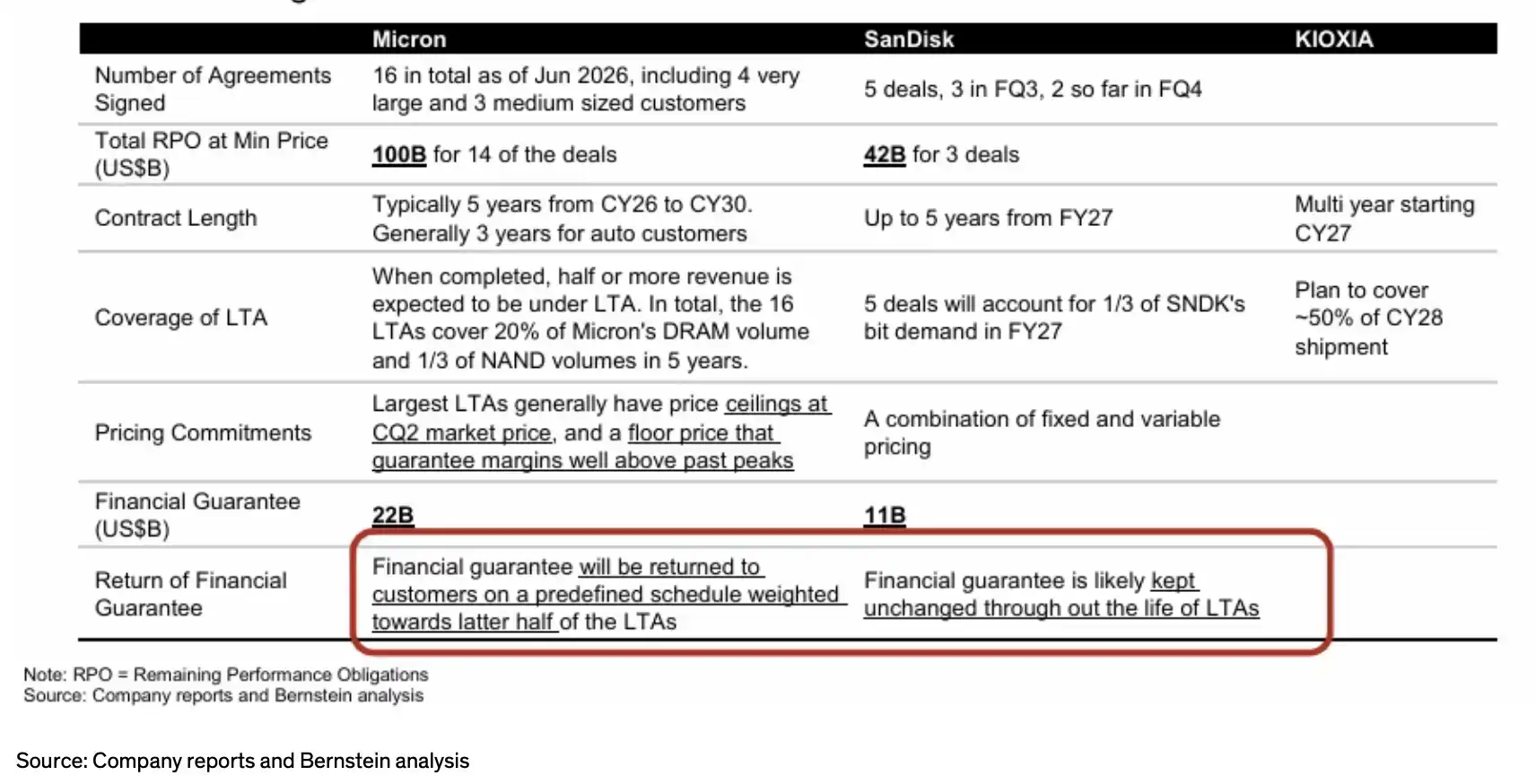
SanDisk disclosed remaining performance obligations, or RPO, of $41.6 billion as of April 3, 2026. On its earnings call, the company also said three current-quarter contracts represent about $42 billion in minimum contract revenue. Across five agreements, financial guarantees total more than $11 billion and cover more than one-third of FY27 bit supply.
The mechanics are not the same at both companies. Bernstein describes Micron’s guarantee structure as more back-end weighted. As the contract runs down and the customer’s remaining purchase obligation declines, the ratio of guarantee to RPO rises, making it more expensive to walk away later in the term. SanDisk’s structure is closer to a fixed-dollar guarantee, with the protected amount expected to remain relatively stable through the life of the contract.
This is the part bulls care about most. Memory suppliers have historically seen profit collapse quickly when prices fall. If large customers are willing to back long-term supply with actual financial commitments, suppliers gain a clearer revenue floor and do not have to let spot pricing dictate every capital spending and capacity decision.
$33 billion is meaningful, but it does not cover a deep downturn
Bernstein’s point is that the guarantee pool and the revenue base that may need protection are on very different scales.
Under the firm’s model, LTA coverage for the next three to five years would correspond to about $5.2 trillion in potentially protected revenue. Bernstein also said that number is a model-based measure, not a figure directly disclosed in public filings, and that comparisons need to distinguish between memory revenue, total semiconductor revenue and the supplier sample used in the analysis.
Still, the 0.6% guarantee ratio tells its own story. LTAs cannot fully defend earnings under every pricing scenario. If spot prices fall only moderately, default may not make economic sense for customers. They would lose their guarantees, strain strategic supply relationships and risk being shut out of scarce capacity later. Bernstein adds that AI server buyers, cloud providers and data center customers have stronger incentives to preserve supply certainty than typical consumer electronics customers.
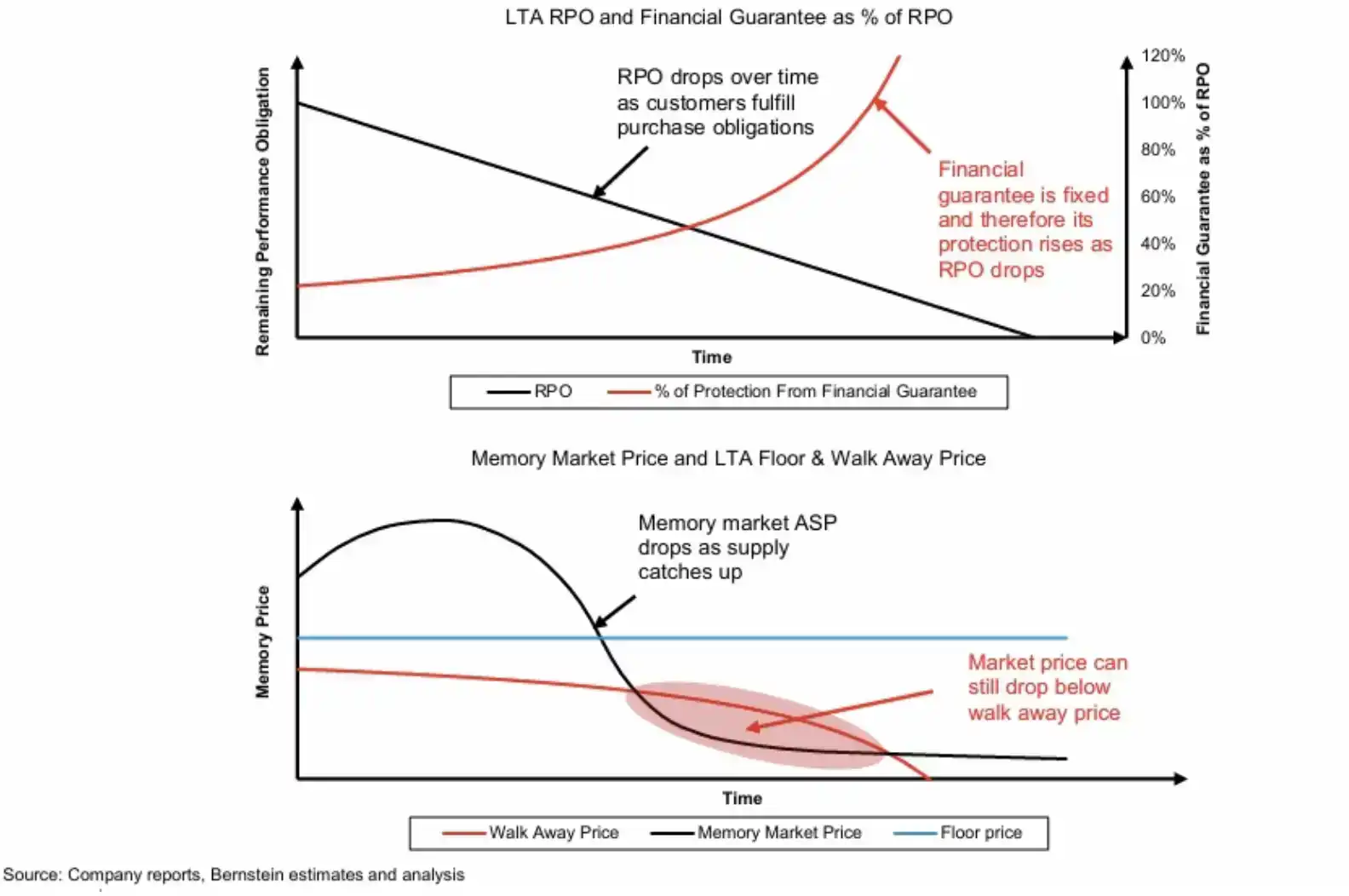
But if prices fall far enough, buyers may still choose the market. When remaining purchase obligations are large and the spot market trades well below a contract floor, a customer could conclude that buying outside the contract is cheaper even after absorbing the loss of its guarantee.
Bernstein says back-end weighting can ease part of that risk. As time passes, RPO declines and the guarantee becomes larger relative to the remaining obligation. That raises the cost of abandoning the contract later in its life. The protection may be stronger in the back half of the agreement, which also tends to be the period when memory cycles need more support.
It is not unconditional insurance. The force of the protection depends on three numbers: how far spot prices fall, how much purchase obligation remains, and how much guarantee balance is still in place. That is also where the bull-bear split sits. Bulls see hard-dollar long-term commitments from customers. Bears focus on the same contracts and argue they are still too small to preserve peak earnings if the next downturn becomes severe.
Not every slice of memory demand fits an LTA
Bernstein also argues there is a practical ceiling to how much of the market can be locked into long-term contracts.
U.S. cloud service providers are the cleanest fit. They buy at scale, carry strong credit profiles and are more sensitive to supply certainty for AI infrastructure. Bernstein said Micron has largely finished negotiations with U.S. CSPs and is still working through discussions with China CSPs, enterprise customers and several other buyers.
Consumer demand looks different. SanDisk’s CFO has said the consumer business is “more transactional” and that LTAs are “not applicable.” Smartphone, PC and consumer storage channels are used to buying around price and inventory cycles. When prices weaken, those customers usually want flexibility, not multi-year floor pricing.
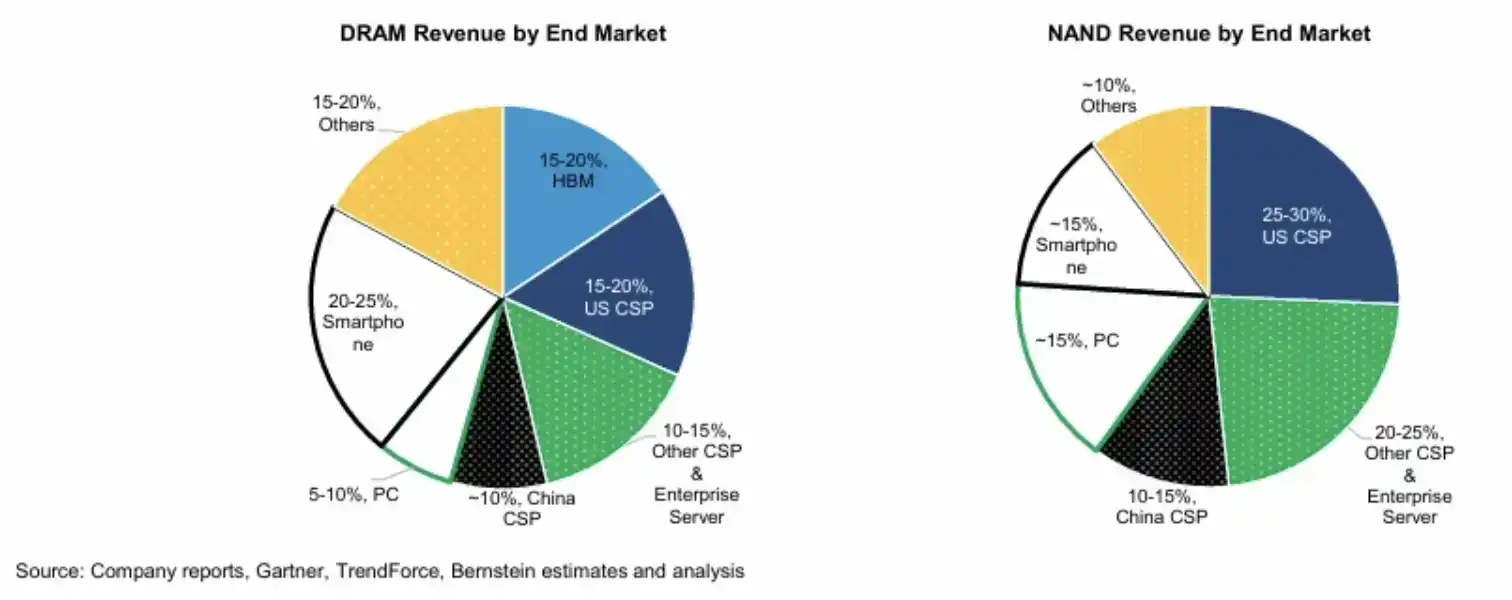
China-related demand may not become a stable LTA base either. Bernstein says China cloud providers and end customers may lean toward domestic suppliers, while expanding local DRAM and NAND supply adds another layer of uncertainty to long-dated purchase commitments.
By Bernstein’s estimate, about 30% to 50% of the end market for DRAM and NAND may remain outside LTA coverage. So even if leading suppliers lock in major U.S. customers, a meaningful share of the market would still trade on spot prices, short-cycle orders and shifting expectations. As long as enough demand stays in spot or short-duration channels, price signals do not disappear. Capacity additions, inventory drawdowns and channel order cuts can still amplify cyclicality.
AI supports valuations, but peak earnings cannot simply be projected forward
Part of the reason investors are willing to assign higher valuations to memory names is that AI demand has changed the shape of the cycle’s lower end.
On the DRAM side, demand for HBM remains strong. Bernstein’s Asia team forecasts that HBM pricing in 2027 could be 2x to 2.5x above 2026 levels. Conventional DRAM contract pricing has already risen sharply, and the report says it may remain elevated over the next 12 months. HBM is more stable than commodity memory, but it still shares part of the manufacturing base with standard DRAM, so capacity allocation matters across product lines.
On the NAND side, AI inference and longer context windows are also creating a fresh demand case. The report says early AI training mainly consumed HBM and DRAM, but storage demand may rise as inference workloads, Agentic AI and long-context applications expand. It also cautions against describing Vera Rubin-related capacity too loosely as “GPU NAND capacity,” noting that Nvidia’s official page lists 20.7TB of HBM4 GPU memory.
In that setting, Bernstein sees LTAs as a way to lock in a portion of elevated-cycle revenue. If AI demand stays firm, suppliers can secure part of that demand through long-duration contracts. If pricing later cools, guarantees and floor prices can slow the decline in profitability.
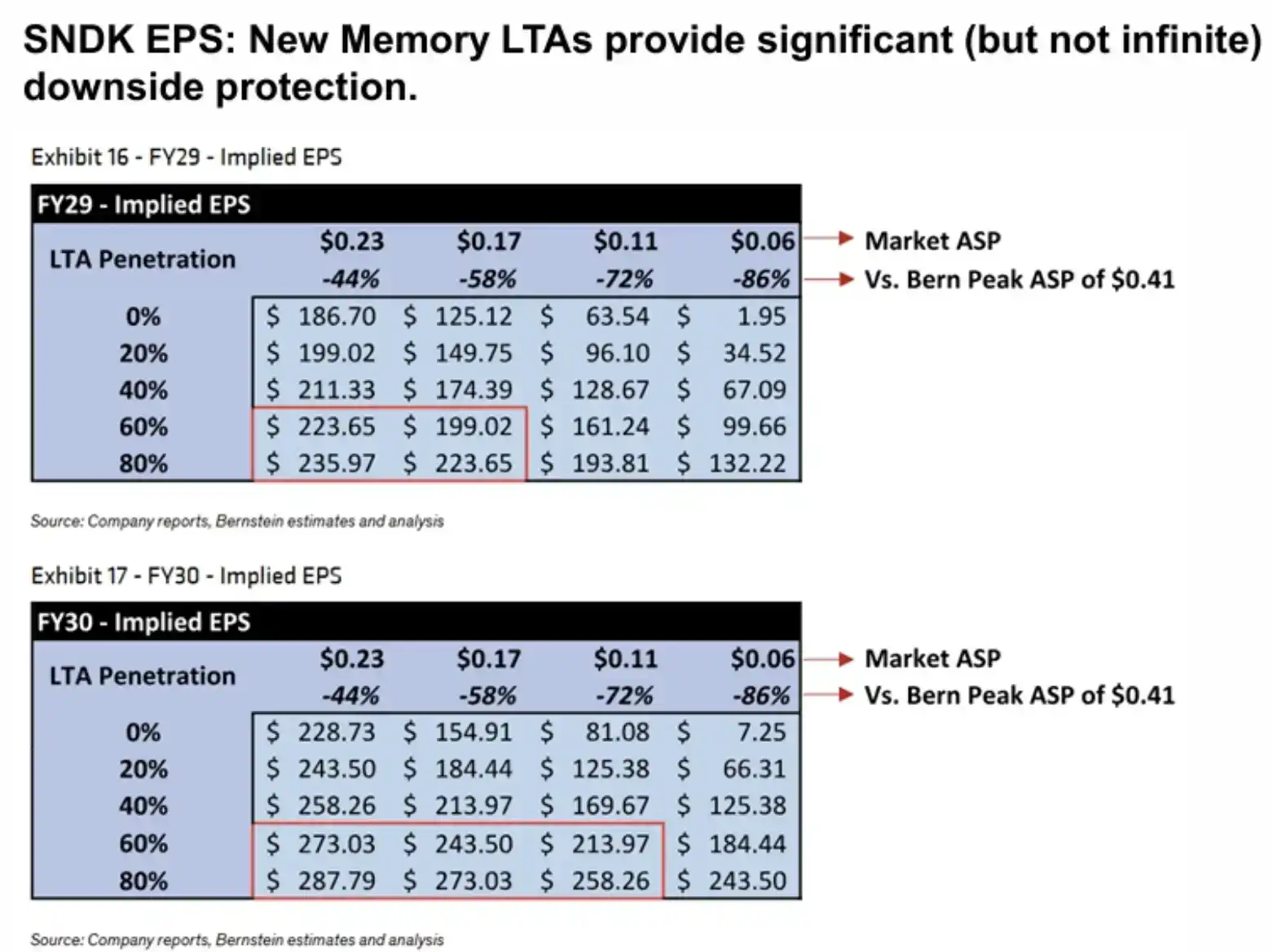
SanDisk’s stress testing points in the same direction. Bernstein’s model shows LTAs can keep FY29-FY30 EPS above the no-LTA case under most penetration assumptions, even under fairly harsh scenarios, with stronger protection later in the contract term. But the same sensitivity work also argues against a straight-line read-through from current conditions to peak earnings. Under lower operating margin assumptions, EPS could come in well below current run-rate levels.
The report does not call the cycle over
Bernstein’s bottom line is not that the memory cycle has ended. Its conclusion is narrower: the next downswing may be softer.
Micron and SanDisk have secured long-term agreements and financial guarantees, which suggests large customers are willing to pay for supply certainty in the AI era. That improves revenue visibility over the next few years and gives investors more reason to believe the earnings floor is higher than in past cycles.
The limits are just as clear in the report. About $33 billion in guarantees provides only partial protection. Consumer demand, China-related demand and other transactional channels are not all moving into LTAs. Bernstein also estimates that China’s DRAM share could rise from about 8% to 16% over the next several years, while NAND could face stronger supply pressure after 2028.
The real test for LTAs is not whether suppliers can sign them in an upcycle. It is whether customers keep performing in the next downturn, whether the guarantees are painful enough to matter, and whether suppliers maintain capacity discipline. Until those questions are answered, Bernstein’s framing is that LTAs are a new shock absorber for memory, not an off switch for the cycle.