
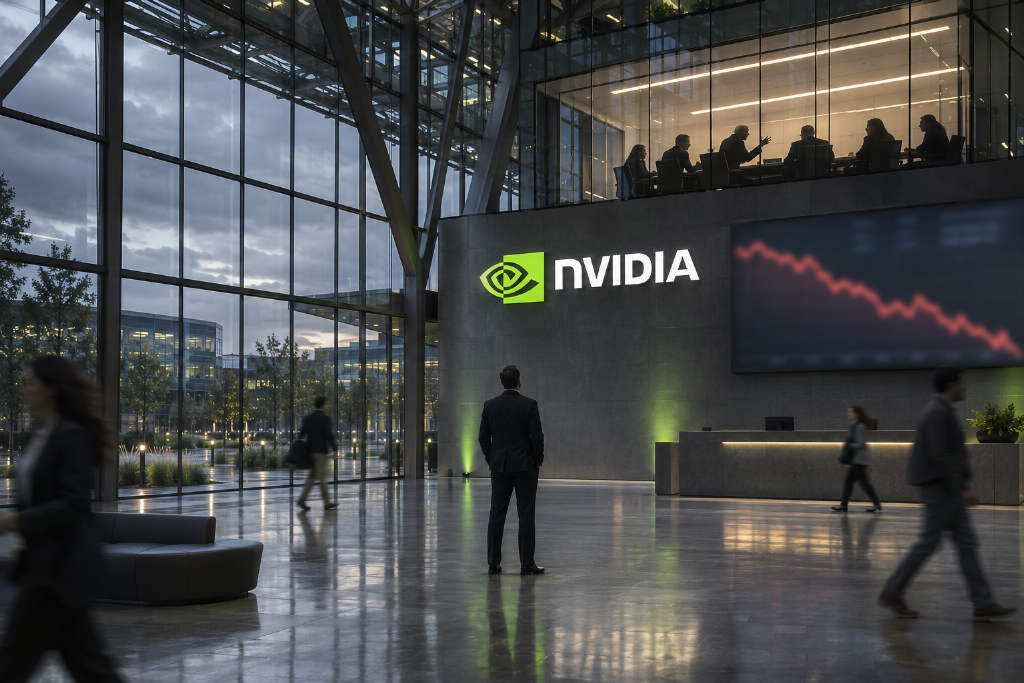
Bernstein downgraded Nvidia from Outperform to Market Perform and cut its price target in half, from $400 to $200. The move was not driven by a weaker business outlook, the brokerage said, but by allegations involving CEO Jensen Huang and uncertainty over the company’s leadership transition. The source article was written by Zhang Yaqi of Wallstreetcn.
Bernstein analyst Stacy A. Rasgon said investors should stay on the sidelines for now, even though Nvidia shares have fallen to what he described as an “almost absurdly undervalued” level. The extent of the negative news remains impossible to assess.
New allegations leave the board facing a leadership decision
The episode came to light after a media report published last weekend alleged an improper relationship between Huang and Alice Huang. Jensen Huang publicly acknowledged the relationship on Sunday. Nvidia’s board then announced that it would launch an independent investigation.
The situation escalated after a later report alleged that Huang had also been involved in an improper relationship with a direct subordinate, reportedly Kimberly Powell, the company’s vice president of healthcare. Nvidia is preparing to remove Huang, according to the report.
Rasgon wrote that some CEOs have been dismissed for conduct far less serious than the allegations now facing Huang. In light of the new claims, he sees little chance that the board will keep Huang in the role. If directors nevertheless choose not to act, Rasgon said, further scandals may only be a matter of time, adding to the risks.
Strong revenue forecasts do not resolve the uncertainty
Bernstein stressed that its downgrade does not reflect a bearish view of Nvidia’s business prospects. Its latest estimates still point to steep growth in the data center business: revenue is forecast at about $378.3 billion in fiscal 2026, rising to $657.8 billion in fiscal 2027 and potentially topping $918.2 billion in fiscal 2028.
Total revenue is expected to increase from $406.9 billion in fiscal 2026 to $690.3 billion in fiscal 2027, a year-over-year growth rate of nearly 70%. Bernstein forecasts average non-GAAP earnings per share of $19.04 for fiscal 2027/2028 (FY28/29), as described in the report. On that basis, it set a $200 price target, equivalent to about 11 times forward earnings, down from the 21-times valuation multiple it had used previously.
The firm expects day-to-day operations to face no significant disruption during a management transition. The succession question is harder to answer. Rasgon asked whether Nvidia would promote an internal candidate or bring in an outsider, and who could take Huang’s place. Neither question has an answer yet, and any eventual choice could introduce a new variable for the market.
Bernstein says the bad news may not be over
Bernstein used a “cockroaches in the kitchen” analogy to explain its concern: if you find two cockroaches in a kitchen, the most reasonable conclusion is not that there are only two.
On that logic, the allegations already made public may be only the tip of the iceberg. Potential developments could include additional internal accusations, a government investigation, and related uncertainty for the business. Questions also remain over Nvidia’s substantial strategic investments in its supply chain, its various backstop commitments, and its remaining guarantees. Meanwhile, shares of some competitors have risen in recent days amid the related news and could continue to benefit.
Rasgon said he was “quite conflicted” about the call and understood the argument for buying on weakness. His instinct, however, was that the depth of the well had not yet been fully mapped. Bernstein has therefore chosen to step aside and wait.



