Behind the $235 Price Target: Qualcomm's Bigger Story Still Faces Near-Term Uncertainty
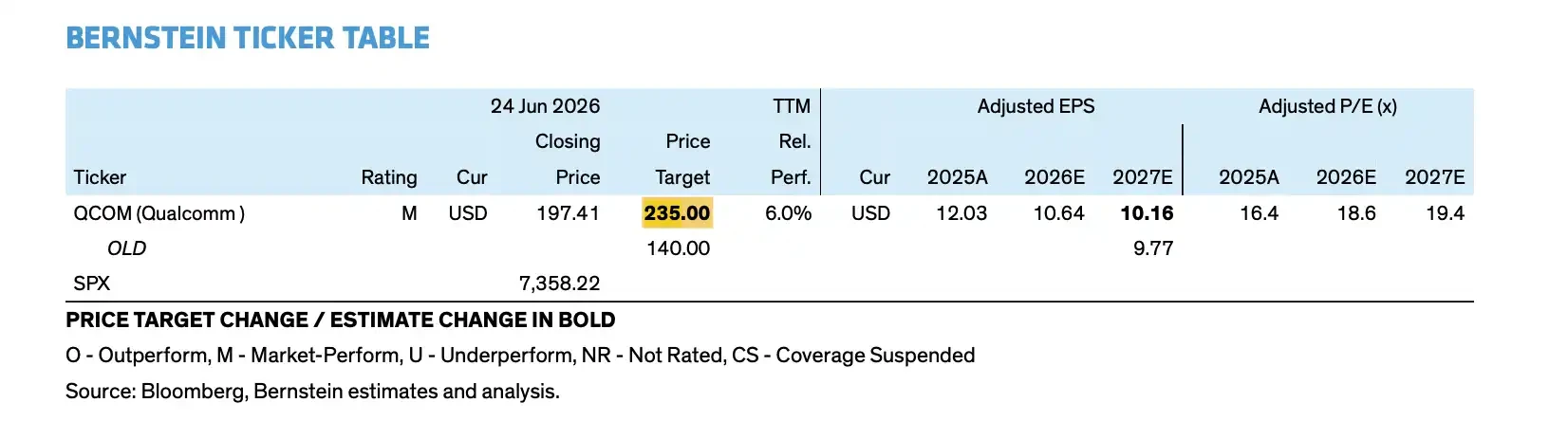
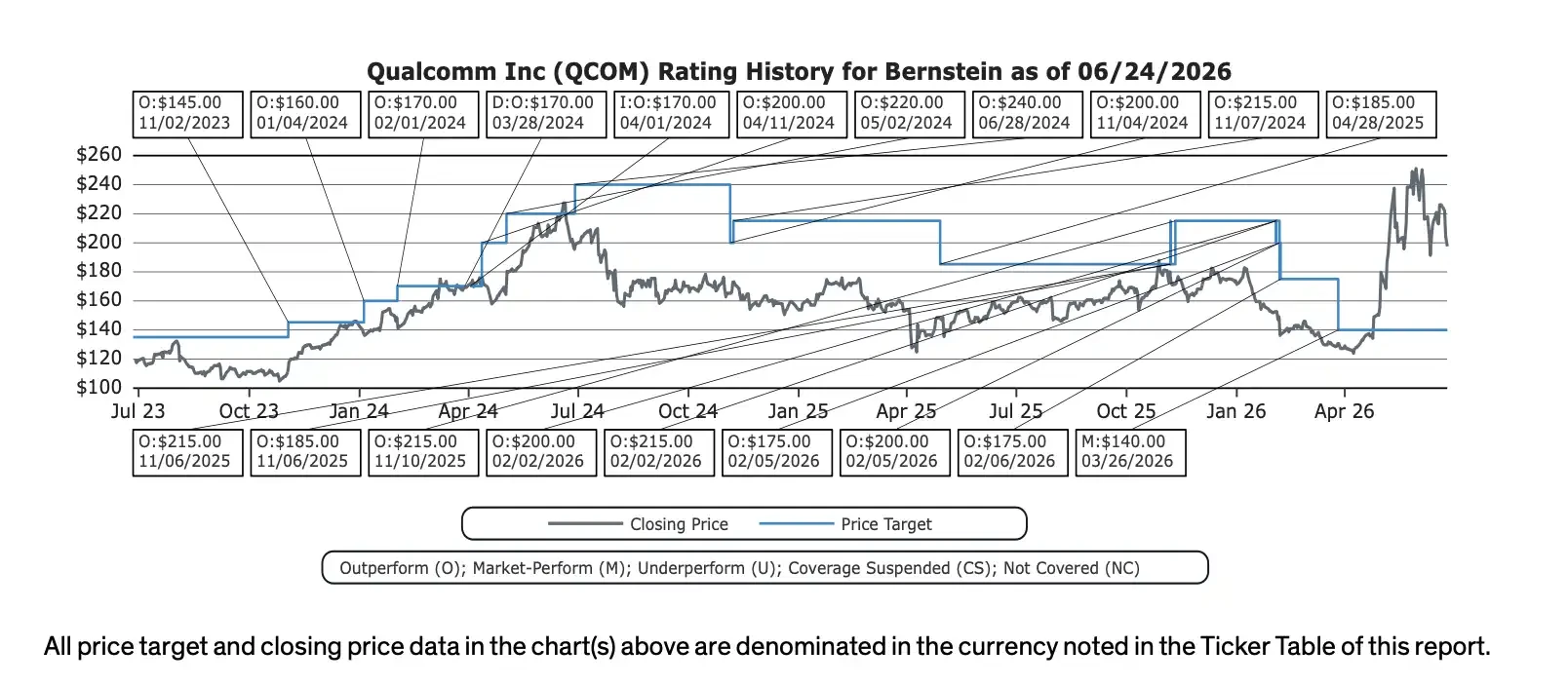
After Qualcomm's Investor Day in New York, Bernstein raised its price target from $140 to $235, but kept a Market Perform rating. This divergence reflects the trade-off between a larger long-term story and near-term pressures. Qualcomm's official targets call for ~$40 billion in non-handset revenue by FY2029, including over $15 billion from data center, $10 billion from automotive, and $14 billion from IoT, with Non-GAAP EPS above $18. Yet the unchanged rating suggests sell-side skepticism about when these milestones will materialize. The data center and auto ramp are back-end loaded, while headwinds from handset decline, Apple revenue loss, OPEX increases, and gross margin compression will hit sooner.
Data Center: The Core of Qualcomm's AI Pivot, But Also the Biggest Variable
Qualcomm's most important new narrative is data center. The company targets >$15 billion in data center revenue by FY2029, up from a current base of ~$30 million. This implies Qualcomm must break into cloud hyperscaler AI infrastructure budgets. The roadmap includes custom ASICs, AI inference accelerators, Dragonfly C1000 CPU, connectivity products, and software layers. Qualcomm disclosed two unnamed hyperscaler customers expected to contribute >$1 billion each in custom silicon revenue by FY2027. The Meta collaboration is a key validation point: Dragonfly C1000 is slated for production ramp in H2 2028. Caution is warranted, as Qualcomm is only one of multiple suppliers, and exact volumes and pricing are undisclosed.

Automotive and IoT: Second Growth Engines Emerge, But Handset Pressure Remains
Automotive and IoT form Qualcomm's second growth curve. Automotive revenue target is $10 billion by FY2029, IoT over $14 billion. The automotive design-win pipeline has grown from $45 billion 18 months ago to $65 billion. However, handset pressure persists: FY2027 Android handset revenue is expected flat to slightly down, and with Apple revenue exiting, total handset revenue could decline by $5–6 billion year-over-year. Qualcomm's Android handset revenue CAGR from FY2026 to FY2029 is estimated at only ~5%, below historical high-growth phases. Additionally, FY2027 OPEX is expected to grow double-digit as R&D and customer support spending for data center CPU, AI accelerators, and custom silicon ramp up ahead of revenue recognition, creating downside risk to EPS in the near term.

Valuation Rerating: Higher Multiple Instead of Higher Earnings
The core of Bernstein's price target increase is not better near-term earnings, but a valuation model that now incorporates larger data center revenue and a more balanced business mix. Bernstein uses FY2027/FY2028 average EPS of ~$11.75 and a 20x P/E multiple (vs. ~14x for the prior $140 target). However, the model assumes data center gross margin of ~40%, below Qualcomm's corporate average. As a result, overall gross margin may decline from 55.2% in FY2026 to 51.6% in FY2029. Therefore, the $235 target is not a conclusion that Qualcomm's AI transformation is successful, but a new price that incorporates a more diversified future. The Market Perform rating reminds investors that until handset headwinds ease, data center revenue materializes, and gross margins prove sustainable, the stock is not a clear buy.
Three Key Verifications the Market Needs
If the market has already priced in optimistic data center revenue and a higher multiple, Qualcomm must prove three things: (1) hyperscaler customers will ramp as planned; (2) data center gross margins will not persistently drag overall margins; (3) handset revenue erosion will not overly depress EPS before new businesses deliver. In a bear case where data center revenue falls significantly below $15 billion and personal AI/computing growth is limited, Qualcomm's FY2029 EPS could still reach ~$15, showing the base is not fragile. But the gap between $15 and $18+ EPS is large for valuation. Bernstein's Market Perform rating signals that investors need not rush to call Qualcomm a definitive AI winner until near-term headwinds clear and long-term execution is proven. The focus now shifts from story-telling to revenue and profit delivery.