
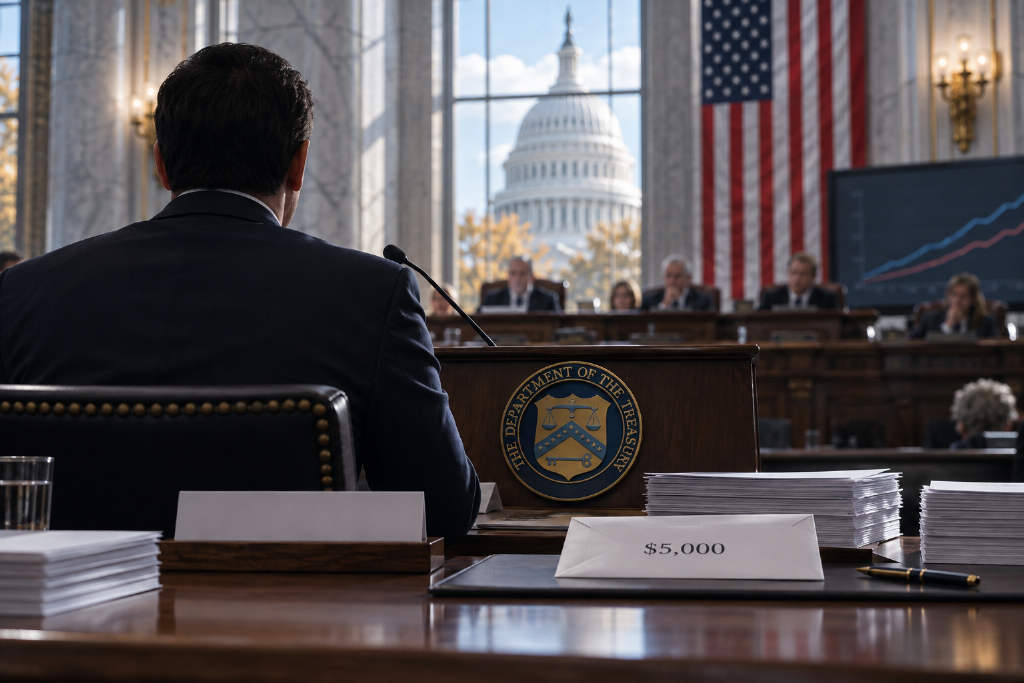
U.S. Treasury Secretary Bessent appeared before the House Financial Services Committee on Sept. 16, using his opening testimony to defend the U.S. economic outlook, the Treasury market, and a politically sensitive proposal from Donald Trump calling for a $5,000 payment to every adult.
Bessent points to GDPNow forecast
Bessent said the U.S. economy is regaining momentum. He cited the Atlanta Fed’s GDPNow model, which currently projects annualized real GDP growth of 4.4% in the third quarter.
That figure is a high-frequency model estimate rather than an official government GDP reading. Still, with markets worried that elevated interest rates are starting to erode consumer spending and business investment, Bessent used the projection to argue that the economy can continue to absorb current rate levels.
Defense of the Treasury market
Asked about the 10-year U.S. Treasury yield moving above 5%, Bessent said the dollar remains a strong global reserve currency. He also said the two most recent U.S. Treasury auctions ranked among the strongest of the past 20 years.
He argued that the rise in long-end yields should be seen mainly as a reflection of global factors, not as a sign that markets are losing confidence in U.S. fiscal credibility or funding capacity. The statement also served as a defense of the Treasury Department’s recent issuance and buyback operations, with the government seeking to reassure markets that demand for Treasuries, auction functioning, and the dollar system remain stable.
Comments on Trump’s $5,000 payment plan
The most politically and market-sensitive portion of the hearing centered on Trump’s proposal to send $5,000 to every adult. Bessent said Trump’s intent to advance the plan is "very real."
He linked the proposal to whether Republicans can continue to control both the House and Senate after the midterm elections. Bessent did not disclose the source of funding, eligibility details, or a timeline for implementation. He said only that there are ways to structure the plan without expanding the federal deficit, and that if congressional legislation is required, the Treasury would work with House Speaker Johnson.