
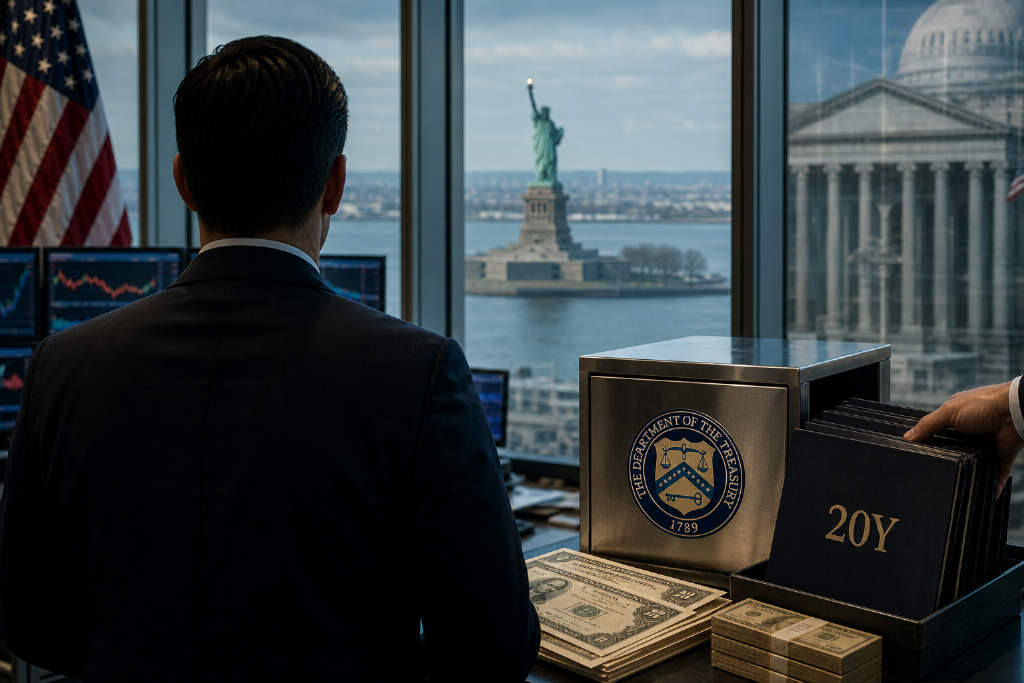
Fox Business reporter Charlie Gasparino said in a post on X on Aug. 24 that several Wall Street executives with direct knowledge of U.S. Treasury Secretary Scott Bessent’s thinking believe his push to expand Treasury buybacks is not meant to prop up the market. In their telling, the point is to make investors shorting long-dated U.S. Treasuries think twice.
According to that account, Bessent’s options include larger Treasury buybacks, increased issuance of short-dated bills, and even the possible elimination of the 20-year Treasury. The target on the other side is a group of bond bears trying to force the 10-year Treasury yield to 5%, and the Treasury’s job, in this version of events, is to stop that from happening.
The claim reframes how markets read the Treasury’s actions over the past week. When the department said on Aug. 19 that it would double the size of its buybacks, many took that as a market-support move. Gasparino’s version casts it instead as psychological warfare aimed at short positioning.
CTA short positioning has reached extreme levels
Bloomberg reported on Aug. 11 that trend-following funds and leveraged investors had built net short positions in Treasury futures to 1.29 million contracts by the end of July, the highest on record.
UBS data cited in the report goes further. By late July, CTAs had expanded their bond underweight position to three times the level seen two weeks earlier. On that basis, every 1 basis point move in the 10-year Treasury yield now shifts this group’s profit and loss by roughly $300 million, the highest figure in UBS records going back to 1990. Assets tied to CTA bets on the bearish side of the global bond market exceed $400 billion.
CTAs are trend-following funds that rely on price action and systematic models rather than fundamentals. That works when the move holds. If the market reverses and risk limits are hit, they have to buy back shorts, and those purchases can push prices higher again, creating a self-reinforcing loop.
ZeroHedge, citing a CTA positioning model, estimated that global bond-market shorts amount to about $155 million in DV01 terms. If bond prices rise by a 2 standard deviation move over one month, the combined scale of short covering and fresh buying could reach $150 million DV01, which would also mark a record high. In that scenario, the 10-year Treasury yield could be pushed back toward 4.3%.
The report’s bottom line is that Bessent is not trying to persuade the market. He is trying to force its hand. Because he comes from a trading background, the story argues, he understands that in a world where deficit reduction is out of reach, the government is unlikely to beat the market with a fundamentals case alone. Technical vulnerabilities are another matter.
Treasury General Account seen as potential ammunition
A $4 billion buyback on its own is not enough to move the whole market. On Aug. 19, the U.S. Treasury raised the cap on individual buybacks from $2 billion to at least $4 billion, targeting off-the-run securities in the 10- to 20-year and 20- to 30-year sectors. The first operation is scheduled for Sept. 9.
Bessent said in an interview that the size could go higher. What appears to have changed market thinking was a CNBC report on Aug. 24 citing two senior Treasury officials who said the department may use the Treasury General Account, or TGA, to fund the buybacks. That account currently holds about $954 billion.
That compares with an official target range of $550 billion to $600 billion during the Biden period. The report says Bessent has accumulated close to twice that level of cash over the past year or so. With the debt ceiling not expected to bind until next winter or even spring, the story says using part of the balance now does not create an immediate short-term risk. It also says funding buybacks through the TGA avoids the need for Federal Reserve help, which addresses one of the market’s biggest concerns.
Critics say the Treasury is muddying the Fed’s message
The policy tension sits at the Federal Reserve. RSM US chief economist Joseph Brusuelas said the U.S. is slowly moving toward a populist logic in which the central bank is expected to support fiscal goals. He said the Aug. 19 intervention "will make life harder for Kevin Warsh" and warned that, over time, it points toward major policy mistakes.
His argument is that the Fed can create money and buy the assets it wants, while the Treasury cannot. The Treasury has to fund buybacks by selling more short-dated debt. He also warned that forcing long-end yields lower could make inflation stickier, which in turn could leave the Fed holding rates higher for longer.
Federal Reserve Chair Kevin Warsh struck a more nuanced tone at his July 29 press conference. He said inflation running above the 2% target for more than five consecutive years made him uneasy, but he did not raise rates and did not spell out what would make him change course. He also suggested that by pushing long-end yields higher, markets had already done part of the Fed’s work. The report says those comments accelerated the selloff in long-dated Treasuries.
If the Treasury now moves to push long-end yields back down, that would blur Warsh’s policy signal and cool the drive to shrink the balance sheet. Market observers quoted in the story described the Treasury’s balance sheet and the Fed’s balance sheet as effectively tied together.
Less than 70 days before the Nov. 3 midterms
There are fewer than 70 days left until the Nov. 3 midterm elections. In the source article’s framing, that is the buffer Bessent is trying to buy.
The larger numbers remain unresolved: $40 trillion in debt, a $2.1 trillion annual deficit, and $963 billion in net interest already paid in the first 10 months of fiscal 2026. Those figures do not go away after the election and will still need to be dealt with once the results are in.
Bitcoin angle and why CTAs matter
The source article’s FAQ section says Treasury purchases of long-dated bonds, paired with heavier issuance of short-dated bills, would push money back into markets and weigh on long-end yields. Markets have read that as a form of liquidity easing, which has helped risk assets. Bitcoin, the article says, has risen nearly 30% in eight trading days from its Aug. 17 low of $62,751.
On CTA short squeezes, the article says these funds follow price momentum through systematic models. When rising prices trip risk controls, shorts have to be covered, and that buying can lift prices again, creating positive feedback. With Treasury short positioning already at record levels, the story says this is the pressure point the Treasury may be trying to exploit with relatively limited capital.