

U.S. Treasury Secretary Bessent made two moves this week in quick succession: he publicly warned traders not to short the yen, and the currency strengthened; he then sharply increased the size of Treasury buybacks in an attempt to contain long-end yields. The result was uneven. The yen rose, but Treasuries did not hold up.
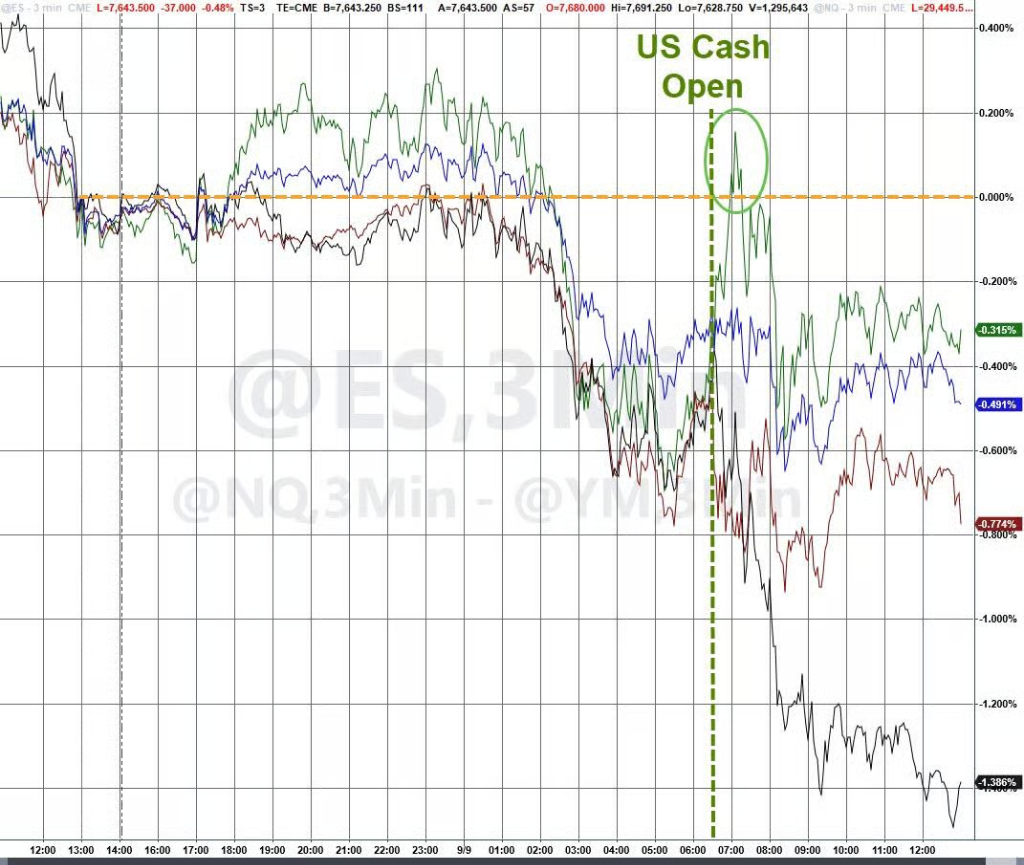
Taken separately, each move had its own logic. Put together, they create two pressures for a U.S. stock market that has been lifted for nearly four years: a stronger yen can hit carry trades, while higher Treasury yields can compress valuations. On Wednesday, Sept. 9, U.S. stocks fell for a third straight day. The Dow dropped more than 400 points, or 0.8%, the S&P 500 lost 0.5%, and the Nasdaq fell 0.6%. AI-related technology shares were among the hardest hit.
Treasury buybacks were increased, but investors wanted more
On Wednesday, the U.S. Treasury said it would raise the cap for a single long-term bond buyback to $6 billion, triple the originally planned size from last month.
The market response was disappointment. Bessent had earlier suggested publicly that the buyback size could exceed $4 billion, and Wall Street had at one point expected the cap for a single operation to reach $8 billion to $10 billion. Once the $6 billion figure was announced, Treasury yields moved higher instead of lower.
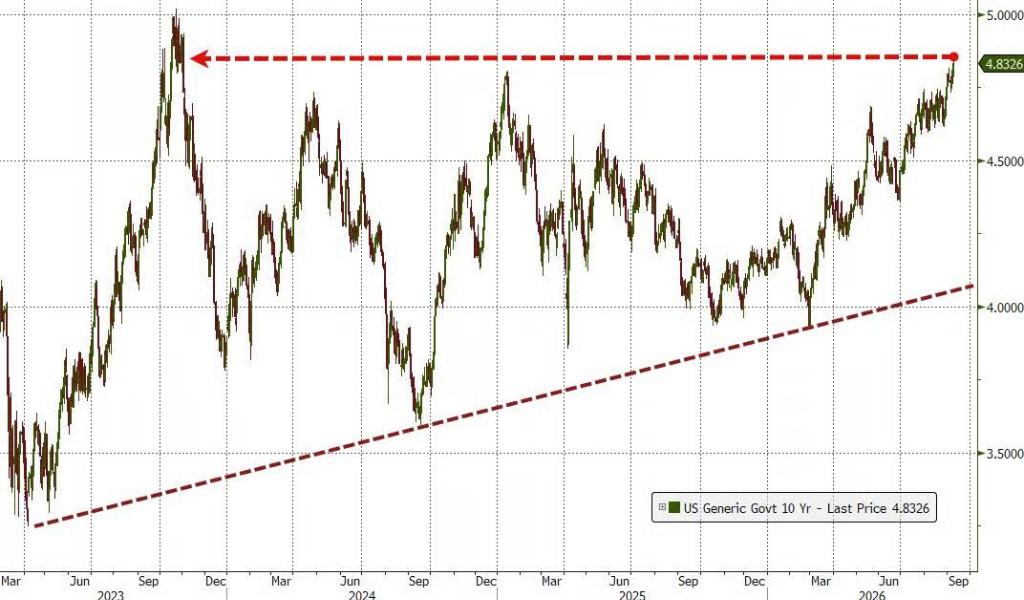
The 10-year Treasury yield touched 4.836% during the session, its highest level since October 2023. The 30-year Treasury yield stood at 5.285%, near last month’s 20-year peak of 5.30%.
Elias Haddad of Brown Brothers Harriman & Co. put it bluntly: 「For now, the Treasury is bringing a pea shooter to a tank battle.」
Deutsche Bank strategist Steven Zeng said, 「It’s as if the Treasury created a monster and now has to keep feeding it.」 He said the $6 billion announcement failed to deliver the deterrent effect that investors had been looking for.
Later on Wednesday, the Treasury sold $39 billion of 10-year notes at a yield of 4.834%, the highest auction yield on record for that maturity.
Dustin Reid, chief fixed income strategist at Mackenzie Investments, said, 「How they manage this situation is still in its early stages. The Treasury certainly won’t be too happy with today’s market reaction.」
Bessent says he cannot control the market’s “equilibrium” price
Facing a sharp reaction from investors, Bessent said Tuesday at an event in Texas that he cannot change the “equilibrium” price of Treasuries. His objective, he said, is only to slow the pace of price swings and prevent harmful narratives from taking hold and spreading.
He attributed the rapid rise in long-end yields to market panic over the idea that the United States might be unable to repay its debt, calling that concern “absurd, but for a time it became the dominant narrative.”
Wells Fargo macro strategists Angelo Manolatos and Francis Brown wrote that lower long-end yields would require other catalysts, including slower growth and inflation, lower energy prices, less uncertainty around Federal Reserve policy, fiscal consolidation, or a decline in corporate bond issuance.
Right now, none of those conditions is in place. Elevated oil prices are still pushing up inflation expectations, and the market is pricing in a 62% chance of a Fed rate hike at next week’s FOMC meeting. Corporate bond issuance is also in a seasonal peak this week. On Tuesday, 18 borrowers sold debt, making it the third busiest trading day of the year.
“I am the house”: Bessent’s warning helped lift the yen
The day before the Treasury buyback plan drew a cool response, Bessent used the same Texas event to issue a hard warning to traders shorting the yen.
According to Bloomberg, he said: 「I am the house now, so when we intervene in the yen, I know exactly what the Japanese, the Bank of Japan, and Japanese policymakers are going to do. If you want to bet against me, go ahead.」

That confidence rested on two points in the original report: Bessent said he understood the direction of Japanese policymaking, and reports indicated that the Bank of Japan was inclined to raise its benchmark rate by 25 basis points this month.
The yen extended its gains on Wednesday, rising to 153.49 per dollar intraday. A day earlier, it had already reached its strongest level since February.
A stronger yen threatens carry trades tied to U.S. equities
The yen has long been one of the cheapest funding currencies in global markets. A standard carry trade borrows in low-yielding yen, converts the proceeds into dollars, and buys higher-return assets such as U.S. technology stocks.
If the yen keeps strengthening, the cost of that trade rises and investors can come under pressure to unwind positions.
Steve Sosnick, chief strategist at Interactive Brokers, said the yen’s current rise 「is already enough to unsettle some people who borrowed yen to make leveraged bets on high-flying U.S. stocks.」
Rich Privorotsky, head of Delta-One at Goldman Sachs, said that whatever one makes of Bessent’s rhetoric, 「the yen is objectively continuing to appreciate, and the market is betting on tighter Bank of Japan policy and capital returning home.」
He then raised what he saw as the central question: 「What happens when the yen carry trade unwinds and money flows back into Japanese bonds and equities?」

His take was this: 「The S&P and large-cap stocks broadly feel oddly heavy, without any obvious fundamental reason. What’s worth watching is that some leveraged and carry positions may be quietly leaking out of the system.」
Jordan Rizzuto, chief investment officer at GammaRoad Capital Partners, called it directly: 「This is the biggest risk facing the bull market.」
The dilemma: the yen cannot be too weak, but it cannot be too strong either
There is an internal contradiction in the policy logic around the yen and Treasuries.
According to MarketWatch, Japan’s holdings of foreign securities fell by nearly $88 billion as of the end of August. Japan has long been a major holder of U.S. Treasuries.
Rizzuto of GammaRoad said that if Japan has recently been selling Treasury assets, that deserves close attention, especially because it comes just after the United States and Japan worked together to intervene in the foreign-exchange market and support the yen. 「That gives you a sense of the weight of these two developments,」 he said.
The Treasury would like the yen to be strong enough that Japan does not need to sell Treasuries to raise funds. But if the yen rises too quickly, a broad unwind in carry trades could hit U.S. technology stocks more directly.
Some traders have already begun to ask in private whether Bessent has the causality backward. He appears to want a stronger yen to relieve pressure on the long end of the Treasury market, but traditionally it is interest-rate differentials that drive currency flows, not the other way around.