
Bill Ackman said he has sold some Alphabet and recently put roughly $2 billion into Microsoft, framing the move as a bet on AI infrastructure and on the return profile of large-scale platform companies rather than a rejection of Google as a business.
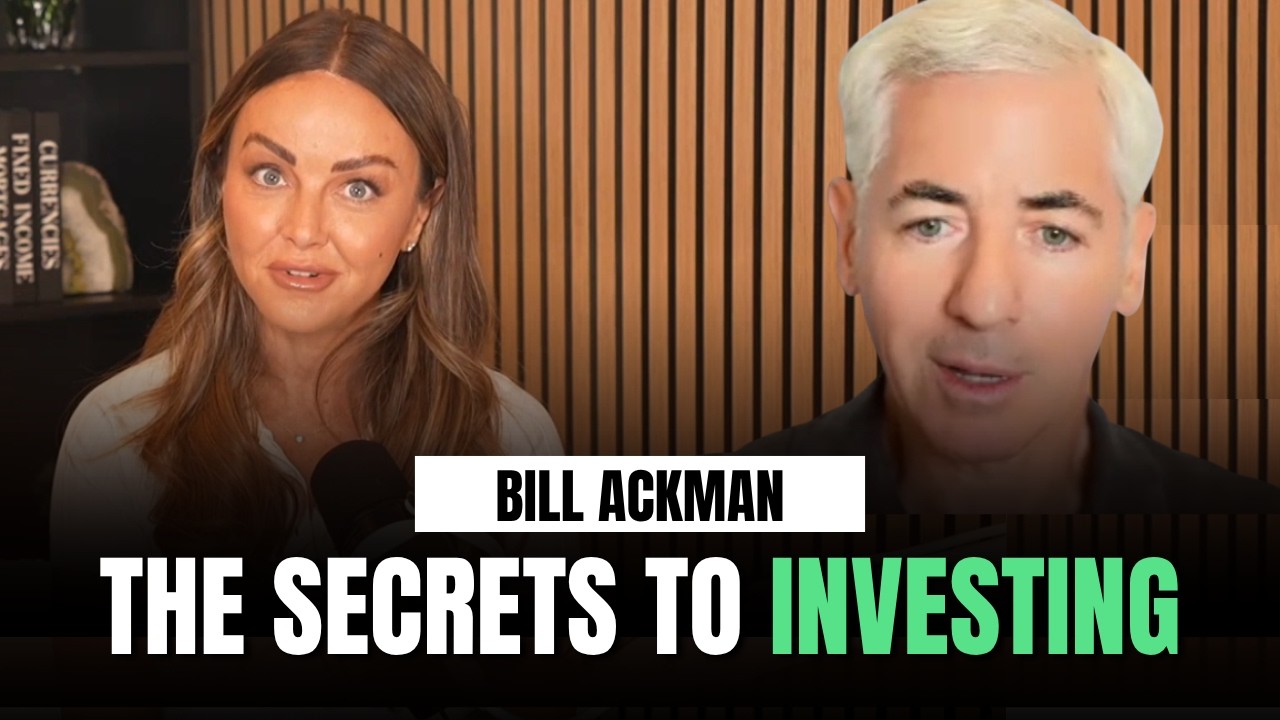
Ackman made the remarks on the Money Rehab podcast hosted by Nicole Lapin and sourced from Money News Network. The episode aired on July 20, 2026. A disclosure attached to the interview said Pershing Square manages about $14 billion, holds a concentrated portfolio of 11 U.S. stocks, and earns revenue from management fees and performance fees. The disclosure also stated that Ackman does not personally own Bitcoin or gold, and that the episode included promotional material tied to PSUS, Pershing Square’s publicly traded fund.
A concentrated portfolio built around a small number of businesses
Ackman described Pershing Square as one of the more concentrated portfolios on Wall Street. The firm manages about $14 billion and holds only 11 stocks, with the top five positions accounting for 78% of the portfolio. He said the goal is to buy what he sees as the best businesses in the world, companies that can stand the test of time, are unlikely to be disrupted by AI, and ideally benefit from AI adoption.
He said some names had been on the firm’s watchlist for a long time but had simply been too expensive before becoming more reasonably priced. He specifically listed Amazon, Meta, Uber, and Microsoft. While large pools of capital have been chasing what has recently made money in the market, including semiconductors and memory, he said Pershing Square is focused on assets that can deliver high compounded returns over the next three to five years.
Brookfield, in his view, also fits that framework. Ackman said the company operates in asset management across private equity, real estate, and infrastructure, with notable exposure to power and energy. If data center construction continues to accelerate, he said, demand for infrastructure should rise with it, leaving Brookfield well positioned because it manages other people’s money and earns fees and equity interests from that business.
Why Microsoft replaced some Alphabet exposure
Ackman said two factors drive the firm’s decisions: business quality and price. If a stock already in the portfolio rises to a level where the expected forward return falls below the fund’s hurdle rate, Pershing Square may trim or sell it and move capital elsewhere.
That, he said, is what happened with Alphabet. Ackman stressed that he is not bearish on Google. He called it a great company. The issue, in his telling, was relative return. He believes the money could earn more in Microsoft at current levels than by remaining in Alphabet.
He said Microsoft was trading at about $387 per share at the time of the interview. Ackman added that investors who wanted exposure to Microsoft at an implied level closer to $310 did not need to wait for the stock itself to fall there, because PSUS, Pershing Square’s publicly traded fund, was then trading at a 22% discount to net asset value and included Microsoft in the basket.
His broader AI view helps explain the switch. Ackman said this is “a very special time in history,” with AI driving startup formation and making intelligence available to a broad group of people at very low cost. The largest companies, he said, are competing to build models that could lead toward superintelligence, and the race is showing up physically in land acquisition, data center construction, and GPU deployment. He described it as a “land grab.”
At the same time, he said he is less interested in betting on frontier model companies themselves. Open-source models are improving quickly, and he expects that low-cost or free models capable of solving most practical problems will become widely available. For that reason, he prefers the businesses supplying or benefiting from the infrastructure buildout over companies competing directly at the model frontier.
On other names, Ackman said Uber looks cheap because the market fears Tesla’s robotaxi ambitions could disrupt the ride-hailing business. His view is that consumers will still open the Uber app because what they want is the cheapest and fastest ride from point A to point B.
When asked which major company might win, he also mentioned SpaceX, saying it is the only place where someone can rent 100,000 GPUs and that the returns are very high. Even there, however, he said valuation matters. If a company reaches a $6 trillion to $7 trillion market value, the upside becomes more limited.
Bitcoin and gold: interesting, but not investments in his framework
Ackman was direct when the conversation turned to gold. He said he does not buy it, though he has bought jewelry for his wife. He recalled that his father bought gold many years ago, around the 1970s, and held it for a long time. When gold moved above $4,000, Ackman said he told his father to sell, and his father did. He would rather own businesses that compound over time.
His reasoning was consistent and simple. Gold does not generate a return. The assets he wants to own produce something measurable: profits, dividends, or rent. Gold is worth only what someone else is willing to pay for it. In his words, that makes it speculation rather than investment.
He placed Bitcoin in the same category. Ackman said Satoshi Nakamoto is a genius, and that if he had read the white paper when Bitcoin was trading at 20 cents, he might have bought some. But he does not own it today because it does not produce income. He said, “I don’t know whether it’s worth 50,000, 70,000, or $5,000 or $1 trillion, but I don’t need to know. The beauty of investing is you don’t need to have a view on every asset class. You only need to know what you know and what you don’t know.”
He added that he does not understand Bitcoin and does not understand gold, so he stays away from both. Ackman did note that he has had indirect exposure to blockchain and crypto-focused companies through some venture capital funds, and said he finds the technology interesting. Trading different coins, however, is not something he does.
The bigger market risk is leverage, not a headline valuation number
Asked about the next crisis and whether another 2008-style event could happen, Ackman said there is always something to worry about. He pointed first to the U.S. fiscal position, saying the government spends more than it takes in and carries about $34 trillion in debt, while continuing to issue more Treasuries to fund deficits.
He said the AI infrastructure wave could add to that pressure because many companies are also issuing debt to finance buildouts, increasing demand for credit at the same time the government is selling more debt. In that setup, he said, investors may need to absorb a large amount of supply, which could push interest rates higher.
Even so, he said the more dangerous risk is the amount of leverage in the market. If some outside shock hits and triggers fear, investors who borrowed money could be forced to liquidate positions, causing a chain reaction as falling prices force more selling. Stock prices, he said, could fall a lot in that kind of event.
For investors who are not using leverage and hold high-quality companies they do not need to sell the next day, he said a sharp drawdown would be a chance to add. For those carrying margin debt, the same selloff could force liquidation at the worst possible time.
Ackman boiled the point down to a blunt warning: do not borrow money to buy stocks. He said that is how investors get wiped out. He cited Carl Icahn as an example, saying Icahn used leverage against his own stock and saw a fortune of about $20 billion fall to roughly $3 billion to $4 billion. Even very wealthy investors, he said, can lose huge sums when leverage turns against them.
That is also why Ackman pushed back on broad claims that the market is simply expensive because the aggregate P/E ratio is higher than history. He said some areas are expensive, but a statement such as “the market trades at 21 times earnings versus a historical average of 17” is not enough on its own. Market value depends on future earnings, and those earnings have been beating expectations. He also argued that the biggest companies today, including NVIDIA, Microsoft, Google, and Meta, are better businesses and faster growers than the largest companies of 20 years ago, so they deserve higher multiples. If Microsoft, Amazon, and Meta all look cheap, he said, it is hard to insist that the market as a whole must be expensive.
2008 was not prophecy, he said. It was pattern recognition.
Nicole Lapin said Ackman’s calls around 2008 made it look as though he could see the future. Ackman rejected that description. What people call predicting the future, he said, is often just careful work on the present plus historical comparison.
Before the financial crisis, he said, his team could already see companies doing things that made no sense. He pointed to bond insurers with AAA ratings that looked almost as safe as the government, yet were insuring risky mortgages for small premiums while reporting strong profits. To him, that structure was unsustainable. The issue was not clairvoyance. The problem was visible in the present, and the only uncertainty was when it would break.
He said he cannot know what specific trigger will set off the next major drawdown. What he does know, in his view, is that the market contains a large amount of speculation and that both professional investors and retail traders are using significant leverage. If he had only one piece of advice to offer, he said, it would be not to borrow money to invest in stocks and not to gamble with money needed for everyday life.
Against daily options trading and short-term gambling
Ackman said he does not like the craze for same-day options trading. He called it gambling. No one knows whether a stock will be up or down over a single day, he said, unless that person has insider information. In his telling, the trade is less an investment process than a crazy game.
Asked what someone with $1,000 to invest should do, Ackman said the starting point is to identify a small number of companies that do not rely heavily on leverage, companies the investor admires and trusts to make sound decisions. His test is whether the investor would still be happy owning the stock for 10 years if the market shut down tomorrow and did not reopen during that period.
He said investors should not chase whatever is hottest in the moment. They should buy what they believe can stand the test of time. A business is worth the present value of all the cash flow it will produce over its life, so the investor needs confidence that the company will remain alive and relevant for a very long time.
He says consumers often spot winning businesses before Wall Street does
Ackman argued that ordinary consumers can identify strong businesses before institutions do. He said many of Tesla’s earliest shareholders were retail investors because institutions did not understand how powerful the company could become. He urged investors to look at the products and services they use in daily life and ask which ones they genuinely admire, then work out whether those businesses can withstand competition.
He used Amazon as an example. When he wants to buy a book, he goes to Amazon. In contrast, he described the experience at some New York pharmacies as frustrating, with products locked behind plastic barriers and staff needed to unlock them. Amazon can deliver in two hours. That difference in customer experience, he suggested, tells investors something real about competitive strength.
When the discussion shifted to career success, Ackman did not offer a complicated formula. He emphasized punctuality, doing a bit more than other people, following through on commitments, and promising less while delivering more. He recalled that in his first real estate job he spent lunch breaks at the McGraw Hill bookstore reading real estate books, building knowledge that his peers needed years of experience to acquire. In the AI era, he said, people can now ask AI to teach them almost anything, which is much easier than teaching oneself from bookstore shelves.
The people who win over time, he said, are often not the smartest in raw IQ terms. They are the people others like and trust, the ones willing to do a little more, bring some creativity, and refuse to give up. IQ may not be changeable, he said, but effort and honesty are choices.
Start early, keep adding, and let compounding do the work
At the end of the interview, Lapin asked for a piece of advice listeners could “take to the bank.” Ackman’s answer was to start investing early and put a little money into the market every month. If someone does not have time to pick stocks, he said, buy an index fund. If they do have time, find the best company in the industry. In either case, avoid highly leveraged businesses and buy companies that are likely to be much larger in five, 10, or 20 years, and are not likely to be disrupted by “two women who just graduated from Stanford building something in a garage.”
He said the power of compounding comes from time. Most investors are short-term in their thinking, while long-term investors have a major advantage. He also noted that, under the current system he described, gains are generally taxed when they are realized through a sale, which lets profits keep compounding in the meantime. If an investor can use an IRA or a Trump savings account, he said, compounding may also come with tax benefits.
Across the full interview, Ackman’s framework stayed consistent. He wants assets that generate cash flow, businesses that can compound for years, and exposure to the parts of AI spending that look durable. Bitcoin and gold, in his view, may attract speculation, but they do not qualify as investments under that framework.