
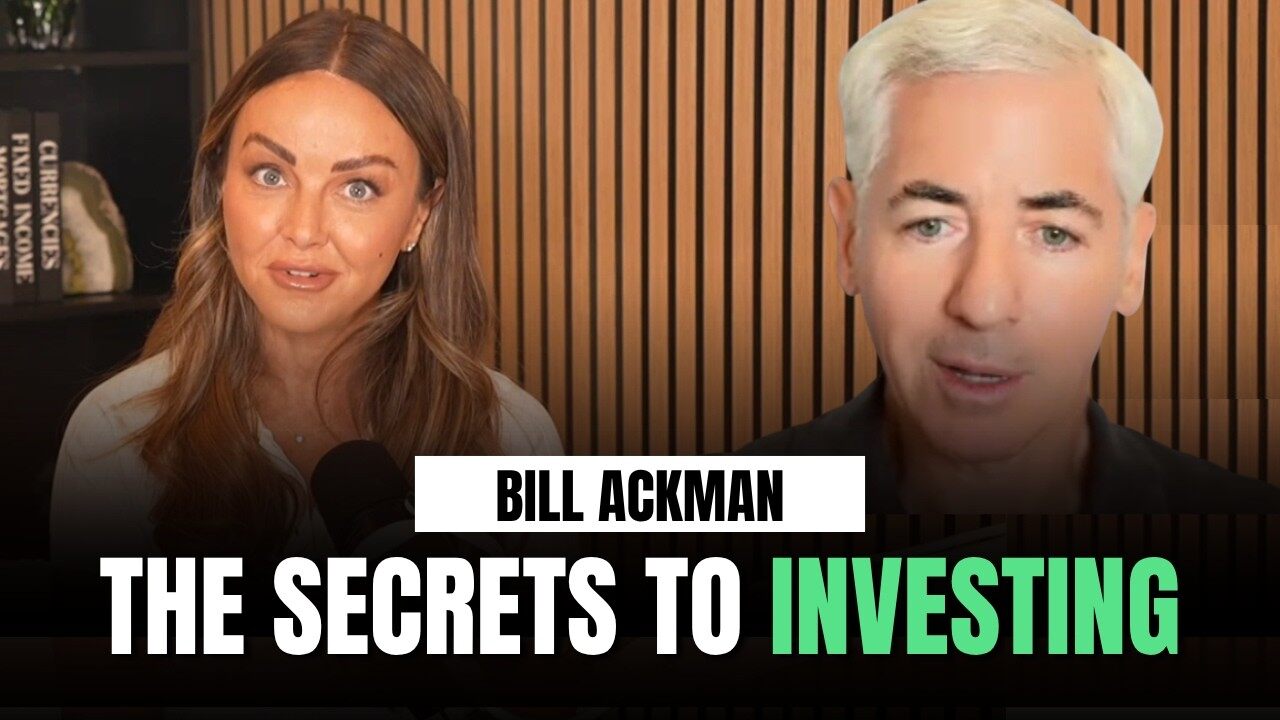
Bill Ackman, founder and chief executive of Pershing Square Capital Management, said he has sold Alphabet and added about $2 billion to Microsoft, arguing that Microsoft now offers better forward returns at the current price while the larger investment case sits with the ongoing AI infrastructure buildout.
Ackman made the remarks on Money Rehab, a podcast hosted by Nicole Lapin and distributed by Money News Network. The episode aired on July 20, 2026. According to the disclosures attached to the program, Pershing Square manages about $14 billion, holds a concentrated portfolio of 11 U.S. stocks, and has 78% of its capital in its top five positions. The disclosure also said Ackman does not personally own bitcoin or gold, and that the interview included promotional references to PSUS, Pershing Square’s publicly traded fund.
AI is the central theme in his current market view
Ackman said the present moment is unusual because AI is driving a wave of new company formation while giving a wide group of users access to intelligence at very low cost. He said the largest companies are competing to build models that could lead toward superintelligence, and that the race is now playing out through land acquisition, data center construction, and GPU procurement.
He described that competition as a “land grab.” At the same time, he said he is not eager to bet directly on frontier model companies. His reasoning was that open-source models are improving quickly, and people may soon be able to access models that solve most practical problems at low cost or for free. Because of that, he would rather own businesses with more predictable economics and clearer exposure to the infrastructure spending that AI is creating.
Why Pershing Square runs a concentrated portfolio
Lapin noted that Pershing Square typically owns only 11 to 12 stocks. Ackman said the firm is looking for what he considers the best businesses in the world, companies that can stand the test of time, are unlikely to be disrupted by AI, or are positioned to benefit from it.
He said some names had been on Pershing Square’s buy list for a long time but were previously too expensive. Amazon, Meta, Uber, and Microsoft all fell into that category, he said. In his view, much of the market’s capital is still chasing what has been making money lately, including semiconductors and memory, while Pershing Square is focused on assets that can compound at high rates over the next three to five years.
Ackman also said Brookfield fits that approach. He described the company as an asset manager with businesses spanning private equity, real estate, and infrastructure, especially power and energy. As data center development accelerates, he said, demand for that kind of infrastructure should rise, leaving Brookfield well placed because it manages money for others and earns fees and economics from doing so.
Why he sold Alphabet and bought more Microsoft
Lapin asked whether the recent purchase of $2 billion in Microsoft stock and the sale of some Alphabet shares meant Ackman had turned negative on Alphabet. He said no. Google remains, in his words, a great company. The decision came down to two variables that matter most to Pershing Square: business quality and price.
Ackman said that when one of the firm’s holdings rises to a level where future returns fall below its required threshold, the position can be reduced or sold and the capital moved into a better opportunity. In this case, he said Microsoft looked more attractive than Alphabet on that basis.
He added that Microsoft was trading at about $387 a share at the time. He then tied that point to PSUS, saying an investor who wanted Microsoft exposure at an effective cost closer to $310 would not necessarily have to wait for the stock to fall there, because PSUS was trading at a 22% discount to net asset value and Microsoft was part of that basket.
Views on Uber, SpaceX, Amazon, and Meta
Ackman said Uber looks cheap because the market fears Tesla’s robotaxi effort could disrupt the company. He disagreed with that conclusion. Consumers, he said, will still open the Uber app when they need a ride because what they want is the cheapest and fastest way to get from point A to point B.
When discussion turned to which large company might ultimately win, Ackman pointed to SpaceX. He said it is the only place where someone can rent 100,000 GPUs and that the returns are very high. His caveat was price. If SpaceX were valued at $6 trillion to $7 trillion, he said, the upside would look much smaller.
On Amazon, Ackman used a consumer example rather than a financial one. He said he goes to Amazon when he wants to buy a book, while drugstore shopping in New York often means products locked behind plastic barriers and a store employee needed to unlock them. Amazon, he said, can deliver in two hours. In his framing, everyday user experience can reveal a company’s competitive strength before Wall Street fully recognizes it.
No bitcoin, no gold
In a “bullish or bearish” segment, Lapin asked first about gold. Ackman said he does not buy gold, though he has bought jewelry for his wife. He also said his father bought gold many years ago, around the 1970s, and held it for a long time. When gold rose above $4,000, Ackman said he told his father to sell, and his father did.
His objection to gold was straightforward: its value depends on what someone else is willing to pay, and it does not produce a return. The assets he prefers to own generate some form of income, whether profits, dividends, or rent. By that standard, he said, gold is speculation rather than investment.
He applied nearly the same framework to bitcoin. Ackman called Satoshi Nakamoto a genius and said he might have bought some bitcoin if he had read the white paper when the asset traded at 20 cents. But he said he has no view on whether bitcoin should be worth $50,000, $70,000, $5,000, or $1 trillion.
His line was clear: investors do not need an opinion on every asset class. They only need to know what they understand and what they do not. Because he does not think he understands bitcoin or gold, he stays away from both. He did say that he has had indirect exposure to blockchain and crypto-focused companies through some venture capital funds and remains interested in the technology, but trading different coins is not something he does.
His biggest market worry is leverage, not valuation
Asked what the next crisis could be and whether another 2008-style event is possible, Ackman pointed to two risks.
The first was the U.S. fiscal position. He said the government is spending more than it takes in, that U.S. national debt is around $34 trillion, and that more Treasury issuance is still coming to finance deficits. At the same time, he said, the AI infrastructure boom is pushing many companies to issue debt as well. More corporate borrowing and more government borrowing mean more supply for investors to absorb, which in his view could push interest rates higher.
The second risk, and the one he said is more dangerous, is leverage in the market. If some outside shock hits and investors panic, those who borrowed money could be forced to sell, starting a cascade that drags others into liquidation and pushes prices sharply lower.
That is why he repeatedly warned against borrowing to invest in stocks. If an investor owns a portfolio of high-quality businesses without leverage and does not need the cash immediately, a sell-off can be a buying opportunity, he said. If the portfolio is financed with margin debt, the investor may be forced out at the bottom.
Ackman used Carl Icahn as an example, saying Icahn borrowed against his own stock and saw a fortune of $20 billion fall to roughly $3 billion to $4 billion. His point was that leverage can destroy capital even for very wealthy investors.
How he thinks about valuation
Ackman said parts of the market are expensive, but he pushed back on simple broad-market valuation comparisons. He said it is not very useful to look at a market price-to-earnings ratio of 21 against a historical average of 17 and conclude, by itself, that the market is expensive.
For him, market value depends on future earnings, and he said earnings have been beating expectations while growth has run faster than in much of history. He also argued that today’s largest companies, including Nvidia, Microsoft, Google, and Meta, are much higher-quality and faster-growing businesses than the market leaders of 20 years ago, so they deserve higher valuation multiples.
He added that if Microsoft, Amazon, and Meta are all inexpensive, it becomes difficult to say the overall market is expensive in a blanket way.
What 2008 taught him
Lapin said Ackman’s calls around 2008 often made it seem like he could see the future. Ackman rejected that framing. In his telling, what looks like forecasting is often just close study of present conditions and comparison with historical precedents.
Before 2008, he said, Pershing Square had already noticed that some bond insurers carried AAA ratings and appeared as safe as the government, yet were guaranteeing risky mortgage loans, collecting small premiums, and reporting large profits. That was never sustainable, he said. The issue was not clairvoyance; it was seeing a broken setup in real time and recognizing that it would eventually fail.
Day-trading options is “gambling”
Later in the episode, Lapin asked about the popularity of same-day options trading among younger investors. Ackman’s answer was blunt. He said he does not like the trend because it is gambling.
No one can know whether a stock will rise or fall in a single day, he said, unless they have inside information. In another part of the interview, he made the same point in even shorter form: nobody knows whether a stock is going up or down in one day unless they have insider information.
Advice for younger investors
When asked what someone should do with $1,000 today, Ackman said the starting point is to find a small number of companies that do not use much leverage, that the investor genuinely likes and respects, and that are run by people who make sound decisions consistently. One test, he said, is whether you would still be happy to own the company for 10 years if the stock market shut down tomorrow and stayed closed.
He said investors should avoid simply chasing what is hottest at the moment. Instead, they should own businesses that can stand the test of time and keep producing cash flow over many years. He also argued that ordinary consumers often spot great products and services before professional investors do.
Ackman’s broader advice was to start investing early and keep putting money into the market every month. If someone does not have time to pick stocks, he said they should buy an index fund. If they do have time, they should look for the strongest company in a sector. Again, he returned to the same filter: avoid highly levered companies and own businesses that are likely to be much larger in five, 10, or 20 years and are not easily disrupted by a new startup.
He also said compounding is most powerful when it has time to work. Most investors are short-term, he said, and long-term investors have a structural advantage because of that. He added that taxes are generally paid when assets are sold, allowing gains to keep compounding before realization, and said IRA accounts or Trump savings accounts can make that compounding tax-free.
Work habits and learning in the AI era
Ackman also spoke about career success. His formula was simple: show up on time, do a little more than others are willing to do, keep your word, promise less, and deliver more.
He said anyone entering an industry should spend the time to become the most informed person they can in that field. He recalled that during his first real estate job, he would spend lunch breaks in the McGraw Hill bookstore reading books on real estate. That knowledge, he said, gave him a head start that peers often needed years of work experience to match.
Now, in his view, AI makes that process easier than it used to be because it can teach almost anything. He said the people who win in professional life are usually not the ones with the highest IQ, but the ones other people like, trust, and want to work with, those who do a bit more, show creativity, and refuse to quit.
Program details and disclosures
The interview was published by Money News Network as an episode of Money Rehab hosted by Nicole Lapin, with the original title “Which Companies Bill Ackman Is Bullish and Bearish on Right Now.” The episode aired on July 20, 2026.
According to the disclosures provided with the program, Pershing Square manages about $14 billion, runs a concentrated portfolio of 11 U.S. stocks, and generates revenue from management fees and performance fees. The discussion focused on the broader market and individual stocks. Ackman does not personally hold bitcoin or gold, and the interview included promotional content tied to PSUS.