
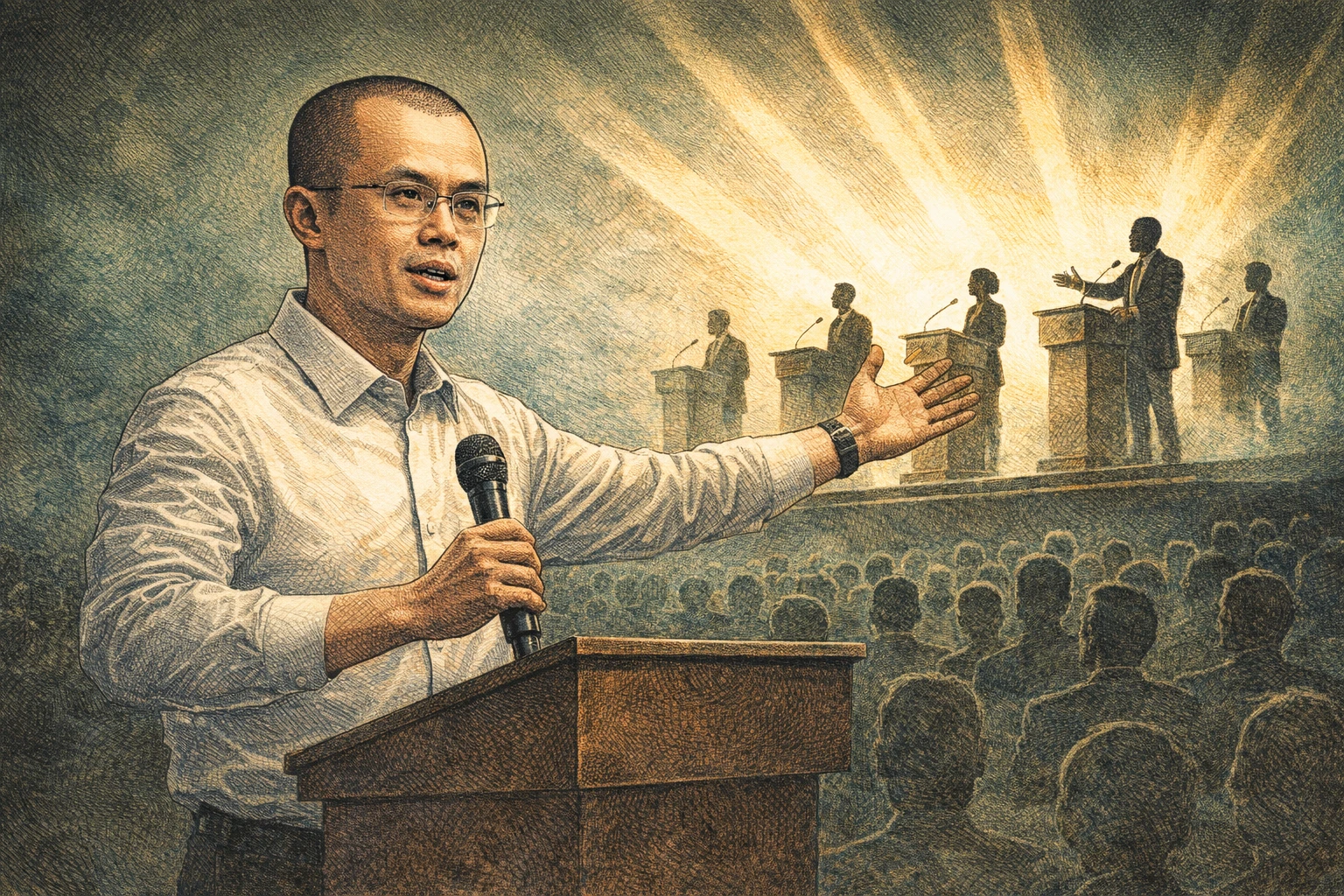
Binance held its Binance Online 2026 event on May 13 Beijing time, drawing more than 50,000 pre-registrations and 300,000 concurrent viewers within the first 10 minutes. The livestream ran for 4 hours and 44 minutes and featured 16 speakers. Across the program, the main themes were clear: user growth, stablecoins, tokenized real-world assets, AI infrastructure, regulation, and institutional adoption.
Binance executives centered the discussion on scale and compliance
He Yi opened the event by putting a number on Binance’s ambition: 3 billion users. She said Binance needed five years to reach its first 100 million users, two years for the next 100 million, and only 18 months for the following 100 million. In her account, the key constraint now is not technology but talent density across compliance, risk control, product, and engineering. She also described AI as Binance’s main “big bet” for the next 18 months, arguing that AI trading tools could narrow the gap between institutions and retail traders.
Co-CEO Richard Teng followed with a compliance-heavy message. He said Binance is licensed in more than 20 jurisdictions and has over 1,600 compliance staff, representing more than 20% of its workforce. Teng framed Binance as moving beyond a crypto exchange into a multi-asset platform that could include precious metals, petrochemical products, and U.S. equities. He also pointed to the 1.4 billion people worldwide without bank accounts, while noting that crypto adoption has risen from 1% to 7%-8%.
CZ said 70% to 80% of his personal portfolio remains in crypto and Web3, with the rest allocated to AI infrastructure such as data centers, power, and custom chips. He added that Binance has already launched an AI trading bot feature using isolated wallets, and said user feedback has been positive. His broader argument was that the future will not be defined by a split between Web3 and traditional finance, but by a combined financial system.
Stablecoins and RWA dominated the broader industry conversation
Ripple CEO Brad Garlinghouse used his session to criticize Coinbase, saying its public withdrawal during the Clarity Act process created a vacuum in lobbying efforts for three to four months. He said prediction markets are pricing the bill at a 70% chance of passage and added that he expects Donald Trump to sign it before the end of summer. Garlinghouse also cited Juniper Research data showing that stablecoin transfer volume reached $10.5 trillion in January alone.
Solana Foundation Chair Lily Liu pushed a much larger frame around tokenized assets. She said RWA could become a $100 trillion to $500 trillion asset class, while on-chain RWA today stands at only about $10 billion to $20 billion. Liu also argued that AI agents will need crypto payment rails because card networks are poorly suited for tiny, real-time machine payments.
Payments were discussed as a product category as well. Thomas Gregory, Binance’s vice president for fiat and payments, said the Binance Card stablecoin campaign offers 15% cashback, zero conversion fees, and zero foreign exchange fees through the end of May 2026. He added that Binance Pay has integrated local QR-code payment systems in some markets, with Brazil and Vietnam already live for in-store stablecoin payments.
BNB Chain metrics, data platforms, and BlackRock’s view added scale
Nina Rong, head of growth at BNB Chain, shared a dense set of network figures: $138 billion in bridged assets, 832 million cumulative unique wallets, and 4 million daily active users. She said 40% of global stablecoin transaction count happens on BNB Chain, with 20 million stablecoin users served each month. On the technical side, she said an upcoming hard fork will cut block times to 450 milliseconds, reduce finality to 650 milliseconds, and raise TPS from 6,000 to 20,000. She also said a fourth chain will be unveiled in the coming weeks.
Research and data providers used the event to show how fast AI interfaces are being folded into crypto analytics. CoinMarketCap research head Alice Liu said CMC launched AI Hub, an MCP server, IDE integration, and XO2 Pay this year, while also upgrading its API in May. DeFi Llama’s Ryan announced that DL Research has been merged into DeFi Llama and renamed DeFi Llama Research, alongside the launch of a Llama AI product that answers market questions directly from backend on-chain databases.
From the institutional side, BlackRock COO Rob Goldstein spoke from the perspective of a firm overseeing $14 trillion in assets under management. He said BlackRock is pursuing both directions: packaging digital assets into ETFs and tokenizing traditional capital market assets, with the BUIDL fund already deployed on BNB Smart Chain. He added that IBIT is the fastest BlackRock product ever to pass $50 billion. Goldstein described institutional demand with a “word cloud” analogy: Bitcoin appears as the largest word in client discussions, but actual active participation remains limited.
Adam Back revisited Bitcoin’s origins and the quantum timeline
Blockstream founder Adam Back offered one of the event’s most direct historical claims. He said that when Satoshi Nakamoto sent out a Bitcoin white paper draft in August 2008, Satoshi did not know about Wei Dai’s B-money. Back said he was the one who mentioned B-money after reading the draft, and Satoshi contacted Wei Dai the next day to confirm the citation. Back argued that Bitcoin should be seen as something discovered rather than simply invented.
On quantum risk, he said current quantum computers are still at a stage far from threatening ECDSA and estimated that it would take at least 10 more years to reach that level. He noted that Blockstream has already deployed a post-quantum signature scheme based on a SPHINCS+ variant on the Liquid sidechain. Back also estimated that around 2.5 million BTC were mined in 2009, with roughly 1 million of those likely belonging to people other than Satoshi, which would put a lower ceiling on Satoshi’s holdings than many assume.