

Gen Z users on Binance are showing a far more conservative investing pattern than the crypto market stereotype would suggest. According to a Binance Research report dated Aug. 12, users in that cohort posted the lowest turnover among working-age groups across three product categories offered through the exchange: direct stocks, tokenized bStocks, and traditional finance perpetual contracts.
The report was based on short-term Binance user data. It also noted that the exchange's direct stock product only reached scaled rollout in June 2026.
How the report defines each generation
The study used the following age brackets:
- Gen Z: 1997–2012
- Millennials (Gen Y): 1981–1996
- Gen X: 1965–1980
- Baby boomers: 1946–1964
Across those groups, Gen Z did not emerge as the most speculative set of users. On the contrary, their behavior on Binance looked closer to long-term allocation than rapid turnover or leverage-heavy positioning.
ETF activity rose sharply in Gen Z stock trading
ETFs were one of the clearest markers of that generational split. In early August, ETFs accounted for 25% of Gen Z direct stock trading volume, up from 14.6% in June. For millennials, the comparable figure was 9.5%, meaning Gen Z devoted more than twice as much of its stock trading mix to funds.
The funding pattern behind those trades stood out even more. In June, unleveraged ETFs represented 18.5% of Gen Z net inflows into stocks. That share rose to 21.9% in July. Over the same stretch, the share of inflows going to individual stocks fell from 77% to 74.2%.
Gen Z reduced overall stock investment in July, with net investment down 17.4%. Even so, inflows into unleveraged ETFs were almost unchanged, slipping just 2%. Inflows into individual stocks fell 20.4%, while leveraged products dropped 28.5%.
Binance data showed Gen Z was also the only cohort to record growth in the number of ETF holders in July, rising 2.9%. Millennial ETF holders fell 4.5%, and Gen X holders declined 5.9%.
That suggests ETFs were not just a side allocation made between speculative trades. When Gen Z cut back on stock exposure overall, ETFs remained the part of the market where they kept putting money to work.
Large allocations favored dividend and semiconductor names over meme-style stock chasing
The report said Gen Z stock holdings did not resemble lottery-ticket speculation. Among Gen Z accounts that had only bought and never sold, the highest average single-position allocation in direct stocks went to the Schwab U.S. Dividend Equity ETF (SCHD), at $16,567 per position. Broadcom ranked next at $12,370.
Holdings were tilted toward semiconductors and AI. But some of the most popular retail trading names drew much smaller average ticket sizes in bStocks. Tesla averaged $633 per purchase, while Nvidia averaged $514.
In other words, Gen Z still showed interest in technology and artificial intelligence themes, but larger sums were not flowing into the most crowd-followed names.
Buy-heavy behavior was common across Gen Z accounts
Position data reinforced that pattern. About 22% of Gen Z direct stock accounts had never placed a sell order, compared with 19% for Gen X and 9% for baby boomers. Millennials led on the strict "never sold" measure, at 30%.
When the definition was widened from "never sold" to "bought more than sold," Gen Z moved into first place.
Roughly 76% of Gen Z bStocks accounts were net accumulators, the highest share among all generations and 9 percentage points above millennials. In direct stocks, 77% of Gen Z accounts kept adding to positions. The comparable figures were 74% for Gen X and 68% for baby boomers.
That means Gen Z was not simply trading less. In the parts of Binance that are more aligned with asset ownership than short-term derivatives activity, they were mostly still accumulating.
Perpetual contract use was lighter than among older cohorts
The contrast became more striking in traditional finance perpetual contracts. A generation that grew up alongside crypto might be expected to use those products heavily. The report found they did use them, but less aggressively than older users.
Gen Z accounts averaged 13 traditional finance perpetual trades per month. Millennials averaged 17, Gen X averaged 16.5, and baby boomers averaged 19.
Only 14% of Gen Z perpetual accounts qualified as high-frequency traders. That was below the 18% recorded for both millennials and Gen X, and also below the 16% seen among baby boomers.
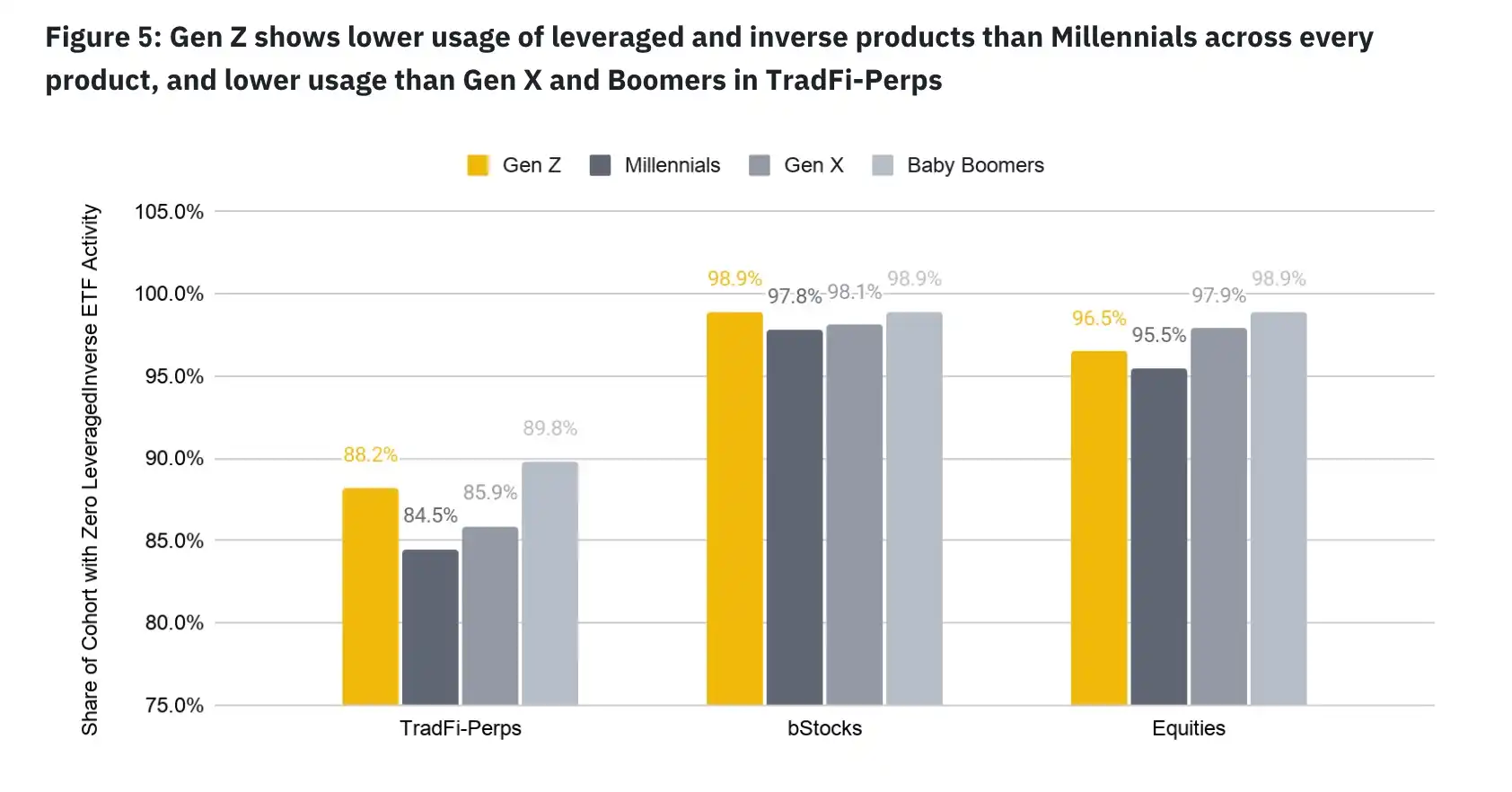
Leverage and inverse ETF usage followed the same pattern. Some 88.2% of Gen Z traditional finance perpetual accounts did not trade leveraged or inverse ETFs. The figures were 84.5% for millennials and 85.9% for Gen X. In bStocks, 98.9% of Gen Z accounts avoided those products, a higher share than other working-age groups.
Baby boomers still ranked first in avoiding leverage and inverse exposure overall. In direct stocks, 98.9% of baby boomer users stayed away from those products, compared with 96.5% for Gen Z.
The report's takeaway was that Gen Z has not turned into baby boomers outright, but among people who are not yet retired, their investing behavior looked surprisingly close.
Trading tools and long-term capital were kept separate
The more important distinction was not just whether Gen Z traded these products, but where they actually left money.
In July, leveraged and inverse ETFs accounted for 9.25% of Gen Z direct stock turnover, but only 3.93% of net capital inflows. By early August, their share of net inflows had fallen again to 2.65%.
That points to leveraged tools being used as they are designed to be used: for short-term positioning, not as a place to park long-term principal.
Traditional finance perpetuals showed a similar split. Around 60% of Gen Z accounts were net buyers, the highest share across age groups, but net fund flow was less than 1% of total trading volume. Traders were opening and closing positions repeatedly, without leaving much long-duration capital there.
Stocks looked very different. Gen Z direct stocks posted a net flow ratio of 26.5%, with average net inflows of $1,898 per account.
That gap helps explain why looking only at whether younger users trade perpetuals misses the broader picture. They do use them, but they keep long-term money elsewhere.
Emerging-market access may explain part of the pattern
Binance's earlier research on younger investors offered context for the data. Gen Z accounted for about 44% of Binance direct stock and bStocks users, and 45% of traditional finance perpetual users. It was the largest user group in direct stocks and bStocks, while its size in traditional finance perpetuals was roughly in line with millennials.
Across all generations, more than 90% of users of these traditional finance products came from emerging markets, according to the report. In those markets, buying U.S. stocks through local traditional brokers can be difficult.
For some of those users, a crypto exchange is effectively the easiest brokerage gateway available. They already know the interface, already have funds in the account, can buy fractional shares, and can trade outside regular U.S. market hours.
Binance data showed that 13% of all direct stock users were Gen Z clients from emerging markets with less than $2,000 in stock assets.
Seen in that light, the behavior becomes easier to read. The exchange does not have to turn every young user into a perpetuals trader. It can also serve as a channel for buying standard investment products.
Crypto's playful product culture did not dictate where younger users put money
The article also contrasted the findings with the style of earlier crypto cycles. Pickle Finance launched Jar and Farm products that let users stack yields from other protocols by depositing tokens for rewards. ShibaSwap used "Bury" to describe token staking, alongside token names such as SHIB, LEASH, and BONE.
Over roughly a decade, products like those helped create a broad assumption: younger users raised in the Dogecoin era would be more comfortable with chaotic, high-risk financial structures.
Binance's data pointed the other way. Younger users were directing a growing share of stock capital into unleveraged ETFs, trading less often than millennials and Gen X, and keeping leverage-linked allocations to a small slice of net investment.
That does not mean they have abandoned crypto. The article cited a 2023 survey by the FINRA Investor Education Foundation and CFA Institute showing that 55% of U.S. Gen Z investors hold crypto. It also noted that CryptoSlate had previously reported broad interest in digital assets among younger Americans.
The broader implication was narrower and more specific: using crypto and pursuing the highest-risk possible investment strategy are not the same thing.
A familiar app interface, but not the same old speculative playbook
For users whose first contact with financial markets comes through an exchange app, Binance may not function as a rebellious alternative to a traditional broker. It may simply be the financial interface they already know. Once stocks and ETFs are available on that platform, their investment preferences do not have to mirror the speculative style associated with early crypto cycles.
That is where Gen Z differs from both millennials and baby boomers. They are not building a classic retirement portfolio. Semiconductor names, AI stocks, tokenized equities, and 24-hour markets are not a replay of 1990s wealth management. But the way they use those products carries a much older logic: buy, hold more than sell, and avoid making every position depend on leverage.
After years in which crypto repeatedly wrapped finance in novelty to attract younger users, the youngest cohort appears to have accepted the interface while passing on much of the high-risk design that came with it. The market, the article argued, still has room for a simpler approach: buy assets, hold them, and wait for value to build over time.