
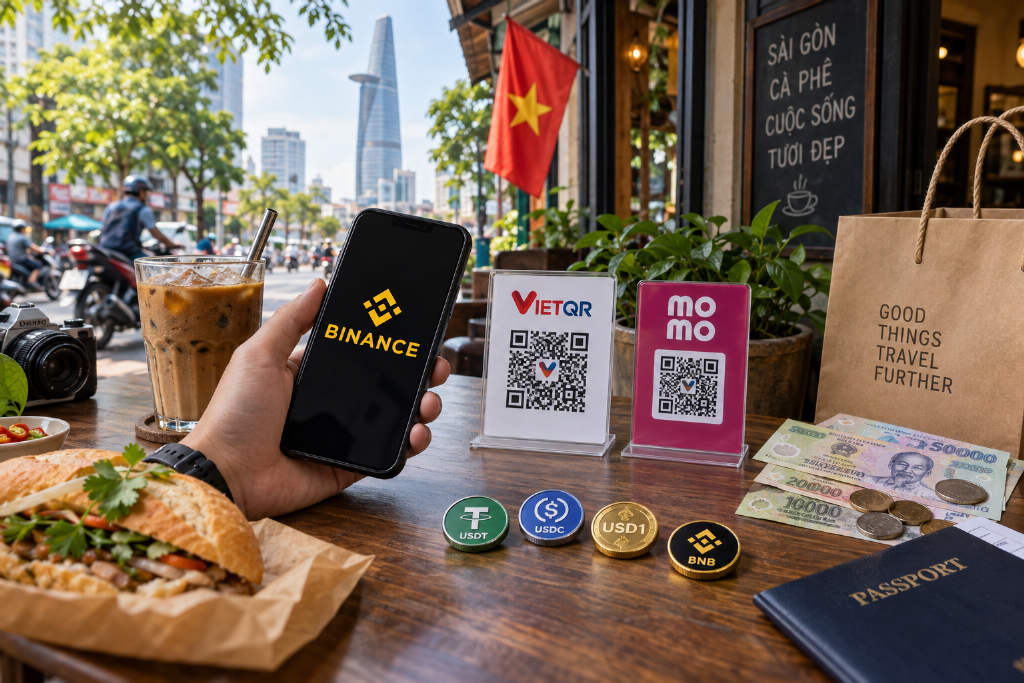
According to a reposted X post by @Sea_Bitcoin cited by WuBlockchain, Binance Pay is being used in Vietnam to extend stablecoin payments into offline merchant settings through local QR payment infrastructure. After spending several days in Ho Chi Minh City, the author wrote that many merchants there could accept Binance QR payments across dining, coffee, shopping and massage scenarios, allowing a cashless experience without currency exchange.
Tourist flow: pay in stablecoins, merchant receives VND
The article describes a simple payment flow for foreign visitors: open the Binance app, scan the merchant’s QR code, enter the purchase amount such as 138,000 VND, choose the asset to pay with, and complete the transaction. The author said users can prioritize stablecoins including USDT, USDC and USD1, while also being able to select tokens such as BTC, BNB and Pepe. Settlement is handled at the live exchange rate, and the post says no trading fee is charged during payment.
On the merchant side, the article says funds are received in local fiat currency, the Vietnamese dong. Merchants do not need to understand blockchain, stablecoins or OTC processes. The post says Binance and its partners handle the intermediate steps, including exchange-rate calculation, deduction of the user’s crypto balance, fiat conversion, connection to Vietnam’s payment network and delivery of the payment instruction.
VietQR and Momo as the local rails
The author said Binance Pay connected to two major payment channels in Vietnam: VietQR and Momo.
VietQR is described as Vietnam’s unified QR payment standard, operated by NAPAS, or the National Payment Corporation of Vietnam. The article compares its role to China UnionPay and says nearly all major Vietnamese banks have joined the VietQR network for interbank clearing and settlement.
Momo, meanwhile, is operated by M_Service JSC. The post describes it as one of Vietnam’s largest e-wallets, headquartered in Ho Chi Minh City and licensed by Vietnam’s central bank for e-wallet and payment intermediary services. Beyond merchant collection, Momo also offers coupons, membership programs and advertising tools, and the article says it has more than 30 million users.
After years of development, the piece says VietQR and Momo together cover more than 90% of offline merchants in Vietnam. By linking into those two channels, Binance Pay gained compatibility with a large number of merchant QR codes.
A practical route instead of merchant-by-merchant onboarding
The article reduces the model to a simple structure: the user spends stablecoins through Binance, and the merchant receives local currency. In the author’s view, that is what makes the approach effective. Binance does not need to negotiate with merchants one by one or teach them how to accept stablecoins, and the learning cost for both users and merchants is close to zero.
The post also says a number of startups have explored the PayFi segment over the past two years, but the hardest part remains access to real online and offline merchants. The author argues that the growth paths of Alipay and WeChat Pay were tied to specific historical conditions, making them difficult to replicate, while Binance Pay’s approach in Vietnam looks more grounded in existing payment infrastructure.
Why Vietnam may benefit
The article points first to tourism. Visitors do not need to withdraw cash from banks or ATMs, exchange currencies or carry banknotes. For merchants, the author says, the model adds no extra cost while opening access to Binance’s base of more than 300 million users.
The post also suggests a second layer of value: by allowing this setup, VietQR and Momo effectively add stablecoins as another asset type within Vietnam’s payment network. In the future, the author says, more assets could be connected as well, broadening the network’s reach.
To illustrate the idea, the article uses a China-based analogy: a U.S. visitor dining in China could scan a code and pay in dollars, while the restaurant receives renminbi, with the payment platform and banks handling the conversion steps in between.
Another use case: QR transfer to a local bank card
Beyond merchant spending, the author described another offline scenario discovered with @Lsssss1106. According to the post, that person had opened a local bank card in Vietnam, and the related banking app supported QR-code collection. The author then used the Binance app to scan the code and transfer 10,000 Vietnamese dong to the card, saying the funds arrived instantly.
The article characterizes that experience as a direct cash-out from Binance to a bank card.
Could the model spread to other countries?
While testing Binance Pay in offline settings in Vietnam, the author said the experience also brought to mind meetings between Binance co-founder CZ and officials including national leaders and central bank governors, where blockchain and stablecoins are discussed. The article adds that Binance Pay has a similar arrangement in the Philippines through QRPH and InstaPay.
From there, the post asks whether a model proven in Vietnam and the Philippines could be replicated in Japan, South Korea, Southeast Asia, South America, Africa, the Middle East and Central Asia.
The article also references a comment by @heyibinance earlier this year that Binance aims to grow from 300 million users to 3 billion. In that context, the author argues that a stablecoin payment network could become one path beyond trading.
Binance Pay settings and limits in Vietnam
The post closes with several product details. Users can enter advanced settings from the plus sign in the upper-right corner of the payment page and customize payment priority. The author said USD1 had recently been moved to the top because it was being held in the account, and BTC could also be added as a payment asset for users whose balances are primarily denominated in bitcoin.
If a refund occurs, the article says it will be returned entirely in USDT.
The post also says users can enable password-free payments. For transactions up to 100 USD, no identity verification is required, which the author says makes the experience smoother.
For QR payments made within Vietnam, the limits listed in the article are $50k per month, $5k per day, a maximum of $5k per transaction and a minimum of $0.39.
Closing view from the original post
The author ends by saying that more than 17 years after Bitcoin was introduced, the idea of a peer-to-peer electronic cash system has not become the dominant real-world payment model, while stablecoins have emerged as a key bridge between crypto and everyday commerce. In the author’s view, stablecoin payments are already common inside crypto, and Binance Pay’s rollout in Vietnam offers a practical model for pushing that usage into broader society.