

Bitcoin fell to $67,500 on Friday, returning to its 200-week simple moving average for the first time in nearly three months. The cryptocurrency reached $67,993 at the average, marking its first interaction with the trend line in 11 weeks.
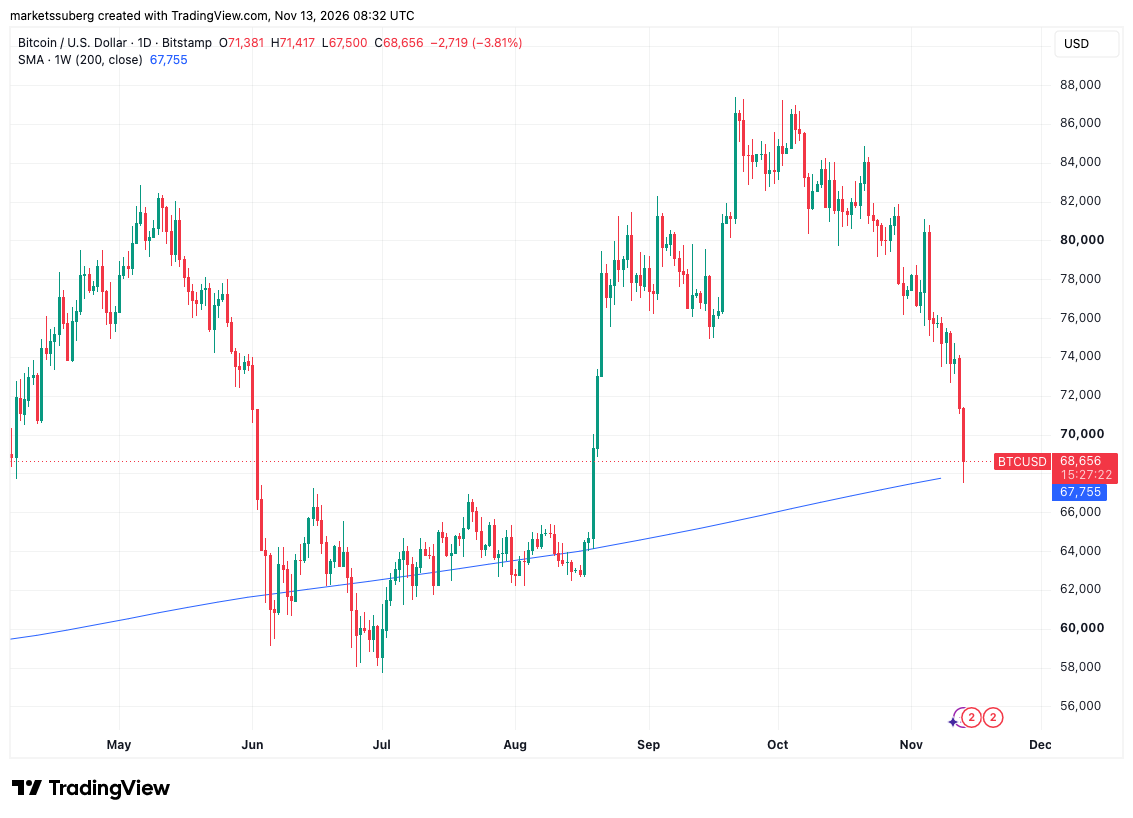
TradingView data showed that Bitcoin last touched the 200-week SMA on Aug. 19. The latest move put price back at a level that has been used as a reference for Bitcoin cycle lows. During bear markets, the average has acted as both support and resistance.
Weekly RSI support comes into focus
Bitcoin traded around the 200-week SMA from March to October 2023, then returned to the area from June through mid-August this year. On the weekly chart, decisive moves back above the average have preceded sharper rallies.
Keith Alan, co-founder of crypto trading platform Material Indicators, said the 200-week SMA now has confluence with a resistance-to-support flip level on Bitcoin’s relative strength index, or RSI.
Weekly RSI has returned to 41.5, a level it established as support in late July after spending several weeks attempting a breakout. Alan wrote on X on Friday: 「Losing 41.5 on Weekly RSI opens the door to test the cycle low at $57.7k.」 He also pointed to the bullish implications of successfully defending the support zone.
Cointelegraph’s charts from TradingView showed Bitcoin’s daily price action against the 200-week SMA, along with the weekly 200-week average and RSI data.
Asian stocks weaken after Nvidia leadership change
Bitcoin’s decline accelerated on Friday as Asian markets reacted to Jensen Huang’s resignation as Nvidia CEO and the continuing controversy around the move. Hong Kong’s Hang Seng finished the session down 1.55%, while South Korea’s KOSPI Composite Index ended 0.98% lower.
U.S. stock futures also slipped slightly, with Nasdaq-100 futures down 0.2%. Analysis focused on a possible redistribution of capital toward Nvidia’s competitors, preserving the artificial-intelligence trade.
「What you’re seeing in markets now is a bit of a rotation into other advanced chip design companies, on the assumption that this will enable other companies effectively to catch up,」 Mark Franklin, head of multi-asset solutions for Asia at Manulife Investment Management, told CNBC.
Nvidia shares were 0.7% higher in premarket trading. Reports pointed to growing support for Huang’s return, while an internal post quoted by Wired drew more than 1,600 comments from employees.
Related information said that Huang resigned as Nvidia CEO and exited the board, while the company’s shares plunged.



