

Bitcoin extended its rebound over the past week, climbing from around $63,000 in mid-August to the $80,000 area, with an intraday high near $81,000 before easing back into a $78,500 to $79,500 range. The move marked Bitcoin’s first return above $80,000 since May. Weekly gains were close to 25%, making it one of the stronger one-week performances seen in recent years.
The article says the main force behind the rally has been spot demand. U.S. spot Bitcoin ETFs posted roughly $1.9 billion to $2.0 billion in net inflows over the past week, one of the strongest weekly readings since October 2025. BlackRock’s IBIT contributed much of that total, with single-day inflows topping $200 million several times. Spot Ethereum ETFs also recorded clear inflows, adding to the case that institutional buying through ETF channels has been providing direct support for prices.
Broader participation has improved, but Bitcoin still holds control
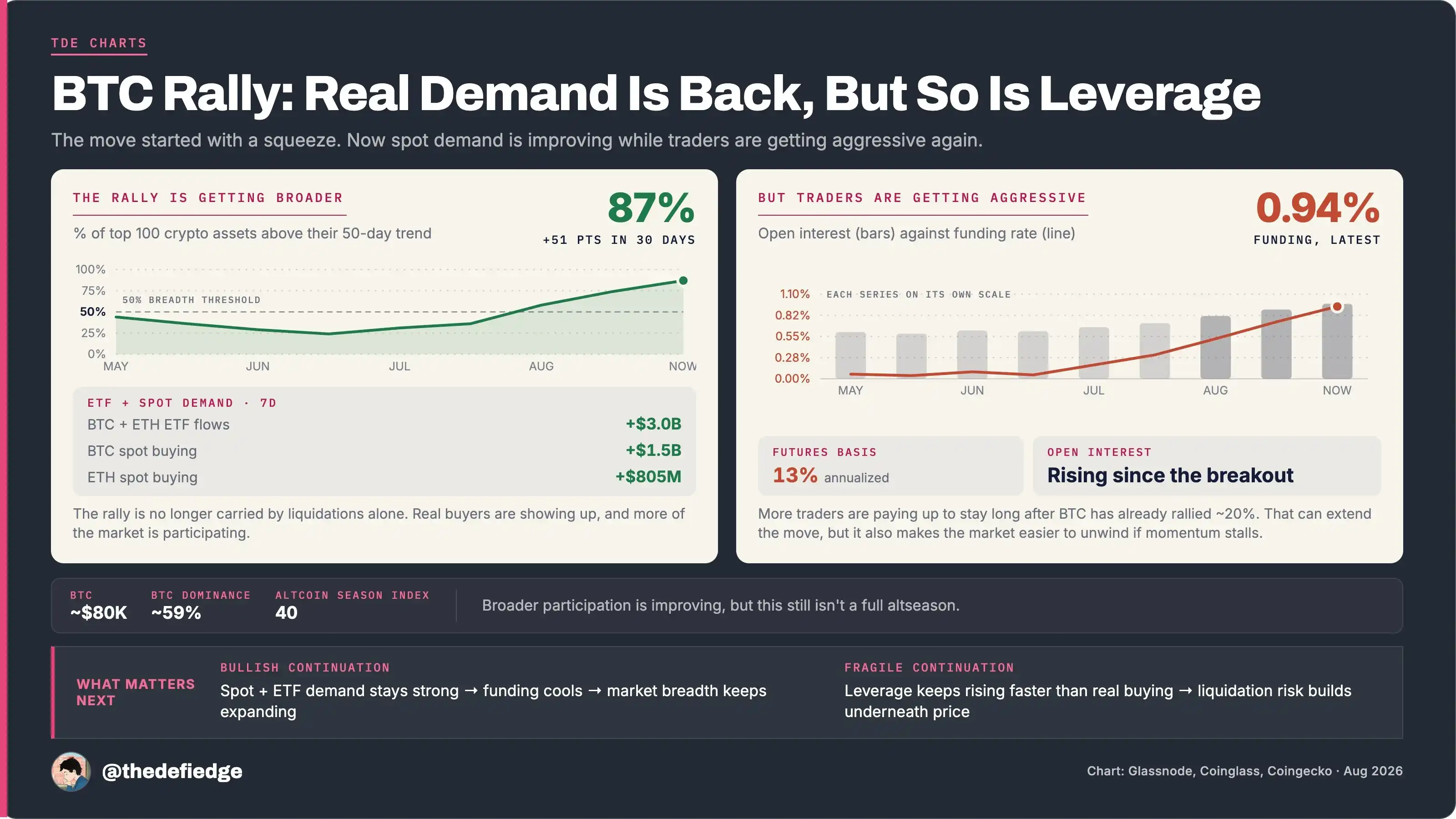
From a market breadth perspective, the structure has improved. Among the top 100 tokens, the share trading back above their 50-day moving averages rose from about 36% a month ago to more than 80%. Total2, which tracks the total market capitalization of altcoins, increased by about $215 billion between Aug. 19 and Aug. 22 and climbed back above the $1 trillion mark. Some tokens also recovered their 200-day moving averages during the same stretch.
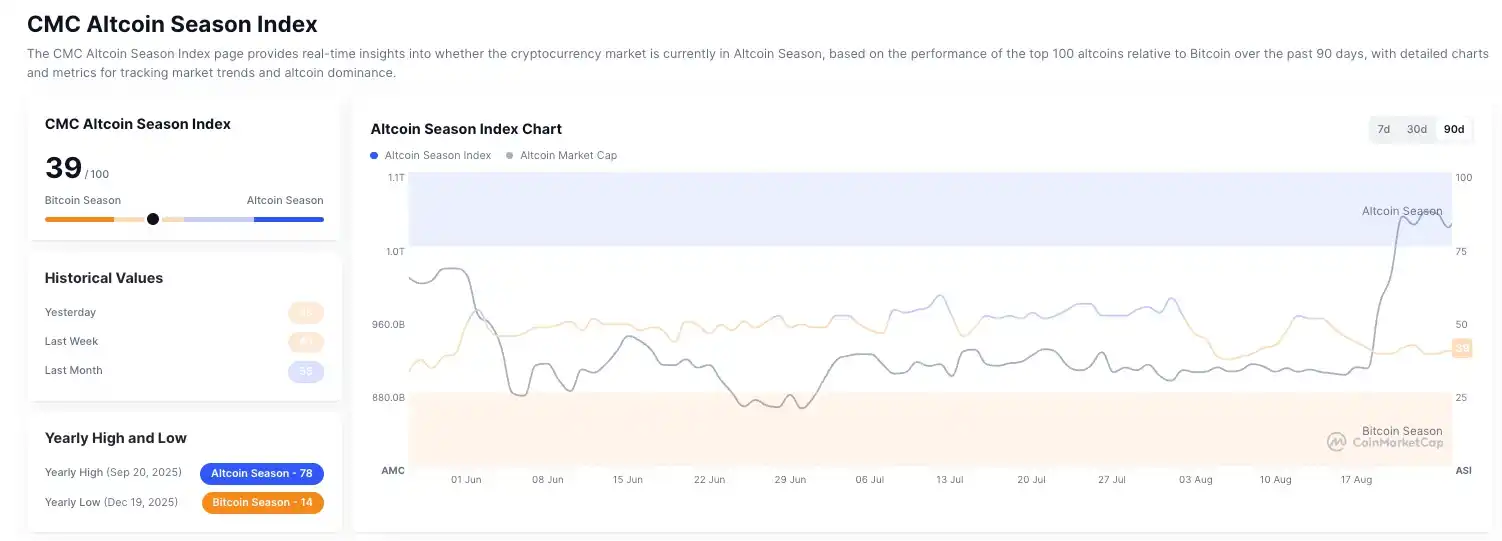
Even so, the key rotation signals have not confirmed an altcoin season. Bitcoin dominance has stayed around 59% to 60%, and some data sources briefly showed levels close to 61%. The Altcoin Season Index sits between 38 and 49, still well below the commonly cited threshold of 75. In practical terms, that means most altcoins have not outperformed Bitcoin over the past 90 days.
The current setup, as described in the piece, looks more like a Bitcoin-led rebound with altcoins following behind, rather than a full rotation of capital from Bitcoin into smaller-cap assets. The ETH/BTC ratio has improved, but capital remains concentrated in large-cap tokens.
Leverage and sentiment are recovering faster than the foundation beneath them
In derivatives, the market has swung from fear to greed in a short span. Funding rates have turned positive, and on some exchanges annualized BTC perpetual funding has been running at around 10%, meaning long traders are paying to keep positions open. Open interest has fluctuated after a round of short covering, while sentiment gauges have moved quickly into greed territory.
The article flags this combination of price rising first and leverage catching up afterward as a point to watch. Based on the historical pattern cited in the piece, when ETF and institutional spot demand are doing most of the buying and leveraged traders begin adding exposure aggressively, any negative shock from the macro side or from liquidity conditions can trigger chain liquidations.
There is also no clear evidence yet of a large-scale return of retail money. Group chats and social media activity have picked up, but the article says they remain well below the levels seen at the peak of the last bull market.
Altcoin season is not confirmed yet
The article’s overall conclusion is that the rebound is still being driven mainly by institutional spot buying and short covering, not by a broad return of retail-led risk appetite. The classic signs of a confirmed altcoin season — falling Bitcoin dominance, an Altcoin Season Index holding above 75, and sustained outperformance by mid- and small-cap assets — have not appeared.
Against that backdrop, the article points to several areas of focus:
- Keep primary attention on highly liquid large-cap assets such as Bitcoin and Ether, which are the direct beneficiaries of ETF inflows.
- Stay selective with altcoins, especially those with clearer fundamentals and the ability to hold key moving averages during pullbacks, rather than chasing the strongest short-term gainers.
- Control leverage carefully. Current funding and positioning suggest long-side crowding is building, which can make highly leveraged positions vulnerable during a fast pullback.
- Use the first meaningful correction as an important test. If breadth remains strong during a decline and Bitcoin dominance starts to fall, the market would be closer to a real rotation phase.
The piece ends on a restrained note: the market has recovered from a deeply oversold state, and institutional buying is real, but calling the start of altcoin season now is premature. Prices can rise quickly. Capital rotation usually takes longer.
Until retail participation returns on a much larger scale, the article argues that patient positioning in large-cap assets and leaving room for volatility remain the approach that best fits the current stage of the market.