
Bitcoin is dealing with a growing list of negatives, but the market still is not behaving as if it is under stress.
In its Aug. 4 Daybook excerpt, CoinDesk said the crypto market is contending with a multimillion-dollar Coldcard hack, anemic institutional demand, and uncertainty around regulation and the macro environment. Even with that backdrop, there are no clear signs of panic in bitcoin, at least not in the behavior of its 30-day implied volatility index, BVIV.
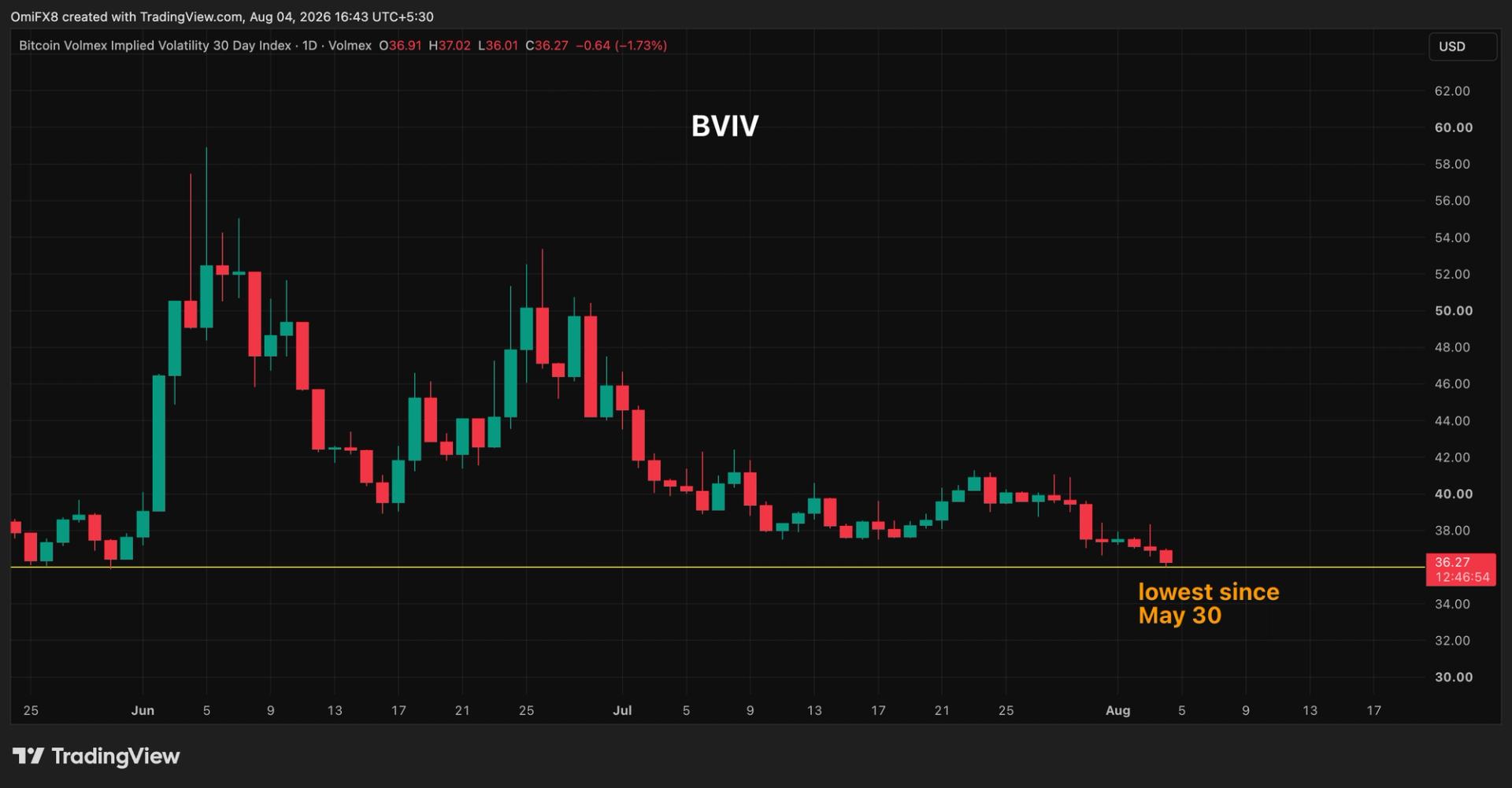
BVIV, which reflects options demand and hedging activity when traders brace for uncertainty and large swings, has dropped to 36%. That is its lowest level since May 31 and down from levels near 60% in early June.
Bad news has not triggered a volatility spike
CoinDesk said a market that does not panic on negative headlines is often seen as constructive, with the potential for a notable upside move.
Still, the report added that volatility tends to mean-revert. It usually rises after falling below historical norms and declines after becoming overstretched. BVIV is now hovering around levels that have previously served as a floor, opening the door to a renewed jump in volatility.
That leaves traders with a gauge worth watching closely. If BVIV starts rising sharply, the move could come with a large directional swing in bitcoin, either bullish or bearish.
Several indicators still support the bearish case
For now, some of the underlying data still favor caution. Institutional demand remains weak. U.S.-listed spot bitcoin ETFs recorded $61.53 million in outflows last week, snapping a three-week streak of modest inflows.
Stablecoin data also softened. USDT, the largest dollar-pegged stablecoin by market value, fell to its lowest market capitalization since October, while USDC stayed in a downtrend. The chart cited in the report showed USDT declining to $183 billion from nearly $190 billion in April. USDC fell to $72 billion from $79.5 billion in March.
CoinDesk described the drop in USDT and USDC market caps, in the context of a broader crypto bear market, as a classic confirmation of weak demand-side pressure. In practical terms, that means less capital is available to buy crypto, liquidity is tighter, and investor risk appetite remains subdued.
Macro conditions add to the pressure. Inflation-adjusted returns on longer-duration U.S. Treasury notes have climbed to their highest level since 2008, reducing the appeal of emerging technology bets and other risk assets. The report also said the passage of the U.S. Clarity Act remains uncertain.
Bitfinex points to buyer absorption near current levels
Even so, the report highlighted one data point that may suggest limited downside. It centers on how much BTC has been acquired around the current price area.
Bitfinex analysts said, “Approximately 155,000 BTC moved into the $62,000-$65,000 cost-basis range, indicating that selling was absorbed by buyers near current prices. This concentration now represents 0.7 percent of circulating supply and could keep BTC range-bound until a stronger catalyst emerges.”
That leaves a notable concentration of holders with cost bases between $62,000 and $65,000, a zone that may help contain price moves unless a stronger catalyst arrives.
Other items highlighted in CoinDesk’s daily roundup
CoinDesk also listed several market stories in its “What’s trending” section.
- Reuters reported that European stocks rose along with U.S. futures despite tensions involving Iran. Oil prices also rebounded, which the report said reflected skepticism that the U.S.-Iran war would be resolved quickly. The yen eased slightly.
- CoinDesk separately reported that crypto asset manager Hashdex is preparing to close and liquidate its $14.7 million spot bitcoin exchange-traded fund, in what may be the first liquidation of a U.S. spot bitcoin ETF product, as inflows fade and investors chase returns tied to AI.
- Another CoinDesk story said a Solana governance proposal aims to raise daily SOL burns from $47,000 to $650,000. Validators had begun signaling support for the measure, which would change how much SOL enters and exits circulation and could tighten supply in the market.
Additional headlines listed in the article
The original piece also included a ranked list of other CoinDesk headlines:
- South African lawmakers propose draft rules on cross-border crypto transactions.
- Bitcoin rises toward $64,000 as the Coldcard exploit and Strategy sales recede, while ADA advances.
- BlackRock debuts tokenized access in Europe to $311 billion of money market funds.
- The first U.S. spot bitcoin ETF is set to close as inflows dwindle and investors chase AI returns.
- Live updates put bitcoin at $63,600 as rare U.S.-Japan yen action tests carry-trade fears.
- Bhutan’s GMC puts part of its bitcoin treasury to work after a 10,000 BTC pledge.
- Jim Cramer’s quantum panic fails to shake bitcoin as the price holds around $64,000.
- XRP holders can now borrow RLUSD on Ethereum through a $280 million lending pool.
- A new Solana proposal aims to ramp up daily SOL burns from $47,000 to $650,000.
- Bitcoin nears $64,000 as traders look past Strategy’s BTC sales and Coldcard sweeps.
Binance case study teaser
The article closed with a brief teaser for a separate case study on the evolution of the centralized exchange market. CoinDesk said Binance remains the leading exchange in crypto, expanding beyond spot and derivatives into RWAs, payments, savings, yield products, and broader financial services.