
Bitcoin holders who need cash do not always have to sell their BTC. They can borrow against it instead, keeping their exposure to Bitcoin’s price while using the asset’s value as collateral.
The problem is that many lending services are built on other blockchain networks. A large share of blockchain lending apps run on Ethereum, which records ownership of assets on its own chain. A user’s Bitcoin, however, sits on the Bitcoin mainnet, so an Ethereum-based application cannot directly use that BTC as collateral.
One common workaround is to hand the Bitcoin to a custodian and receive an on-chain token that lending apps can recognize. The original BTC stays with the custodian, while a newly issued token on another chain represents that Bitcoin position.
This setup does allow users to borrow without selling their Bitcoin, but it also changes what they depend on. The borrower now has to rely on the custodian to safeguard the BTC, follow the redemption rules, keep the token properly pegged, and on the lending protocol itself to keep operating as intended.
Wrapped Bitcoin works like a transferable warehouse receipt
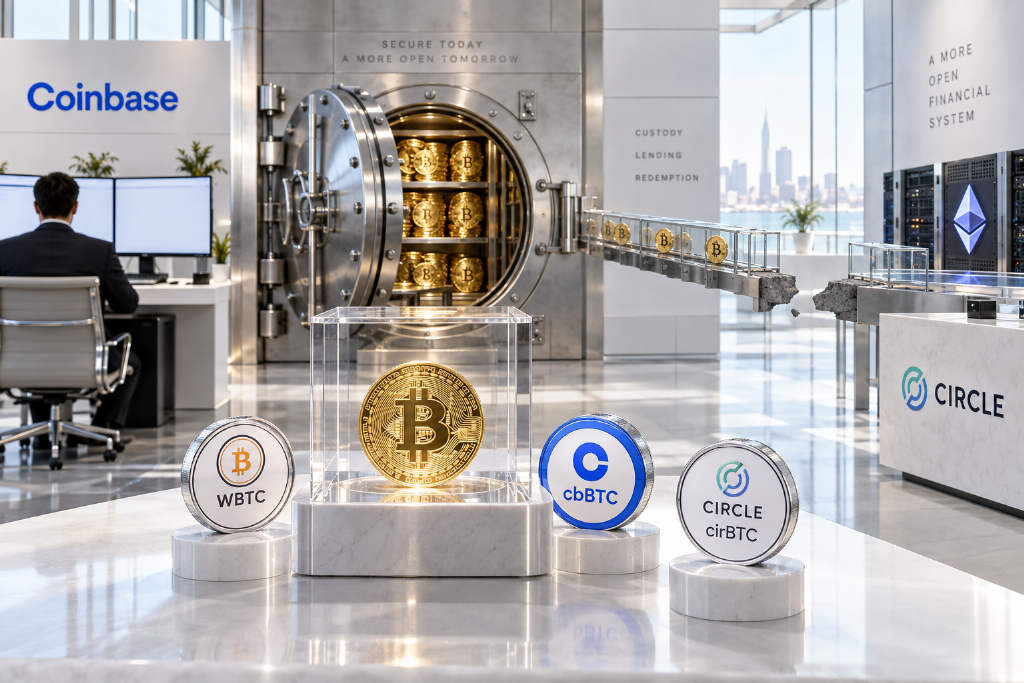
Coinbase, Circle, and WBTC all offer products built around that model. On Sept. 4, Circle released product documentation for cirBTC, joining a market where cbBTC and the older WBTC were already established. The underlying design is the same across all three: Bitcoin is placed in custody, and a transferable wrapped token is issued against it.
The real competition is not simply over whether each token is backed by Bitcoin. It comes down to two practical questions: how usable the token is once issued, and how reliable the full process is when a user wants native BTC back.
Custodial wrapped Bitcoin can be compared to a warehouse receipt that can change hands. The goods stay in storage, but the receipt circulates. The custodian holds the underlying Bitcoin, the token moves between users, and the product terms define who is allowed to redeem that token for actual BTC.
The deposit flow works like this: once a Bitcoin deposit is confirmed, an equivalent amount of tokens is minted on another chain. Redemption runs in reverse. The circulating token is burned, and the service provider releases native Bitcoin according to its process. BitGo has described WBTC’s deposit and redemption mechanism before: approved merchant partners interface with the custodian to complete conversions and charge fees.
Retail users can also buy wrapped tokens that are already in circulation on the secondary market. In that case, only ownership of the token changes. No new Bitcoin needs to enter the custody pool. The same underlying BTC and its matching token supply remain in place, and the wrapping process does not create a new coin on the Bitcoin network itself.
Wrapped tokens still move with Bitcoin
In theory, each wrapped token equals 1 BTC. That means the token does not shield holders from a drop in Bitcoin’s price. Even if the tradable asset in your wallet is now a token on another chain, gains and losses still track BTC.
Redemption is what keeps the token’s market price close to Bitcoin. If the wrapped token trades below the value of the underlying asset, eligible traders can buy the token, redeem it for native BTC, and capture the spread after costs. That buying pressure can narrow the discount.
There are limits to that mechanism. Redemption restrictions and processing delays can weaken arbitrage. Knowing that the underlying Bitcoin exists is not the same as being able to redeem it smoothly.
Borrowing against wrapped BTC introduces liquidation risk
Once the token is deposited into a lending app, borrowing can begin. Smart contracts are programs on a blockchain that execute rules automatically. They can accept wrapped Bitcoin as collateral and allow users to borrow dollar-pegged stablecoins. The borrower takes on debt, but still keeps exposure to Bitcoin’s price.
Borrowers must post collateral worth more than the loan because Bitcoin can fall before the debt is repaid. If the price drops far enough and the safety buffer disappears, the app can liquidate the collateral to cover the debt.
That is the outcome many users wanted to avoid in the first place: they did not sell their Bitcoin voluntarily, but they still lost part of their BTC position.
During liquidation, other market participants can repay part of the debt in exchange for the collateral, and platforms typically offer incentives to attract liquidators.
The wrapped token itself does not generate interest. If holders want yield, they need to do something extra, such as lending the token out again. Any return comes from those added steps, and so do additional risks beyond simply holding the token.
The same Bitcoin can have very different redemption paths
Even if a token is fully backed by Bitcoin, it is useless to a borrower if lending protocols do not accept it. Some tokens may have broad ecosystem support, while ordinary users still face obstacles when trying to redeem them for native BTC. Service providers may point to the same type of underlying asset, but the user experience can differ sharply.
WBTC uses a merchant network to handle minting and redemption, connecting exchanges and institutions. Most retail users buy WBTC on exchanges. Lending protocols that already support WBTC provide collateralized borrowing use cases, while merchants handle the Bitcoin inside the custody pool. A mature token gets much of its value from that partner network, and new entrants are unlikely to recreate those conditions quickly.
Coinbase has folded conversion into exchange accounts. Eligible users withdrawing Bitcoin from their accounts can choose a supported network and receive cbBTC on-chain directly. When users send cbBTC back through Coinbase’s designated deposit route, their accounts are credited with native Bitcoin. cbBTC’s conversion rules come with regional limits, but for eligible users the process is close to a standard transfer.
Circle’s cirBTC is aimed mainly at institutional clients, including trading firms and lending protocols, and is tied closely to Circle’s existing business and USDC. Circle says the underlying Bitcoin is ring-fenced from the company’s own assets, reserve addresses are published, and Chainlink oracles are integrated so on-chain software can read reserve-related data.
For borrowers, competition between these products decides something very concrete: which platforms will accept their Bitcoin-linked token as collateral, and how easy it is to turn that token back into BTC.
Reserve backing is not enough without liquidity
The business logic is straightforward. First, make the wrapped token easy for existing customers to use. Then convince outside DeFi applications to accept it. The second part takes more than a recognizable brand name or public proof of reserves.
Lending protocols need to evaluate how much can be lent against each collateral asset. They also need to be confident that collateral can be sold without trouble when a borrower is liquidated. Liquidity matters because the asset must be disposed of quickly without crushing the market price. A token can have ample reserves behind it and still be of limited practical use if there are too few buyers on the target chain.
That helps explain why older wrapped tokens with more active trading are more likely to be chosen as collateral. More lending use cases attract more holders and traders in return. New tokens face a difficult loop: they need to persuade lending protocols to accept an asset with a smaller user base while also persuading users to hold a token that relatively few protocols support.
WBTC directly allows merchant partners to earn conversion fees. More broadly, a useful wrapped token can bring traffic to a service provider, though the actual revenue depends on the business model. Unlike some dollar stablecoins backed by Treasury assets, the Bitcoin sitting in custody does not earn yield on its own. The commercial value comes from the user activity that follows once the token is in circulation.
Holding the token is not the same as holding native BTC
For ordinary users, checking the Bitcoin reserves is only a first step. Coinbase provides a cbBTC reserve dashboard so users can compare the circulating token supply with disclosed custody holdings of Bitcoin.
But public reserves do not answer a harder question: what happens to those assets if the service provider fails or goes bankrupt, and whether every token holder can redeem promptly. The product terms define who has redemption rights, and the redemption service itself must have the capacity to pay out. Knowing the Bitcoin is there does not mean you can actually get your coins back.
This is easy to miss when the token sits in a personal wallet. You control the private key that moves the token, but the private key for the underlying native Bitcoin is held by the custodian. Even when the token is in your own wallet, custody of the underlying asset still rests with a third party.
Users who place the token into a lending protocol take on another layer of dependence. The protocol software needs to execute its logic correctly and use reliable price data to assess the collateral’s value. Even if the issuer’s Bitcoin reserves are intact down to the last satoshi, a software flaw can still leave users with losses.
For holders who want cash but do not want to sell Bitcoin, wrapped tokens are a trade-off. They make it possible to connect Bitcoin to DeFi applications that would not otherwise support BTC. The cost is fees, plus reliance on multiple third parties and smart contracts. Whether that trade is worth it depends on the value of the application and on the risks and obligations the user is willing to accept.
That also helps explain why several companies are competing to wrap the same underlying Bitcoin. A wrapped token stands or falls on whether it opens the door to borrowing or other financial services.
The process may start with Bitcoin. In the end, the key question is simpler: can the holder get that Bitcoin back?