


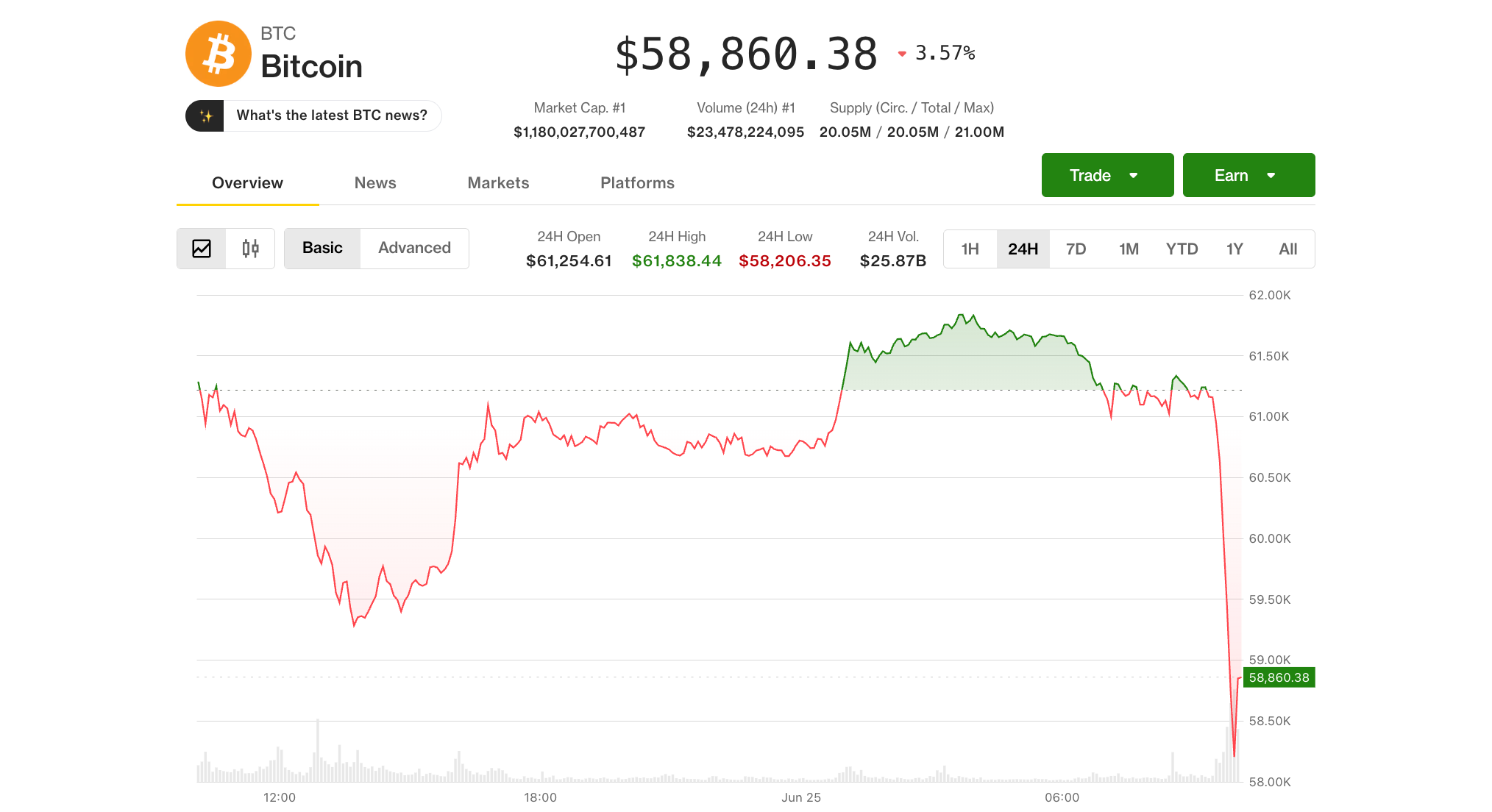
Bitcoin fell as much as 5% during Thursday's U.S. session, sliding to $58,000, its weakest level since 2024. It later recovered to around $59,400, though it was still down 2.5% over the past 24 hours. The decline spread across the broader crypto market: Ether dropped to roughly $1,550, down 5.5%, while Solana and DOGE posted similar losses.
The move came during a mixed session for risk assets. Memory chip maker Micron surged after reporting strong earnings on Wednesday evening, but much of mega-cap tech traded lower, leaving the Nasdaq down 0.4%. Markets are still adjusting to the funding demands tied to the AI buildout, while also repricing after the Federal Reserve's hawkish shift last week.
According to the report, policymakers under new Chair Kevin Warsh signaled that the next policy move is far more likely to be a rate increase than a rate cut, and that such a hike could arrive sooner than investors had expected. That shift added pressure to risk assets and kept Bitcoin in the broader downtrend that has been in place since October.
Liquidation clusters sit above the market
Even with the price trend still weak, derivatives positioning suggests the downside trade may be getting crowded. The liquidation heatmap shows a larger concentration of liquidation risk above current price levels rather than below them. In practice, that reduces the odds that another leg down would be magnified by forced selling, while raising the pressure on traders holding short positions.
Open interest rose by about 0.28% over the past 24 hours even as Bitcoin fell roughly 3%. That combination suggests traders were not closing bearish bets during the drop; they were adding to them and leaning on the idea that $58,000 support could break. Funding rates also turned negative, showing that the market is paying a premium for downside exposure.
Order-book depth shows stronger bids below
Spot market depth offers another signal. CoinGlass data shows about 6,900 BTC in bids, worth roughly $409 million, sitting on the order book between the current price and $50,000. On the upside, there are only about 1,570 BTC in resting sell orders, worth roughly $93 million, between the current price and $70,000. That leaves the visible supply structure tilted in a bullish direction.
In setups where one side of the trade becomes crowded, a move the other way can force rapid repositioning. If price pushes higher, short sellers may have to close positions to avoid liquidation and ongoing funding costs. The report stops short of calling a reversal, but the data it cites shows conditions for a short squeeze are building even as Bitcoin remains in a clear downtrend.