
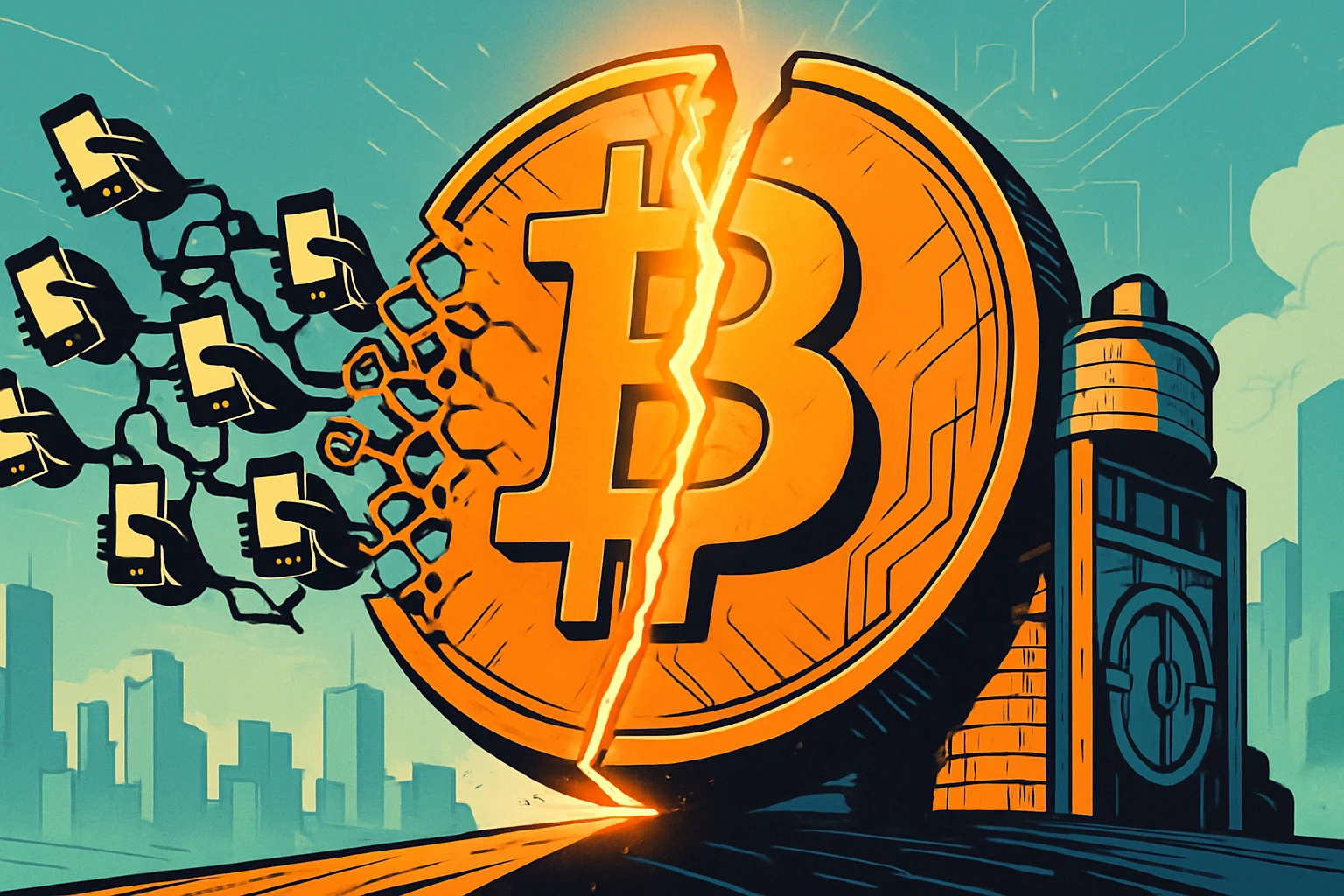
Bitcoin is facing a deeper argument over what it is supposed to be: peer-to-peer electronic cash, a settlement layer, a store of value, or an immutable ledger capable of preserving any kind of data. The debate shows up in disputes over block space, on-chain storage, and fees, but the larger issue is governance and whether Bitcoin’s decentralized model can hold over time.
The article argues that Bitcoin is, at its core, an information system. What moves across the network is not a physical object but digital data, including address strings and unspent transaction outputs, or UTXOs. Because the protocol can store data and its scripting language, while limited, is not tied to only one narrow use case, Bitcoin can support monetary transfers while also being used to embed images, videos, websites, and other non-financial material. That flexibility is one of its strengths. It is also the source of the present identity conflict.
The debate over “spam” is really a debate over purpose
In recent periods, more non-monetary data has been written onto the Bitcoin blockchain. Supporters see this as a demonstration of censorship resistance and durable information storage. Critics describe the material as spam and argue that it bloats the chain and consumes scarce block space.
The piece says the central question is not the images or files themselves, but Bitcoin’s intended role. Is it a payment network designed mainly for financial transactions, or an immutable ledger that should permanently record whatever users are willing to pay to include? The protocol can process arbitrary data and OP_Return fields, yet proof of work means this use is not free. Anyone attempting it must bear the cost. At the same time, the article says there is not enough evidence to show that long-term storage of non-monetary data has damaged the network to a degree that threatens other users, and no evidence that node operators incur legal liability because of it.
The block size war set an earlier governance precedent
This is not Bitcoin’s first identity dispute. The 2015 block size war turned the philosophical split into an open conflict. Advocates of larger blocks wanted more capacity so Bitcoin could process more transactions and move closer to the scale associated with Visa or Mastercard. Supporters of smaller blocks pushed the opposite path, keeping the base layer lean and relying more heavily on Layer 2 systems while reserving Bitcoin’s main chain for security and final settlement.
The disagreement did not reconcile. Bitcoin split, and Bitcoin Cash emerged as the large-block alternative, while Bitcoin itself kept the small-block approach. The article presents that episode as evidence that Bitcoin governance has no single command structure. It works more like an unruly competitive order in which anyone can run different code and try to win market acceptance for a set of rules.
Falling node counts add pressure to the decentralization model
Bitcoin’s decentralization depends on nodes, not slogans. Node operators verify transactions and enforce protocol rules, making them central to the network’s trust model. The problem is that incentives are uneven. Miners receive block rewards and fees. Users have a clear reason to validate their own transactions. People who run nodes mainly out of conviction often do so without direct economic compensation.
The article notes that the number of Bitcoin network nodes has fallen by nearly 60% from its 2018 peak. That is presented as a long-term concern. If more participants outsource verification, custody, and usage to trusted third parties, the system may drift toward specialization and concentration. The expansion of custodial services would add both centralization risk and broader systemic risk.
Competing interests remain unresolved
The governance dispute around Bitcoin is not something a single technical fix can settle. Users want lower fees. Node operators want a smaller blockchain. Developers care about a base layer that remains workable to build on. Miners need enough economic incentive to secure the network. The block size war did not close the debate, and the arguments around Ordinals and on-chain spam remain open.
That leaves Bitcoin’s identity unsettled. What Bitcoin is, in practice, depends on who is using it, how they use it, and which mix of rules the market accepts.