
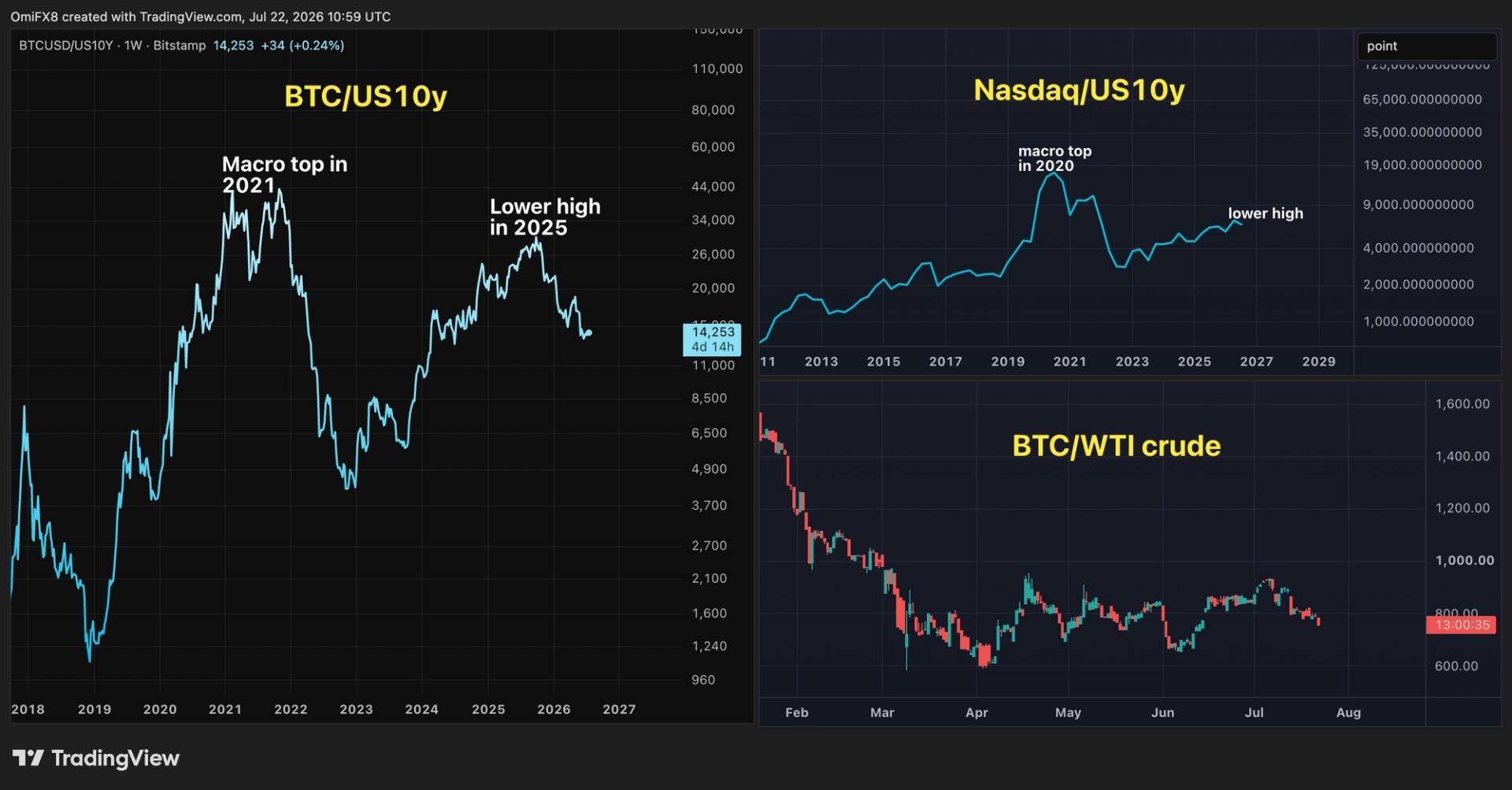
Bitcoin’s recovery has brought optimism back into the crypto market, and some observers now see the latest move as the beginning of a decisive bull run that could carry valuations well beyond last year’s $126,000 peak. CoinDesk’s July 22 Daybook excerpt takes a different view: once interest rates are treated as a cost of capital, the rally looks much less clear-cut.
Yield-adjusted valuation has not cleared the highs from 2020-2021
CoinDesk said bitcoin was at $65,964.86 as it regained its footing. Even so, a review of bitcoin and Nasdaq valuation trends adjusted by the U.S. 10-year Treasury yield, or US10Y, points to a more restrained interpretation of the current move.
According to the report, neither the BTC/US10Y ratio nor the Nasdaq/US10Y ratio has surpassed its 2020-2021 peak, even though both bitcoin and tech assets set new record highs in dollar terms over the past 12 months. In that framing, the real macro top for bitcoin and the broader technology sector may already have occurred in 2020-2021 once the cost of capital is taken into account.
The newsletter also notes that the chart in the left pane shows bitcoin’s price adjusted for the 10-year Treasury yield. That ratio peaked in 2021, and the 2025 bull market in BTC did not come close to taking out that high. Nasdaq, CoinDesk said, shows a similar pattern.
How the gap between nominal prices and adjusted valuations could close
CoinDesk outlined two ways this divergence could resolve.
- One path would be a collapse in interest rates, which would shrink the denominator and allow these ratios to break higher.
- The other would be a decline in nominal dollar prices, bringing assets back into line with the structural weakness shown by the ratios.
The piece says the second outcome looks more likely for two reasons. First, recent comments from Federal Reserve officials have remained hawkish, and some have even floated the possibility of higher rates. If that stance holds, the valuation pressure coming from elevated yields does not go away on its own.
Oil’s rebound adds another layer of pressure
The second complication is energy. CoinDesk said bitcoin’s bounce from $58,000 to $66,000 has been respectable, but its ratio against WTI crude oil futures has declined. That means oil has been outperforming even the most aggressive risk assets.
The report treats that as a sign that a new wave of cost-push inflation may be building. It adds that the BTC-WTI crude ratio has weakened over the past few days, which points to energy prices rising faster than digital risk assets.
CNBC, cited in the same section, reported that oil prices jumped 4% after the 11th consecutive round of U.S. strikes against Iran. Secretary of State Marco Rubio said the Strait of Hormuz remains a sticking point between the two sides and said Iran was “not serious” about peace talks.
CoinDesk’s warning for bitcoin bulls
The conclusion in the Daybook excerpt is blunt. A sustained bull run may be far harder to build than market participants currently assume. If oil keeps rising, CoinDesk said nominal prices could face a sharp “snap adjustment,” falling quickly to better match yield-adjusted valuations.
That leaves bitcoin and tech assets in an awkward position. Their headline prices remain elevated, but the picture changes when those prices are measured against borrowing costs and energy strength. In CoinDesk’s framing, the market should stay alert rather than assume the latest rally has already settled the bull case.
Other stories listed in the Daybook roundup
The “What’s trending” section of the same page included several other items.
- CoinDesk reported that the Crypto Clarity Act remains tied up over its ethics section, with U.S. Senate Democrats unhappy about some of the language in the market structure bill, including wording that would bar government officials from maintaining significant crypto ties.
- Movement Labs filed for Chapter 11 bankruptcy months after its token scandal. In its filing, the company said it had fewer than 1,000 creditors, between $100,000 and $500,000 in assets, and more than $1 million in liabilities.
- Balance Coin, a low-circulation algorithmic stablecoin designed to keep a $1 peg, collapsed by more than 99% after an attacker exploited a pricing flaw. CoinDesk said nearly all of its roughly $3.5 million in nominal value was wiped out, and the attacker took $912,000. The headline described the event as a roughly $1 million exploit that drained its bitcoin vaults.
The page also listed a stream of shorter market headlines, including 1SecondFi shutting down after a $2.4 million ADA wallet theft, bitcoin retreating from a one-month high as oil moved above $85 and inflation concerns returned, Kraken’s parent expanding tokenized stocks to equities in Hong Kong, the U.K. and South Korea, and bitcoin falling below $66,000 as traders watched Alphabet earnings for clues on the AI trade.
TRON’s Q2 2026 snapshot
In a separate section on the same page, CoinDesk highlighted TRON Network’s second-quarter 2026 figures. TRON’s stablecoin dominance rose to 28.7%, USDT supply on TRON reached an all-time high of $89 billion, protocol fees came in at $89 million, second only to Hyperliquid, TRX gained 3%, and the network’s institutional and agentic reach continued to deepen.