
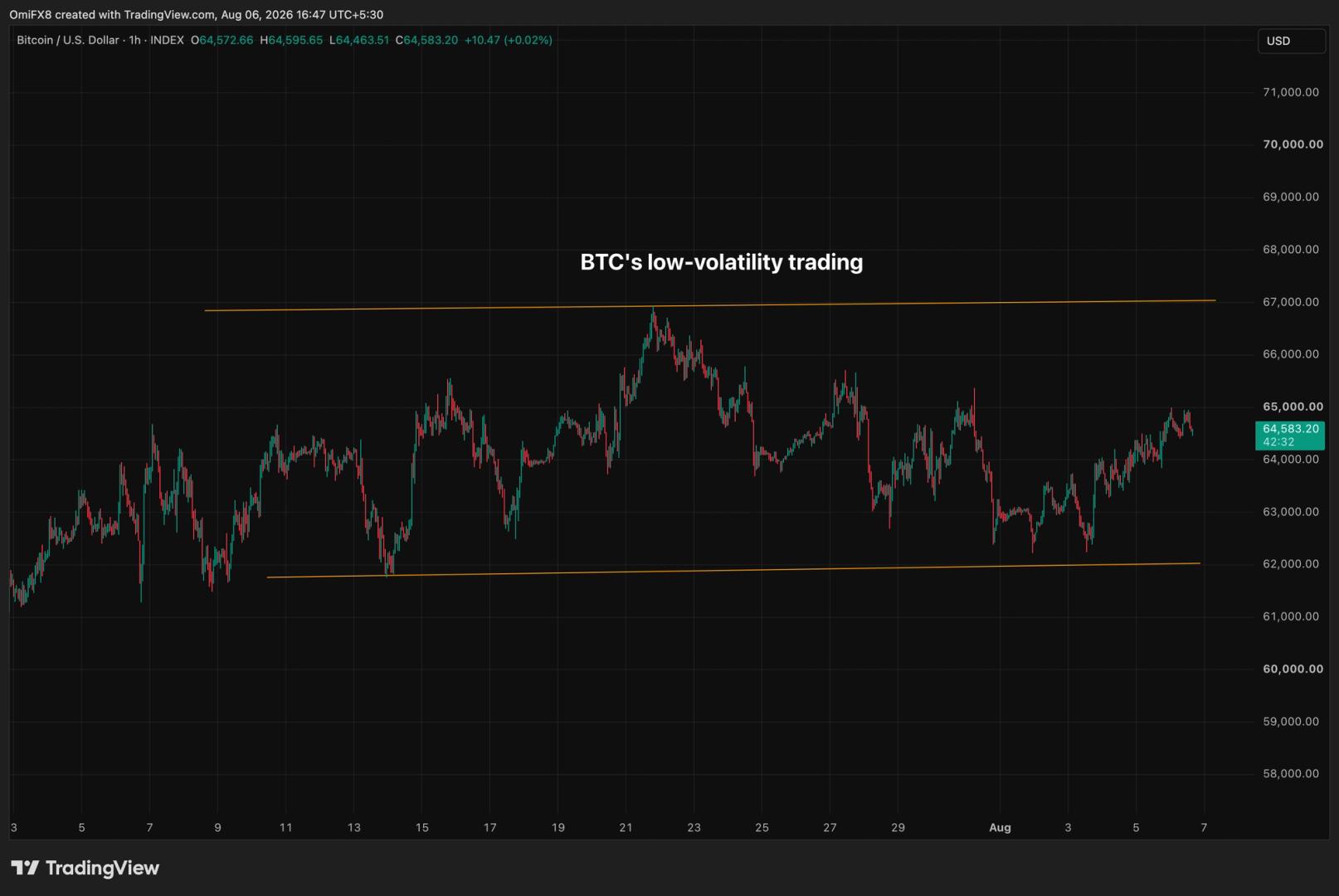
Bitcoin’s recent calm may be sending the wrong signal. In CoinDesk’s Aug. 6 Daybook, the main point was not only that BTC has failed to join the risk-on rally seen in stocks, but that the cryptocurrency has been so steady that its 30-day implied volatility has dropped to a long-held floor of 36%.
That kind of reading is often taken as a sign of safety. If an asset is not swinging sharply, many traders assume it is less risky and easier to predict than one moving around fast. CoinDesk noted that, in recent weeks, BTC has looked steadier than South Korea’s Kospi index.
Low volatility says little about what happens next
CoinDesk’s argument was that this only describes current conditions. It does not tell traders what could happen once the market starts to move. Low volatility, in that framing, is no reason to relax.
When volatility is cheap, trading it is cheap too. That lowers the cost of building large directional positions and hedges. It also means market makers on the other side can end up carrying a significant amount of exposure.
If prices then begin to move through key levels, both sides have to do more position management. That activity can add to the swings rather than absorb them. This is why volatility is often described as rising again, or reverting toward its mean, after a long period of decline.
Adam Haeems, head of asset management at Tesseract Group, which manages $500 million in client assets, said in an email: “When volatility is cheap, traders can build directional positions and hedges at relatively low cost. If the market then moves through a level with concentrated positioning, dealer hedging can accelerate the move.”
He added: “The practical implication is that low volatility should not be mistaken for low risk. It is a reason to be careful with leverage, particularly when trading volumes and market depth are subdued.”
BTC remains below $65,000, though some early positives are showing up
For now, CoinDesk said, BTC remains choppy below $65,000, though there are some green shoots in the market.
Paul Howard, a senior director at market-making firm Wincent, said demand for puts, or downside protection, has weakened. At the same time, there is still no strong bid for upside exposure.
In his email, Howard said: “It indicates that the bear market is close to trading at its lowest price range for this cycle, arguably over the coming weeks.”
Glassnode described the options picture this way: “The asymmetry is not a bid for puts; it is the disappearance of the call bid. Nobody is paying for upside, and nobody is paying much for downside.”
Regulatory news could be the next major catalyst
Howard said the next big catalyst could be “some positive regulatory news such as with the Clarity Act, which would likely manifest as institutional ETF inflows.”
On the downside, he pointed to a potential breakdown in the Hormuz talks and an inflation shock as risks that could change the picture.
Other market threads CoinDesk flagged
The Daybook also listed several stories drawing attention across markets:
- Clarity Act uncertainty: CoinDesk said the crypto market-structure bill remains in a precarious position with only two days left before the Senate goes on recess. Senators had not indicated whether they would work on the Clarity Act or hold a vote on it.
- BTC above $64,000: In another CoinDesk item, bitcoin held above $64,600 while major tokens showed little directional conviction. Traders were also watching SpaceX, where roughly $101 billion of stock was set to become tradable as the first lockup expired.
- FX markets drift: Reuters reported that the yen gave back some intervention-driven gains and the dollar stayed near a six-week low as investors waited for details of a proposed U.S.-Iran deal and Friday’s U.S. jobs report.
- Global equities mixed: The Associated Press said shares in Europe and Asia were mixed, with South Korea’s Kospi dropping more than 4.6%. Oil held steady as uncertainty tied to the Iran war continued to hang over markets despite hopes for a reopening of the Strait of Hormuz.
BTC-DOGE divergence points to weak speculative appetite
CoinDesk also referred to a chart comparing bitcoin’s price swings with dogecoin, the largest meme token by market value.
Since early July, DOGE has remained under pressure and has decoupled from the recovery in BTC’s price, according to the report.
That divergence suggests speculative interest is still missing. Even as bitcoin stabilizes, traders are not chasing high-beta, meme-driven exposure. CoinDesk said this is usually one of the earliest signs of a market bottom.
Additional stories listed on the page
The newsletter excerpt also included a list of other CoinDesk items:
- Free Markets and Innovation, Sort Of
- Why Sandisk and Western Digital crashed 10% and what it means for bitcoin
- JPYC raises $38 million Series B led by major Japanese logistics firm AZ-COM Maruwa
- Bitcoin, ether benefit as traders seek safety of largest tokens
- NFT startup founder charged with misusing funds from $10 million fundraising
- Live updates: BTC trades near $65,000; SpaceX rises ahead of $100 billion unlock
- Bitcoin developers flag 85 critical bugs in an “extremely bad” situation
- S&P 500 has added crypto’s $2 trillion market cap this month. Bitcoin is not impressed. Here’s why
- Bitcoin steadies above $64,000 as traders watch $100 billion SpaceX unlock
- XRP whales keep buying the dip, but ether shows deeper capitulation
Binance case study teaser appears at the end
The page closed with a teaser titled The Evolution of the Crypto CEX Landscape: A Case Study on Binance. It said Binance remains crypto’s leading exchange and has expanded from spot and derivatives into RWAs, payments, savings, yield products, and broader financial services. The excerpt ended with the phrase “Why it matters,” without providing further detail in the input.