
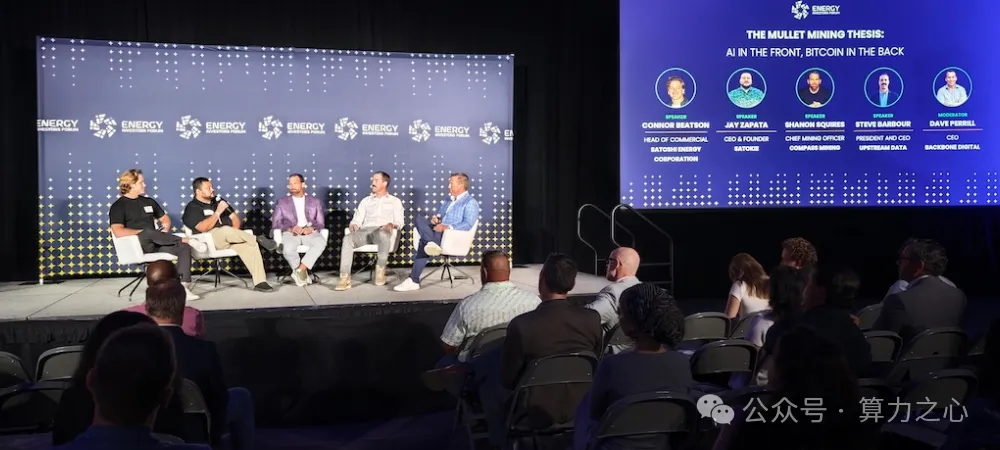
Data presented by the Cambridge Centre for Alternative Finance at the inaugural Energy Investors Forum in Dallas put the Bitcoin network’s annual power consumption at 190 TWh and its carbon emissions at 48 million tonnes. Against that backdrop, miners have grown increasingly eager to reposition their sites for AI compute, with large operators already signing deals and others accelerating their plans.

Yet the message from the forum was more restrained than the industry narrative now circulating. The idea that a mining site can slide into AI simply because it already has land and power approvals met pushback from several participants, who argued that the jump is much harder in practice.
Mining can shut down. AI usually cannot.
The mining industry often frames the transition in simple terms: both bitcoin mining and AI turn electricity into computation, so existing mining sites should be able to switch over with limited rework. Speakers at EIF said the operational differences are much sharper than that comparison suggests.
Mining is highly tolerant of interruption. Containers can be placed on remote land with minimal road access, and miners can power down when the grid is tight. In some cases, they can even earn demand-response payments by shutting off voluntarily. AI tenants want something very different: firm power. Once a site signs strict service-level agreements, even one hour of server downtime can trigger extremely costly penalties.
That changes the infrastructure requirement entirely. An AI campus needs more than power access. It also needs liquid cooling, low-latency fiber, layered power redundancy and skilled technical workers. Alpine Fox founder Mike Alfred said during a fireside chat that “Texas is Mecca, the most important data center market in the world.” He also warned that the wrong business model will still separate winners from losers.
Forum participants boiled the challenge down to six hard checkpoints that a mining operator must clear before leasing power to AI customers:
- Generation
- Interconnection queue
- Transmission
- Substation capacity
- Cooling equipment lead times
- Public acceptance
Miss any one of them, and deep-pocketed AI tenants are unlikely to sign.
A “mullet” model: keep mining while waiting for AI demand
Because full conversion is difficult, one compromise discussed at the forum was labeled the “mullet” model — AI in front, mining in the back. The idea is to keep monetizing available power with conventional mining equipment to preserve cash flow, then carve out part of the site for higher-spec AI capacity once capital is in place or an AI tenant actually shows up.
The article cited TeraWulf’s project in Kentucky as an example. The company acquired a former aluminum smelter site, redeveloped it into an AI campus and secured a long-term lease with Anthropic.
Still, speakers argued that the model has limits. An operator may be able to mine one day and rent to AI the next in theory, but not in physical buildout. A fan-cooled setup cannot be turned into liquid cooling overnight, and a remote site cannot instantly gain fiber connectivity and the rest of the needed communications stack. The gap in hardware and site readiness is structural, not cosmetic.
Soluna Holdings CEO John Belizaire offered a more practical direction: instead of waiting in long lines for fresh grid capacity, operators could use power that is already being wasted because of interconnection bottlenecks, including wind and solar generation, and pair it with small- to mid-scale data centers.
That led to another idea that gained traction at the forum: distributed inference. Rather than chasing very large campuses that demand hundreds of megawatts, miners could focus on smaller compute clusters in the 10 MW to 20 MW range. Those projects can be built faster, require less capital and fit better with the site profiles many miners already know how to manage.
Local communities may matter more than the pitch deck
Another theme ran through the forum from start to finish: community acceptance. BlocksBridge founder Nishant Sharma put it plainly: “Physical infrastructure also needs the support of social infrastructure.” In other words, a site can have grid approval and installed transformers and still fail to become an AI campus if local communities do not support it.
Compass Mining’s Curtis Harris went so far as to criticize the industry’s own approach. He said the problem is not someone else’s fault and that developers need to show up in communities well before formal hearings begin, not only after residents first see a construction notice on their phones.
He contrasted that with a real case in Iowa, where a company skipped technical jargon and focused on three plain messages for residents: it would curtail when grid load was high, its machines would not consume local water resources, and it would hire local construction crews. Those were points people could understand immediately.
Texas state representative Jared Patterson delivered a similar warning from a political angle. Spending money on lobbying in Austin, he said, cannot replace support at the local level. Developers need to talk about taxes, school funding and groundwater in language residents understand. Technical branding carries little weight in city hall.
That is because local communities are not primarily focused on whether a project is mining or AI. The immediate questions are simpler: Will household electricity bills rise? Will wells run dry? Will there be more noise near homes? Speakers said that without this form of social buy-in, even well-built physical infrastructure will not be enough.
EIF offered a sorting framework, not a conversion blueprint
The forum did not present a single roadmap for miners to become AI infrastructure providers. What it offered instead was a more candid classification framework: which sites are best left as mining operations, which are better suited to flexible compute or distributed inference, which merit full AI redevelopment, and which may be better sold or leased long-term to operators with deeper pockets.
As TheEnergyMag wrote in its on-site coverage: “The best-positioned miners in the next cycle may not be those claiming the biggest AI pipeline, but those who can most honestly classify every megawatt they control.”
The closing point was direct. Before selling an AI transformation story, miners need to know what each megawatt in their portfolio can actually support: continued mining, small distributed inference clusters, or a full AI campus. If that classification work comes second and the story comes first, the gap between narrative and reality may prove costly.