
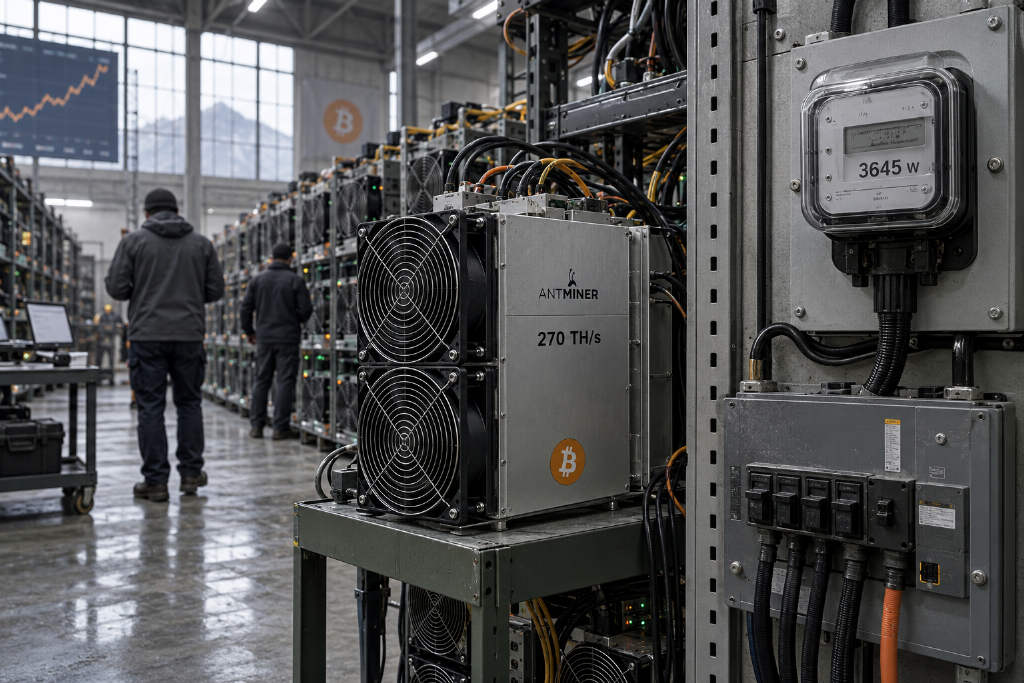
A mainstream Bitcoin mining rig rated at 270 TH/s is generating about $10.54 in gross daily revenue under current network conditions, based on figures cited from Luxor-owned Hashrate Index. The article says current Hashprice stands at $39.05 per PH/s per day, with network hashrate around 1,014 EH/s and projected difficulty at 132.72 T. CoinGecko data cited in the piece showed Bitcoin at about $83,750 on Oct. 13, after dipping near $81,000 intraday.
That price level is still not far from prior highs, but miner revenue per unit of hashrate remains close to historical lows. CoinShares said in its second-quarter 2026 mining report that Hashprice hit a record low of $27.7 per PH/s per day in June, versus a peak of about $63 in July 2025. The same report put listed miners’ weighted average cash cost at about $75,500 per BTC.
The article frames the issue around three numbers miners need to track: how much a machine earns each day, how much electricity consumes from that revenue, and where the economics flip from positive to negative.
Hashprice, not BTC alone, sets the tone for miner revenue
Hashprice measures how many dollars of revenue 1 PH/s of hashrate can produce in a day. Because it compresses Bitcoin price, network difficulty, and fees into one figure, the article says it gives a clearer picture of miner conditions than BTC price alone. A rising Bitcoin price does not automatically improve miner economics if network hashrate expands even faster and dilutes the gain.
Using the machine in the example, 270 TH/s converts to 0.27 PH/s. Multiplying 0.27 by the current Hashprice of $39.05 gives daily gross revenue of about $10.54.
CoinShares data cited in the article shows network hashrate peaked at about 1,160 EH/s in October 2025, then fell to 879 EH/s by July 13, 2026. Difficulty dropped to 127.48 T at one stage, about 18% below the October 2025 record. That contraction should have improved revenue for surviving miners, but Bitcoin fell to $58,400 by the end of the quarter, offsetting much of the benefit and helping push Hashprice to a record low in June.
Rising hashrate is taking share back from individual machines
The article says conditions have changed again since July. Hashrate Index data shows network hashrate has recovered to about 1,014 EH/s, while block time has shortened to 9 minutes and 32 seconds. Based on that, mempool.space projects the next difficulty adjustment at +4.82%, with 552 blocks remaining before the change.
For a single machine, that is not an abstract number. If Bitcoin price and fees stay unchanged, a 4.82% difficulty increase would cut daily revenue by roughly the same proportion. On the article’s starting figure of $10.54 per day, revenue would fall to about $10.04 after the adjustment, while electricity costs would stay the same.
How the article calculates mining revenue for one machine
The full model uses five inputs: machine hashrate, total power draw, electricity price, pool fee rate, and Bitcoin price. Hashrate and power come from hardware specifications. Electricity depends on the miner’s contract or location. Pool fees usually range from 1% to 3%, and BTC price moves continuously.
The example machine is Bitmain’s Antminer S21 XP. The hardware review cited from Hashrate Index lists 270 TH/s of hashrate, efficiency of 13.5 J/TH, and total power draw of about 3,645 W. The efficiency figure links the first two variables directly: 13.5 J/TH means producing 1 TH/s each second consumes 13.5 joules, and a lower number means better power efficiency.
Step-by-step using the S21 XP example
Step one is unit conversion. A 270 TH/s machine equals 0.27 PH/s. Multiply that by the current Hashprice of $39.05 and gross daily revenue comes to about $10.54.
Step two is electricity use. Running 3,645 W continuously for 24 hours consumes 87.48 kWh per day.
- At $0.05 per kWh, daily power cost is about $4.37
- At $0.06 per kWh, daily power cost is about $5.25
- At $0.09 per kWh, daily power cost is about $7.87
- At $0.12 per kWh, daily power cost is about $10.50
As a reference point, the U.S. Energy Information Administration monthly power report cited in the article showed average industrial electricity prices at $0.0977 per kWh in July 2026, up 4.7% year over year.
Step three is the pool fee. At a 2% fee rate, the pool takes about $0.21 per day.
Subtracting power cost and pool fees from gross revenue gives net profit:
- At $0.05 per kWh, daily net profit is about $5.96, or roughly $2,175 annualized
- At $0.06 per kWh, daily net profit is about $5.08
- At $0.09 per kWh, daily net profit falls to about $2.46, or less than $900 annualized
- At $0.12 per kWh, daily net profit turns negative at about -$0.16
The article’s point is simple: the same machine can move from steady profitability to a net loss solely because electricity rises from $0.05 to $0.12 per kWh.
What the protocol-level formula shows
Hashprice is useful for quick estimates, but it already embeds current difficulty and fee conditions. To show where revenue comes from, the article goes back to the protocol formula: BTC produced per PH/s per day equals 86,400 seconds multiplied by 10 to the 15th power, multiplied by the block subsidy, then divided by the product of difficulty and 2 to the 32nd power.
Plugging in current difficulty of 132.72 T and a block subsidy of 3.125 BTC gives about 0.000474 BTC per PH/s per day. For a 270 TH/s machine, that works out to about 0.000128 BTC per day. At a BTC price of $81,573, the implied dollar revenue is broadly in line with the $10.54 figure from Hashprice, with the small gap attributed to fees and methodology.
The article also notes that implied network hashrate derived from difficulty is about 950 EH/s, below the real-time reading of 1,014 EH/s. That gap helps explain faster block production and the expected difficulty increase, and it also suggests actual short-term revenue can run slightly below the theoretical value based on current difficulty alone.
Two break-even lines: electricity price and Bitcoin price
Break-even electricity price
This line answers the question: at what power price should the machine be shut down? The method is to divide daily revenue after pool fees by daily electricity use.
In the example, $10.54 of gross daily revenue becomes about $10.33 after a 2% pool fee. Dividing that by 87.48 kWh gives a break-even electricity price of about $0.118 per kWh.
The article says the practical meaning is straightforward. At the EIA industrial average of $0.0977 per kWh, the machine still has a margin of roughly 2 cents per kWh. If the power contract is above $0.12, the machine can no longer cover electricity costs at the current Hashprice. CoinShares also provided an older-machine comparison: the S19 XP’s break-even power price fell from about $0.12 per kWh in December 2024 to $0.077 a year later.
Break-even Bitcoin price
This line answers a different question: at what BTC price should the machine be shut down? The method is to divide daily electricity cost by the machine’s daily BTC output after pool fees. The article puts net daily production at about 0.0001267 BTC.
- At $0.05 per kWh, the shutdown BTC price is about $34,500
- At $0.06 per kWh, it is about $41,400
- At $0.09 per kWh, it is about $62,100
- At $0.12 per kWh, it is about $82,900
The last figure is already above the current market price cited in the article, which is why high-power-cost miners are under pressure now.
The article stresses that break-even BTC price moves linearly with electricity price. If power cost doubles, the shutdown line doubles as well. In that sense, there is no single universal “miner capitulation price” without specifying which miners are being discussed.
A difficulty increase pushes both lines at once: it raises the break-even BTC price and lowers the break-even electricity price because both depend on the same output stream. A halving has an even larger effect because it cuts unit output roughly in half in one step.
Subsidy, difficulty, and fees still define the structure
The April 2024 halving reduced the block subsidy to 3.125 BTC per block, which the article describes as the starting point for all current calculations. At 144 blocks per day, that implies about 450 BTC of new daily supply across the network.
The Block was cited as saying transaction fees at one point fell to about $300,000 per day, accounting for less than 1% of total miner revenue. That leaves the subsidy as the dominant source of income for now, with fees acting as only a small adjustment in single-machine models.
Difficulty adjusts every 2,016 blocks, or roughly every two weeks, to bring average block time back to 10 minutes. The design keeps Bitcoin issuance on schedule regardless of how much hashrate enters the network, but it also means miners are in a constant competition that dilutes revenue per unit of hashrate.
The next halving is expected in 2028. CoinShares said the market often sees a wave of hashrate expansion about a year before a halving. For anyone evaluating hardware payback periods, the article says profitability needs to be modeled under both pre-halving and post-halving assumptions.
Why public miner costs sit far above single-machine power costs
A single-machine model only captures electricity. Public company financials include depreciation, hosting, labor, maintenance, and infrastructure amortization, which is why the gap is so large.
CoinShares estimated listed miners’ weighted average cash cost at about $75,500 per BTC in the second quarter of 2026, above the quarter-end BTC price of $58,400. On a full-cost basis, the article lists:
- Riot Platforms at about $113,500 per BTC
- CleanSpark at about $135,700 per BTC
- IREN at about $141,600 per BTC
- MARA Holdings at about $163,900 per BTC
CoinShares also estimated that the same 1 MW of power capacity could generate about $1.5 million in annual revenue in AI workloads, versus about $500,000 in mining.
The article uses IREN as a case study. According to a Benzinga analysis dated Oct. 12, the company posted $578.2 million in mining revenue in fiscal 2026 through June 30. AI cloud revenue rose from $16.4 million in the prior fiscal year to $128.8 million, while total revenue increased from $501 million to $707 million. Net loss for the period was $702.6 million, including $638.8 million in non-cash impairment tied mainly to retired mining equipment. The company said contracted annualized revenue for its 2026 capacity had reached $4 billion and that it planned to be largely done with the transition by Dec. 31.
That shift matters for investors using mining stocks as a proxy for Bitcoin exposure. If most of a company’s capacity is rented to AI customers, its share price may increasingly reflect data center leases, financing costs, and delivery schedules rather than daily moves in Hashprice.
Risks outside the model and three scenarios
The article says a calculator can produce a precise number, but nearly every input changes over time. Difficulty resets roughly every two weeks, so a revenue estimate can go stale quickly. Equipment depreciation is another cost that can be underestimated, and IREN’s $638.8 million impairment is cited as an example. Hosting contracts may include floating power clauses and minimum usage commitments that push real costs above headline electricity rates. Firmware overclocking can raise hashrate, but it can also increase power draw and failure rates.
It outlines three scenarios:
- Recovery scenario: BTC price rises while network hashrate remains restrained after earlier exits. Hashprice climbs from around $39 toward the 2025 range, high-power-cost miners return to profitability, and idle machines restart.
- Squeeze scenario: BTC trades sideways while hashrate keeps rising, difficulty moves higher repeatedly, Hashprice drifts back toward the June low of $27.7, and break-even power prices fall toward about $0.08 per kWh, forcing out miners without long-term low-cost power contracts.
- Accelerated transition scenario: more capacity is converted to AI use, mining-side hashrate growth slows or declines, unit revenue improves for surviving miners, and sector valuation logic moves further away from Bitcoin price itself.
What the article says to watch next
The next difficulty adjustment, projected at +4.82%, is presented as the nearest hard event because all calculations need to be refreshed once it lands. U.S. CPI data is due on Oct. 14, and the article says macro data can affect BTC price through rate expectations, which then feeds into Hashprice. ETF flows are another variable to monitor, with about $680 million in net outflows over the past week.
Over a longer horizon, the 2028 halving means hardware bought today still needs to make economic sense after the subsidy is cut in half. If it does not, the payback model fails from the start.
James Mitchell’s view: mining is one of the few cash-flow models that can be checked line by line
James Mitchell says the value of the topic is not just knowing what one machine earns today. In his view, it offers a rare cash-flow model that can be verified almost entirely with public data. Mining revenue can be derived from difficulty, subsidy, and BTC price, while costs can be derived from power draw and electricity price.
He points to two common market mistakes. The first is assuming a higher BTC price automatically means better miner conditions. The article’s 2026 data argues otherwise: Hashprice hit a record low when BTC fell to $58,400 at the end of the second quarter, and even with BTC back above $80,000 now, Hashprice has only recovered to $39, still well below the roughly $63 peak from July 2025. The reason given is that network hashrate rebounded from 879 EH/s to 1,014 EH/s, absorbing the benefit from price.
The second mistake is using single-machine electricity cost to infer public miner profitability. A machine-level break-even power price of about $0.118 per kWh says little about listed miners facing weighted average cash costs of $75,500 per BTC once depreciation, hosting, and infrastructure are included.
Mitchell says the most important signal to watch next is the direction of divergence between Hashprice and network hashrate. If hashrate keeps rising while Hashprice stalls, new capacity is still entering and marginal miners face more pressure. If hashrate peaks and falls while Hashprice stabilizes, that would suggest a clearing process is underway and unit economics for surviving miners may improve. For mining-stock investors, he adds that AI contract execution also needs close attention because the revenue gap of $1.5 million versus $500,000 per MW means the success or failure of that transition can matter more than Bitcoin price itself.
The article closes by arguing that Bitcoin mining is shifting from a commodity-production business toward a power-allocation business. What miners really control is grid-connected capacity and long-term electricity contracts, while machines are only one way to convert power into revenue. If AI can earn roughly three times as much from the same electricity, capacity allocation becomes the central question.
FAQ points included in the article
What does it cost to mine one Bitcoin?
The article says there is no single answer. On a machine-level electricity basis, a 270 TH/s, 3,645 W rig at $0.06 per kWh produces about 0.000127 BTC per day net, implying an electricity cost of about $41,400 per BTC. On a listed-company basis, CoinShares estimated a weighted average cash cost of about $75,500 per BTC in the second quarter of 2026, with Riot at about $113,500 and MARA at about $163,900.
What is Hashprice and why does it matter?
Hashprice is the daily dollar revenue generated by 1 PH/s of hashrate. The article puts the current level at $39.05, versus a record low of $27.7 in June and a high of about $63 in July 2025. It matters because miner revenue can still fall even when BTC rises if network hashrate grows faster.
How is break-even electricity price calculated?
Take daily revenue after pool fees and divide it by daily electricity use. In the example, $10.54 of gross revenue becomes $10.33 after a 2% pool fee. Dividing by 87.48 kWh gives about $0.118 per kWh.
At what BTC price would the machine shut down?
That depends on electricity cost. For the same machine, the shutdown BTC price is about $34,500 at $0.05 per kWh, $41,400 at $0.06, $62,100 at $0.09, and $82,900 at $0.12. The relationship is linear, so there is no single universal shutdown price for all miners.
How much does a difficulty increase reduce revenue?
Approximately in proportion. With mempool.space projecting a 4.82% increase, the article says daily revenue would fall from about $10.54 to about $10.04 if BTC price and fees stay unchanged.
How much do fees contribute to mining revenue?
Very little at the moment. The Block said fees at one point fell to about $300,000 per day, less than 1% of total miner revenue. In single-machine models, fees are treated as a small adjustment rather than the main driver.
Why are public miner costs so much higher than the power bill in a home calculation?
Because a machine-level model only includes electricity. Public miners also carry depreciation, hosting, labor, maintenance, and infrastructure amortization. The article cites IREN’s $638.8 million non-cash impairment in fiscal 2026, mainly tied to retired mining equipment, as a cost that would never appear in a simple electricity-only model.


