

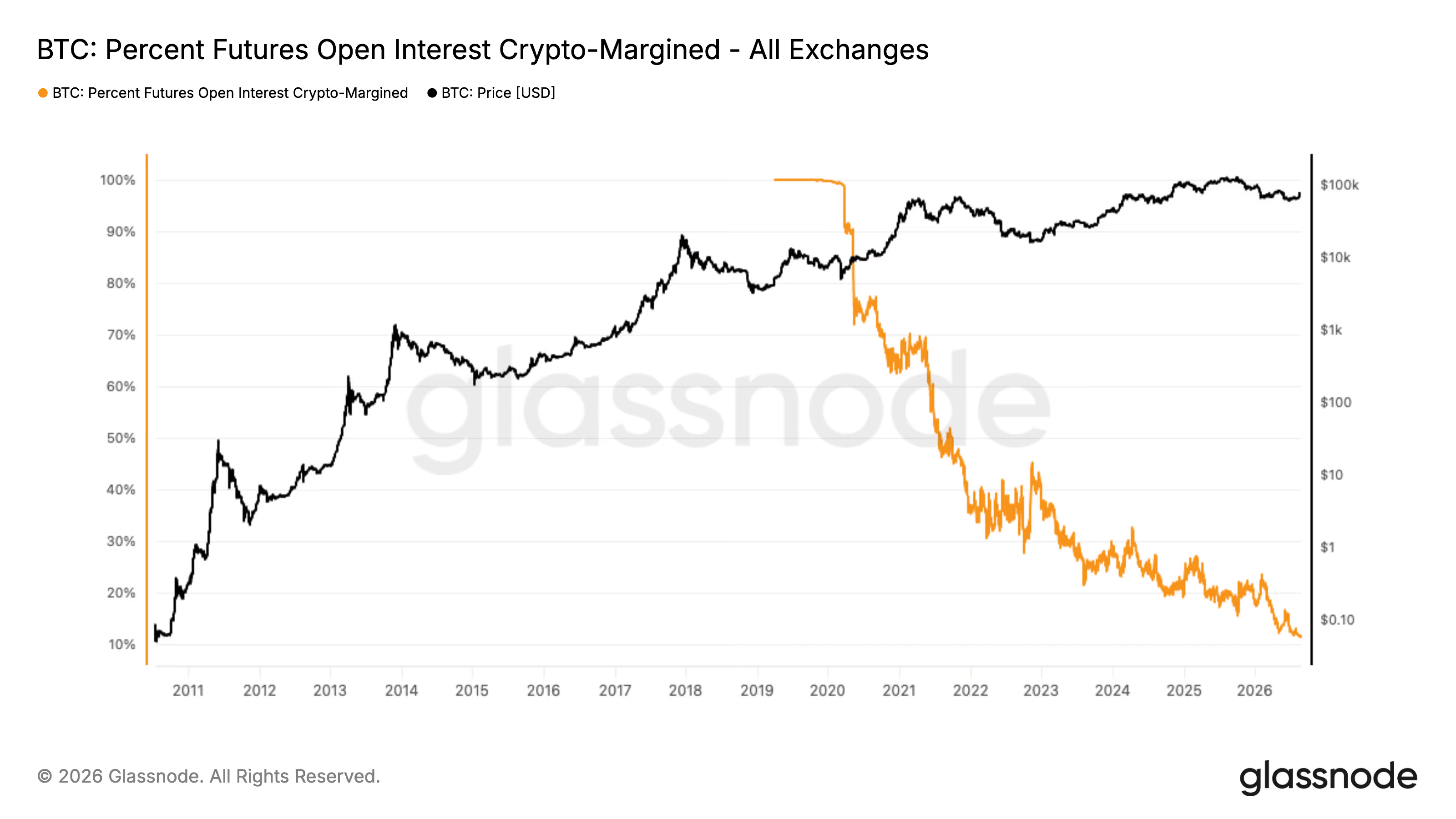
Bitcoin open interest backed by crypto collateral has dropped to about 12% across exchanges, according to Glassnode’s long-run metric.
That is far below the levels seen in 2019 and 2020, when crypto-margined contracts made up close to 100% of the market. For most of the past decade, opening a BTC futures position usually meant posting margin denominated in BTC itself.
Stablecoin margin has become the dominant setup
In a crypto-margined trade, the collateral is the same asset being traded. If the price falls, the position moves against the trader while the collateral also loses value, shrinking the safety buffer at the worst possible moment. That feedback loop can trigger margin calls as the market is moving fastest.
Stablecoin-margined positions work differently. The collateral sits in dollar terms, so its value does not fall alongside Bitcoin during a sell-off. The report says traders have opted for the steadier form of backing.
A more dollar-based derivatives market
Decrypt said the move toward stablecoin collateral mirrors the maturation of the broader derivatives market. This month, Coinbase opened derivatives trading in the U.K. through Hyperliquid with leverage of up to 50x. Bitcoin ETFs pulled in $854 million over five days as rate-hike bets faded. Strategy also reduced its Bitcoin holdings.
According to the report, those developments point to institutional flows that tend to settle in dollars rather than coins.
Spot demand stayed firm this week
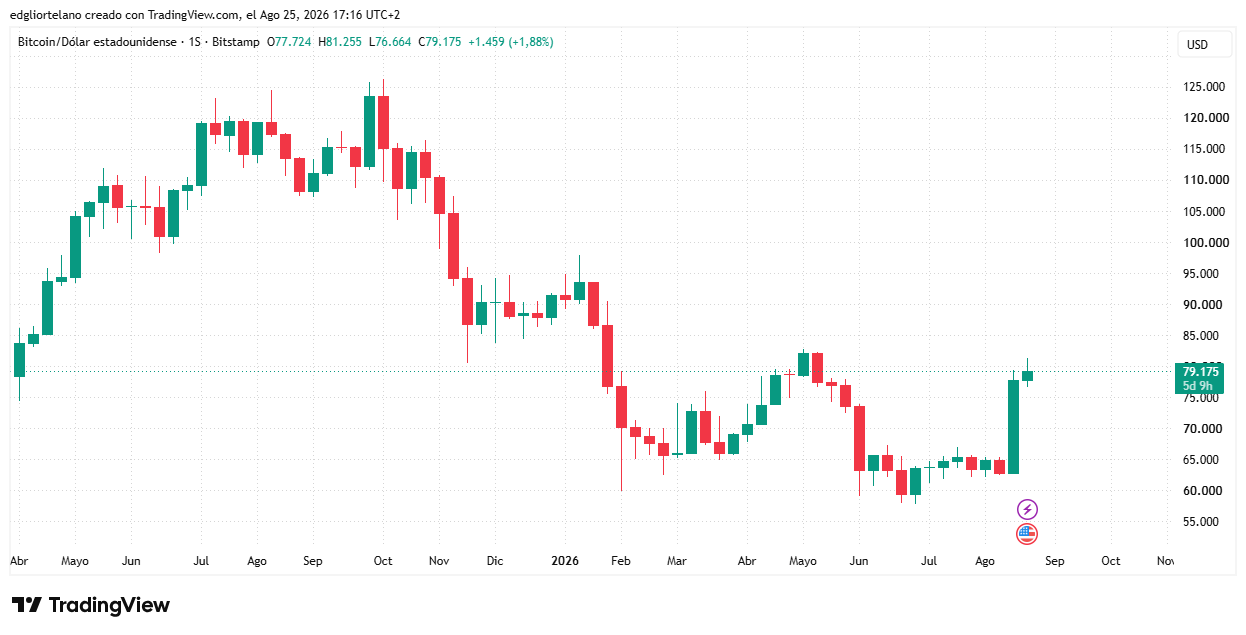
The report said spot demand did not cool this week. Bitcoin rebounded from around $57,000 to a weekly close near $79,175, and was up about 1.88% on the day after months of low-volatility trading between $60,000 and $68,000.
It also explicitly noted that these events are not causally related.
Liquidations show a classic short squeeze
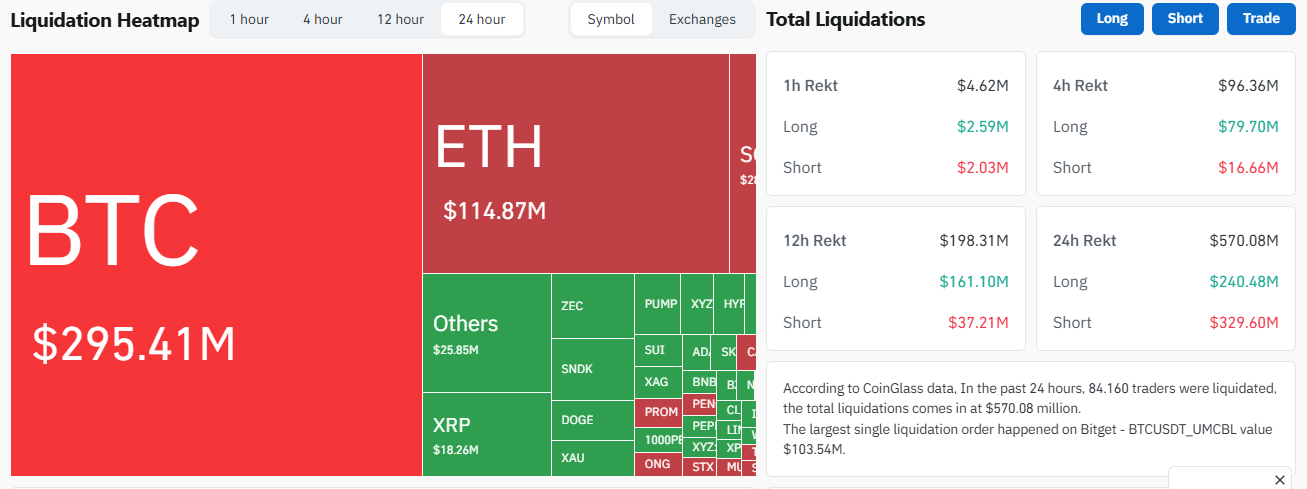
CoinGlass data put total liquidations over the last 24 hours at $570.08 million. Shorts were hit harder than longs, with $329.60 million in short liquidations compared with $240.48 million in long liquidations. Losses accelerated as the price moved higher.
Bitcoin made up the largest share at $295.41 million. The single biggest liquidation was a $103.54 million BTC position on Bitget.
Two separate signals from the same market
The report draws a line between the short squeeze and the collateral transition. They are not the same story, even if both reflect the current state of the crypto market. Stablecoin margin has led the market for years, and the direction of travel has remained the same: dollar collateral has steadily displaced crypto as the base for leveraged bets.
Decrypt added that broader access to fiat markets increases participation by investors looking to trade crypto, which in turn can make the asset less vulnerable to major price swings after trades are disrupted.
At the same time, leverage remains leverage regardless of what backs it. Dollar-based margin did not cause this week’s liquidations, and the report said it will not stop future liquidation events either. On the basis of these data points alone, the Bitcoin squeeze may not be over. One data set reflects the market’s slow-moving structure; the other captures the noise of daily price action.