
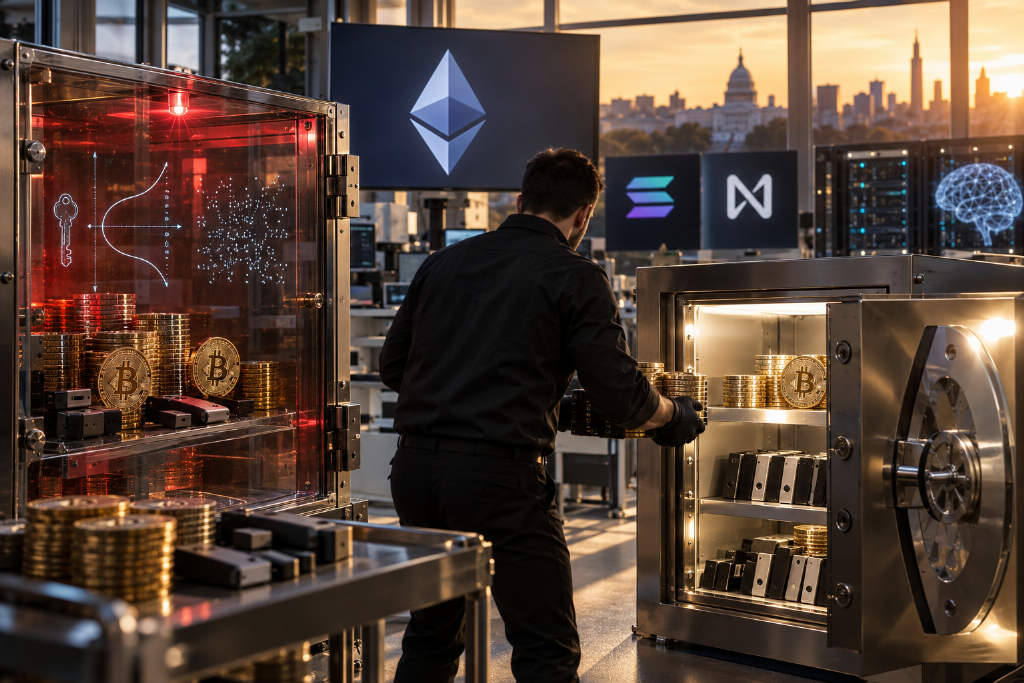
Ethereum core researcher Justin Drake has called on the crypto industry to prepare for a possible “bunker mode” scenario by moving assets to fresh addresses whose public keys have not been exposed. His concern is that artificial intelligence could deliver a mathematical breakthrough that makes practical attacks on ECDSA possible before the quantum threat arrives in force. In Drake’s worst-case framing, holders may have only months.
Price drawdowns can still be debated through valuation and market cycles. Once the safety of private keys is in doubt, the question changes: are the assets in a wallet still effectively under the owner’s control? That goes to the foundation of crypto itself.
Drake’s warning and the dispute over timing
Drake’s scenario is not centered on new hardware. He is worried that AI could uncover mathematical methods humans have not found, allowing attackers to recover wallet private keys from public information with existing machines. He described the idea in concrete terms, including the use of large GPU clusters to recover a target private key in about a week.
Quantum risk depends on hardware capability. The AI-related risk points to an algorithmic shift instead: if a problem long treated as computationally hard turns out to have a more efficient solution, the cost assumptions behind current security models fall. Defenders were waiting for quantum computers. Now they may also have to consider changes in classical algorithms.
Drake is especially concerned about the mathematical structure of elliptic curves. The open question, in his view, is whether stronger AI systems could discover solution paths that human researchers have missed, and whether past security experience will still offer the same assurance in the future.
Vitalik took that possibility seriously and extended the concern beyond elliptic curves to lattice cryptography, including post-quantum schemes such as ML-DSA. Those systems also rely on the hardness of specific mathematical problems. If AI-accelerated research changes how those problems can be solved, the security margin implied by current parameters would need to be reassessed.
That is why the label “post-quantum” does not settle every AI-related risk. Vitalik said he leans toward using hash-based constructions in signatures and proofs where possible, reducing dependence on richer mathematical structures. He also noted that public-key encryption faces harder constraints and cannot simply follow the same path.
There has been substantial pushback against Drake’s statement, with the main objection focused on his “months” timeline.
NEAR founder Illia said AI is challenging assumptions about mathematical complexity, but he has not seen a meaningful change in the expected timeline for practical attacks on elliptic curves. He is more concerned that complicated migration procedures could create fresh risks for holders, and argued that cryptographic replacement should become a routine system capability.
Cryptography researcher Sean Bowe also criticized the gap between the intensity of the warning and the amount of new evidence behind it. In his view, experts need to help non-specialist holders deal with uncertainty, and language that is too urgent can leave people disoriented while weakening the credibility of later risk communication.
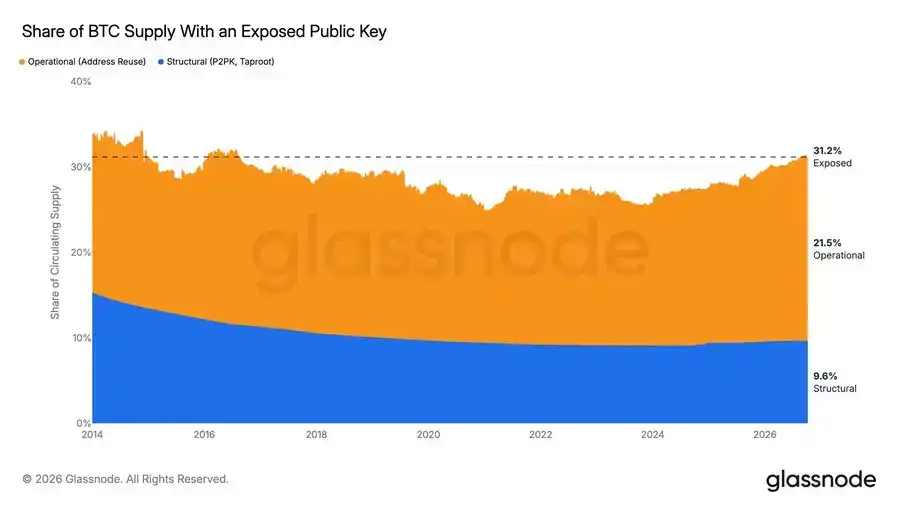
About 31.2% of issued BTC already has visible public keys
Even while the timing of any practical attack remains disputed, the amount of potentially exposed Bitcoin can already be measured.
Glassnode researcher Rafael said roughly 6.26 million BTC have public keys visible on-chain, equal to 31.2% of issued supply. That is up from 24.8% in early 2021.
To understand why, it helps to separate public keys from private keys. A private key is used to generate the digital signature that authorizes a transfer. A public key lets the network verify that signature. Public keys are meant to be public; the security model assumes an attacker cannot feasibly derive the private key from them. If a sufficiently strong quantum computer, or another effective attack path, changes that assumption, already revealed public keys become usable attack material.
Some Bitcoin addresses initially show only a hash of the public key on-chain, not the public key itself. But once the holder spends funds, the public key is revealed. If funds remain under the same key afterward, or if new funds continue to arrive there, those balances are tied to a public key that is already exposed.
That is the exposure created by address reuse. Rafael’s estimate for that category is about 4.33 million BTC. Moving funds to suitable fresh addresses where the public key remains hidden behind a hash can reduce current long-term exposure.
A separate group, about 1.94 million BTC, is exposed because the script type reveals the public key directly. Early P2PK outputs recorded the public key on-chain, and Taproot outputs also reveal public keys. In those cases, the key is visible even if the funds have not yet been spent. Handling that group requires looking at the structure of the address type, not just whether an address has been used before.
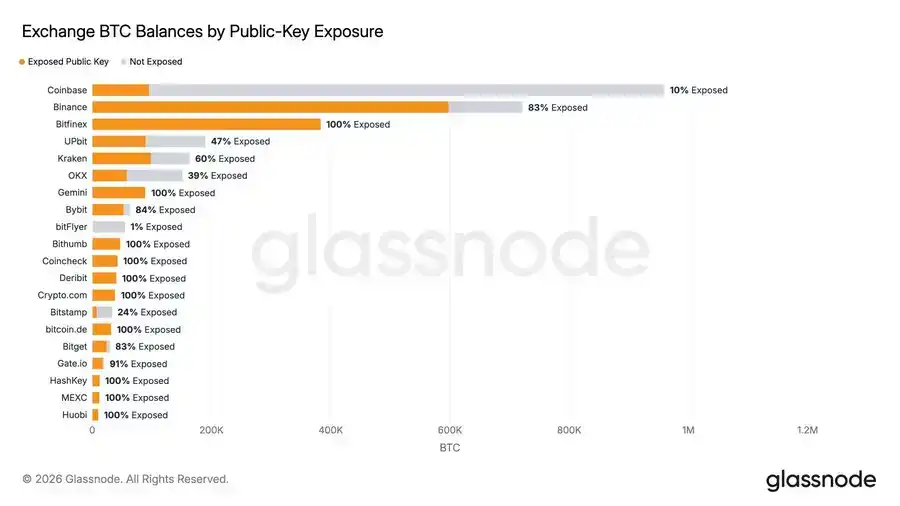
Exchanges stand out as one of the larger groups that can act. Among labeled exchange holdings, about 1.79 million BTC have visible public keys, equal to 57% of those balances, up from 55% in May. Since the May report, total exposed supply has increased by about 222,000 BTC, while newly added BTC supply over the same period was only about 64,000.
Reducing exposure is not the same as completing a full cryptographic upgrade. Funds whose public keys are still hidden today would still face an attack window once they are spent and the keys become visible. Still, the data shows that part of the defensive work can begin before any full protocol transition, and that progress can be tracked.
Some investors are rethinking whether to stay in crypto
The uncertainty is already affecting investor behavior.
Trader metavestor said on X that he had sold most of his spot holdings. He said he does not want every new development in AI mathematics to trigger doubts about whether he could face an irreversible loss, and he does not want every transfer from an old Bitcoin address to raise the question of whether a private key has already been cracked.
He said he entered crypto as a technology optimist, but now prefers to focus on AI and biotechnology. Continuing to hold crypto, in his view, feels like shorting AI progress. Even if that means missing the next bull market, he said he can accept it because other assets remain available to trade.
The argument that banks also rely on cryptography did not remove his concern. In a follow-up explanation, he pointed to banks’ security teams and defensive capacity, and to the possibility of recourse and government support after a major attack. He said he does not have the same confidence in on-chain assets.
Still, an attacker would not need every cryptographic system to fail at once. If the cost of recovering a private key for a given address falls below the value that can be extracted, there is an incentive to try. How easily assets can be moved, how easily an attack can be monetized, and whether losses can be recovered would all shape how risk is distributed.
There is also a counterargument. Bitcoin in its early years faced existential risks around custody, adoption, and regulation. Investors accepted those risks, and that acceptance was part of where returns came from. The existence of risk alone does not settle whether an asset is worth holding.
Those critics also reject the idea of treating government support as a guaranteed backstop in advance. If trusted institutions come under broader attack pressure, the relative value of permissionless money could itself be reassessed. In that view, Drake’s warning may push the industry to take preventive action more seriously, and that shift could ultimately be constructive.
Some people are willing to bear a risk that is still hard to quantify. Others think the effort required to keep monitoring it already exceeds the expected return.
But moving from a personal decision to exit to a conclusion that the whole industry has no future requires another step: assessing what defenders can still do.
Rebuilding the security model
Crypto already has several concrete response paths under discussion.
Ethereum’s EIP-8141 proposal aims to make account validation programmable, so accounts can choose how transaction authorization is verified instead of being locked to one fixed signature algorithm. According to Ethereum Foundation member binji, the roadmap that follows also includes a goal of a minimally viable post-quantum Layer 1.
The point of that kind of cryptographic agility is to preserve room for changing verification methods. Holding assets for the long term does not have to mean relying forever on the algorithm chosen today.
Solana’s Jacob Creech described a recovery path based on a secret seed. Signing keys are derived from that seed, and he wants legitimate holders to prove knowledge of the seed through a hash-based proof before migrating to a new signing scheme.
The NEAR account model described by Illia also emphasizes key management and rotation. He said NEAR already supports ML-DSA and plans to add hash-based schemes. Read alongside Vitalik’s concern about lattice cryptography, the ability to keep adjusting authentication methods may matter more than any one promise that a specific algorithm is safe.
None of these paths guarantees that all funds can be upgraded in time. Wallets need to support new validation methods. Institutions need to organize custody migrations. Holders need to keep assets safe while making changes. Vitalik specifically noted that he has personally lost more money through mistaken migrations than through hacks. Those operational costs have to be counted as part of defense.
AI will also strengthen the defensive side. Binji said AI can accelerate cryptographic research and assist formal verification, allowing implementations to undergo stricter review. Better tools can help find attack methods, but they can also help uncover bugs and test new designs.
AI will also improve impersonation, deception, and social engineering. Even if cryptography remains strong, the people who control critical permissions will still be targets. A system that can update its security base while reducing the damage caused by the compromise of any one person or institution would still matter in a stronger-AI environment.
That is one reason some participants remain relatively optimistic. Technological progress changes offensive capability, defensive capability, and demand for trusted systems at the same time. It cannot be modeled by freezing the latter two and extending only the attacker’s gains to the endpoint.
Seen through that lens, cryptographic upgrades and custody migration could become defining themes for 2027.
Crypto’s sense of security will need to be rebuilt. In an AI era, a system that can keep updating its security foundations while reducing concentration around critical permissions may become more valuable, not less.



