

Bitcoin rose above $66,000 this week, its first return to that level since early June. The rebound has improved market mood after the previous sharp decline, but on-chain and derivatives data still show a market that has not fully repaired.
According to Blockcast, citing data from VanEck, the move higher came as U.S. ETF flows turned positive again, macro pressure eased somewhat, and long-term holder supply continued to tighten. Even so, investors who sold Bitcoin over the past month realized more losses than gains. Network-wide unrealized losses were also estimated at about 16% of Bitcoin’s market capitalization. Only around 53% of circulating supply is currently in profit, below the roughly 76% four-year average, a sign that the market is still carrying damage from the earlier slide.
Spot activity remains weak
The first signal comes from the spot market. Bitcoin’s average daily spot trading volume over the past 30 days was about $5.1 billion, down roughly 29% from the average of about $7.2 billion seen since 2019. Price briefly moved back above $66,000, but broader spot participation did not expand in step with that move.
Order flow still leaned toward sellers. Over the past month, market sell orders exceeded market buys by an average of about $70 million a day. In the most recent week, that gap narrowed to about $59 million, but it remained above the historical average of roughly $21 million. That leaves the rally exposed if fresh demand fails to follow through or if macro headlines trigger renewed pressure.
Options traders are still paying for downside cover
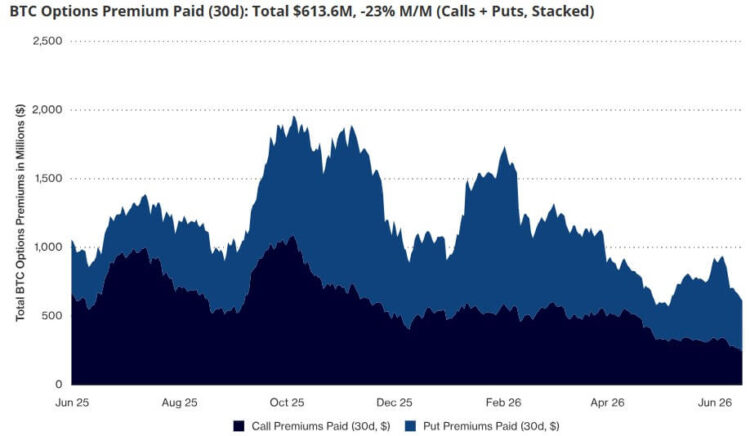
The second signal is visible in derivatives. Over the past month, premiums paid for Bitcoin puts were nearly 50% higher than those paid for calls, lifting the put-to-call premium ratio to about 1.49. VanEck said that level has been seen only around 10% of the time since 2021, which suggests traders are still willing to pay a higher price to hedge against another decline even as Bitcoin recovers.
Perpetual futures positioning also looks restrained. Average open interest fell from about $35.7 billion two months ago to roughly $29.4 billion. Funding rates stayed positive, but remained below historical averages. That points to limited leverage chasing the market higher and reduces the immediate risk of forced-liquidation cascades. It also means derivatives alone may not be enough to drive a longer rally without stronger spot demand.
Long-term holders are still not rushing to sell
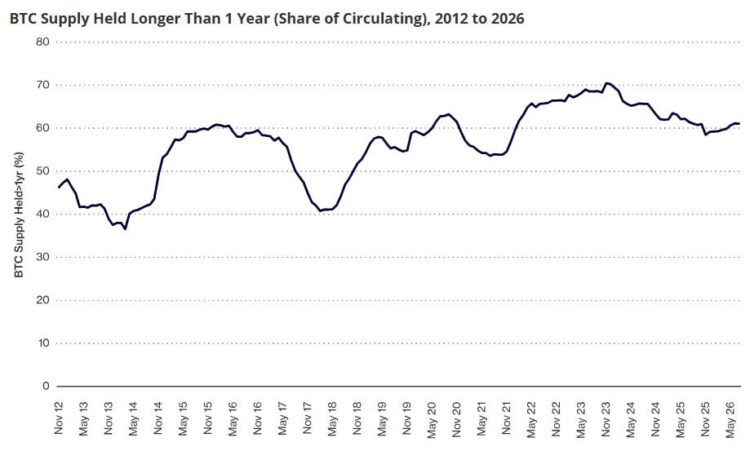
The third signal is continued supply contraction. About 12.2 million BTC have not moved for more than one year, or roughly 60.8% of circulating supply, up from 59.1% six months ago. Another roughly 3.55 million BTC have been dormant for six to 12 months, which means about 78.5% of supply has not changed hands for at least half a year. That keeps tradeable supply tight.
There has still been some change on the supply side. Exchange balances increased by about 26,674 BTC over the past month, showing that some coins have moved back into liquid circulation. Some Bitcoin held for three to 10 years has also started to move.
ETF inflows have returned, but the rebound is still early
The fourth signal comes from ETF demand. U.S. spot Bitcoin ETFs have recorded six consecutive days of net inflows, totaling more than $930 million. On July 20 alone, net inflows were about $226 million. That follows outflows of roughly 40,010 BTC, worth about $2.4 billion, from related U.S. products over the previous 30 days, so the latest turn still looks more like an early repair phase than a full reset in demand.
$69,000 is the next key zone
Glassnode said Bitcoin is approaching the short-term holder cost basis near $69,000, the average entry area for investors who bought over the past five months. If price reaches that zone, some previously trapped holders may choose to exit at breakeven, making $69,000 an important near-term decision area. A clean break above it would open the way to test resistance around $70,920.
Support is clustered near $63,000. If ETF inflows continue, spot volume picks up, and long-term holders do not begin broad profit-taking, the rebound would have a stronger base. If spot demand stays thin and the options market remains tilted toward hedging, the breakout may keep its high-volatility structure.
Taken together, the four signals point in the same direction: Bitcoin is recovering, but the market has not shifted into broad-based chasing yet.