
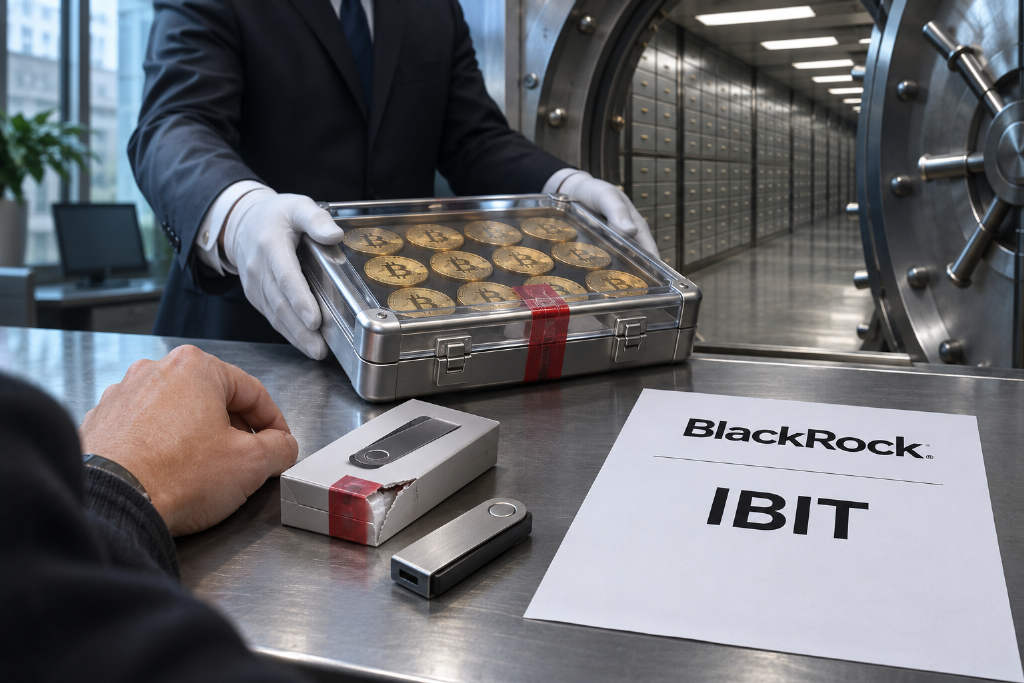
“Not your keys, not your coins” has long been one of crypto’s core rules. That rule is facing a practical challenge as large bitcoin holders move assets from self-custody into exchange-traded funds.
Robbie Mitchnick, BlackRock’s head of digital assets, said large bitcoin holders are converting self-custodied BTC into IBIT shares through in-kind transactions at a pace the firm has not previously seen. Security is a central reason. Physical threats, compromised hardware wallets and attacks on centralized exchanges are changing how some investors assess custody.
Physical attacks add a new layer of risk
Crypto holders can lose control of assets without clicking a phishing link or exposing a seed phrase online. In recent years, “wrench attacks” have become more frequent. Attackers may pose as delivery workers, food couriers or police officers, then use physical force to obtain a seed phrase or compel a victim to unlock and transfer funds.
These attacks do not require sophisticated code or a break in cryptography. A physical threat can bypass technical defenses. Reported incidents have included kidnapping, serious injury and fatal violence.
CertiK reported 52 violent attacks against crypto holders worldwide in the first half of 2026, up 33.3% from a year earlier. The cases involved about $124.1 million in documented financial exposure, compared with $10.5 million a year earlier. France accounted for 33 cases, close to two-thirds of the global total.
Attackers are also combining on-chain transaction records, leaked customer databases and social-media information to identify wealthy holders and map their assets, routines and family details. Hiding a private key is no longer the only concern; some holders also need to conceal their wealth and identity.
Hardware-wallet security has come under pressure as well. Cold wallets were once viewed as a refuge for long-term holders because private keys remained offline and devices were separated from the internet. Offline storage, however, does not eliminate every threat.
In August, the bitcoin-focused hardware wallet Coldcard was linked to the theft of more than $100 million after an early key-generation vulnerability. In October, Ledger became involved in a supply-chain attack after devices sold through its Southeast Asian distributor CryptoBilis were found to contain unauthorized hardware implants. Estimated losses reached as much as $93 million. Trezor recently confirmed that devices sold through CryptoBilis may have faced similar tampering.
For most users, such manipulation is difficult to detect. The appearance of a device may not reveal whether a malicious component has been installed, weakening confidence in hardware wallets as a custody solution.
Exchanges are not a risk-free alternative
Centralized exchanges are not an absolute safe haven either. Many retail users have historically stored assets with major exchanges because those platforms maintain security teams, risk controls and reserves. Compared with managing private keys alone, exchange custody can appear easier to operate.
In recent months, however, major exchanges have also suffered serious security incidents. Bitget and Binance were both hit by major events involving assets worth billions of dollars. Reserves and reimbursement capacity may cover losses, but they cannot guarantee that a platform’s defenses will never be breached.
As artificial-intelligence technology advances, attackers may gain more complex, efficient and discreet methods. Compensation can address a financial loss; rebuilding damaged confidence is harder. The risk now spans physical attacks, tampered hardware and compromised exchange infrastructure.
Why whales are choosing ETFs
Some bitcoin whales are handing custody to Wall Street. For them, an ETF offers more than an investment vehicle: it offers a form of security and operational relief.
Last month, analyst PlanB said he moved his bitcoin into an ETF in 2025. The decision drew criticism at the time. After the Coldcard key-generation controversy and the discovery of unauthorized hardware in Ledger devices, he said he did not regret the move and no longer considered himself a bitcoin maximalist.
PlanB said an ETF lets him manage bitcoin in a way similar to stocks and bonds, without handling a hardware wallet or protecting private keys himself. That structure gives him greater peace of mind.
Mitchnick said in a recent interview that ETF demand had reached levels BlackRock had never seen before and was not moving with bitcoin’s price. “The scale of demand for ETFs is at a level we have never seen before, and it does not change with the price of bitcoin,” he said. “This kind of asset-replacement demand has basically continued to grow.” He identified security and peace of mind as the main reasons cited by clients.
Since regulators approved in-kind creation and redemption for crypto assets last year, BlackRock has recorded about $3.6 billion in conversions from directly held bitcoin into IBIT shares. BlackRock does not process every transaction itself, and the fund may not capture every conversion, so the actual amount could be higher.
The minimum size for an IBIT in-kind conversion has also fallen. It declined from about $30 million initially to roughly $1 million-$2 million. Mitchnick said he would like to see the threshold fall to a single ETF share, although the cost structure is unlikely to reach zero in the short term.
Matt Hougan, chief investment officer at Bitwise, has made a similar argument. He said an attack on Binance does not mean that the bitcoin network itself has a security flaw; the target was Binance’s hot-wallet system. Investors focused on security can use professional custody, a personal cold wallet or an ETF with multiple security layers.
Hougan said an ETF’s underlying bitcoin is held by regulated custodians in cold wallets physically isolated from the internet. At Bitwise, transfers from cold storage require approval from multiple people. A compromise involving one employee or device would not be enough to trigger a transfer. Assets can be sent only to a small number of pre-approved market-maker addresses that are authorized to create and redeem ETF shares, making a direct transfer to an attacker’s address more difficult even if cold storage is breached.
ETFs still have limits. The underlying bitcoin is transferred only once a day. ETF shares can trade throughout the day, but investors cannot instantly withdraw or move the corresponding bitcoin. The structure is therefore better suited to long-term holders than users who require immediate transfers.
Custody concentration creates another concern
Du Jun, a partner at ABCDE Capital, previously said that some family offices that had been advised to hold BTC and ETH moved their bitcoin into IBIT after suffering exchange thefts and hardware-wallet supply-chain incidents. Some others sold crypto assets for physical gold and other traditional assets.
The use of security concerns to promote institutional custody has drawn criticism from self-custody advocates. They argue that bitcoin was created to reduce dependence on traditional financial institutions and give individuals direct control of their assets. Moving coins into traditional financial custody may reintroduce risks such as asset screening and freezing, conflicting with bitcoin’s original principles.
Institutional custody and self-custody do not have to be mutually exclusive. Self-custody may suit investors who prioritize asset sovereignty and direct control, while institutional custody can meet the security and management needs of large holders. A tiered approach, with different custody arrangements for different asset sizes and liquidity needs, is also being discussed.
Concentration is a separate issue. Coinbase is the primary custodian for several major bitcoin ETFs. Its disclosures show that it holds about 90% of the bitcoin ETF custody market. Investors may hold shares through different funds, but a substantial amount of the underlying bitcoin is still held by one institution.
Yishi, founder of OneKey, has warned that concentrated BTC custody deserves close attention and said he suspected IBIT could be on a potential target list for North Korean attackers. Recent major crypto security incidents have been linked to North Korean hacking groups. Such attacks may not steal private keys directly; attackers can disguise malicious software as legitimate tools, compromise a signer’s device and hijack the transaction-approval interface. Cold storage and multisignature procedures can face similar threats.
Yishi noted that Anchorage Digital had been appointed as an additional custodian, but the latest quarterly filing showed no plan to transfer bitcoin at that point. If a major theft occurred and the fund could not recover the bitcoin or obtain sufficient compensation, the remaining loss would ultimately fall on IBIT shareholders. He recommended distributing assets across independent custody arrangements, keeping private keys offline, verifying transaction details independently on a trusted device screen and reviewing the security architecture on an ongoing basis.
Coinbase’s latest disclosure said assets in its custody vaults are held entirely in cold storage and segregated on-chain. Its controls include key sharding, signing without reconstructing a complete private key, limits on transfers from cold wallets to hot wallets, abnormal-activity monitoring and an emergency stop that can take signing keys offline. Client assets are held on a 1:1 basis and are not lent or used for other purposes without client instructions.
The ETF-versus-self-custody debate remains unresolved. The practical question is how each holder should balance security, control, liquidity and operational needs against the available custody options.



