
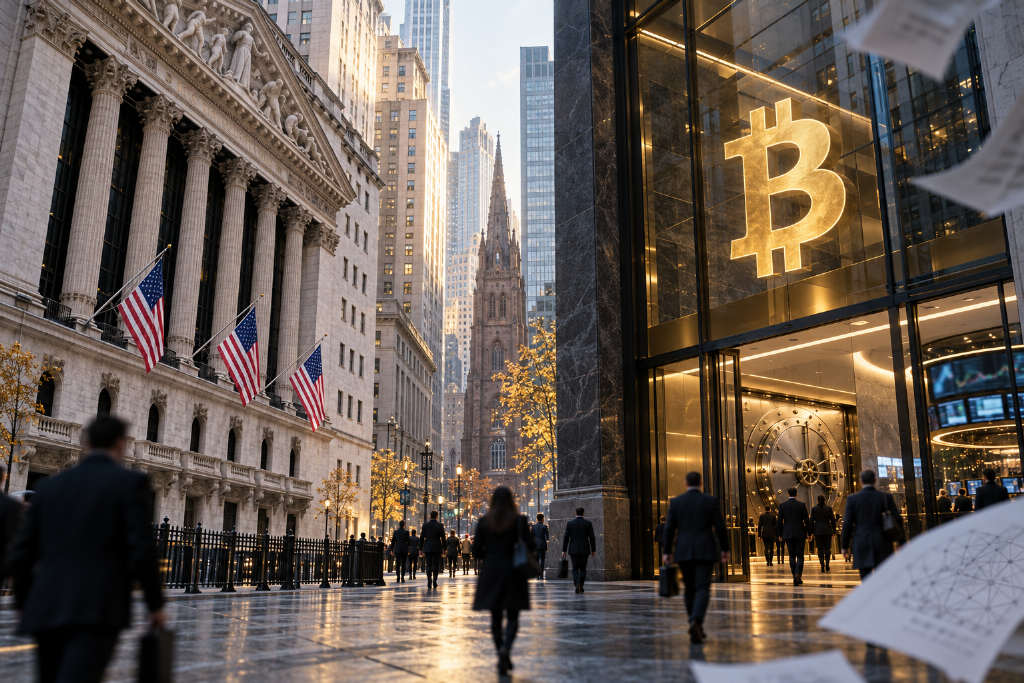
Bitcoin will turn 18 this Saturday, marking another anniversary of the white paper published by the pseudonymous Satoshi Nakamoto. In a report by Bloomberg, the milestone is framed less as a celebration than as a test: after nearly two decades, has Bitcoin truly matured, or does it only look more grown-up now that Wall Street has embraced it?
Eighteen years ago, Nakamoto outlined a decentralized electronic payment system designed to let people transfer value directly without relying on banks or other central authorities. Looking back, Bloomberg says the experiment has traveled a long way from that original rebellion. People have made fortunes from Bitcoin, and some relationships have broken under its weight. Entire ecosystems have formed around it, and some later collapsed. Governments have bought it. Public figures have called it "rat poison." For years, arguments over what Bitcoin actually is have never stopped.
Bitcoin has also been declared dead more than once, only to return again. It was once pushed to the edge of mainstream finance. Now it has supporters across the financial system, including Wall Street.
Wall Street is now one of Bitcoin’s backers
"It has definitely come a long way," Anastasia Melachrinos, head of growth at Kaiko, said. "Think about where Bitcoin started, on the dark web and in forums. And in 18 years, we’ve gone from there to a whole new asset class."
Bloomberg says Bitcoin has gained social legitimacy, especially in recent years, and investors now have several ways to get exposure. Those options include products offered by Wall Street firms such as BlackRock. The report says BlackRock manages a Bitcoin ETF worth $66 billion. Dozens of listed companies have also added Bitcoin to their balance sheets, while some of the world’s wealthiest investors continue to speak positively about it.
The irony is hard to miss. Bitcoin was created to challenge centralized finance, yet some of the institutions it aimed to bypass have become among blockchain’s strongest supporters. Bloomberg says Wall Street is accelerating its push into stablecoins, tokenized assets, and blockchain-based financial infrastructure, bringing the technology into the same financial system Bitcoin originally tried to route around. There are many examples of that shift, but few still carry the feel of a revolt against the old order.
"Bitcoin’s most fundamental significance is that it proved value can move without intermediaries," Linda Jeng, chief legal and policy officer at Aave Labs, said. "Since then, Bitcoin has also driven several waves of digital finance. A technology that once sat at the margins is becoming a new financial system."
Volatility has eased, but sharp moves remain
On stability, Bloomberg says Bitcoin has made some progress. As ETFs have become more common, access to Bitcoin has become easier, and that has helped pull back some of the extreme price swings that once defined the asset. Earlier this month, its 30-day volatility fell to the lowest level in three years.
That does not mean Bitcoin has left its unruly side behind. It still goes through violent moves. Bloomberg points to a sudden selloff in October last year that liquidated a record $19 billion in leveraged positions in a single day. The report also revisits the 2022 crypto winter. In November of that year, FTX, the crypto exchange founded by Sam Bankman-Fried, collapsed, and more than $2 trillion in crypto market value was erased afterward.
Bitcoin also continues to move with U.S. equities. Bloomberg says it remains highly correlated with the Nasdaq 100, a sign that its price action still lacks independence.
Little party mood ahead of the 18th birthday
As Bitcoin has moved deeper into the mainstream, it has also lost some of its edge. It is no longer just the rebellious asset challenging the financial establishment, and no longer only a bold wager for risk-seeking traders. Bloomberg says it has become an asset that ordinary investors may include in a balanced portfolio. Last week, venture capital firm Andreessen Horowitz formally changed the name of its crypto fund from a16z Crypto to a16z Frontier.
There is not much celebration in the market ahead of Bitcoin’s birthday. On current performance, this month may become Bitcoin’s worst month since June. The momentum built over the summer has not carried through, and the price is now hovering around $80,000.
Views on Bitcoin remain sharply divided. Supporters say it can soon return to $100,000 and eventually reach $1 million. Critics say it is worth nothing.
Anthony Scaramucci, founder of SkyBridge Capital, said he first bought Bitcoin years ago at $6,000 and later bought more at $16,000. He said he has always treated the position as a five-year bet on the future. He expects Bitcoin to double over the next five years, which he calculates would equal a compound annual return of about 15%.
"Bitcoin is the benchmark for this industry," he said in the interview. "It will still be here long after you and I are gone."



