

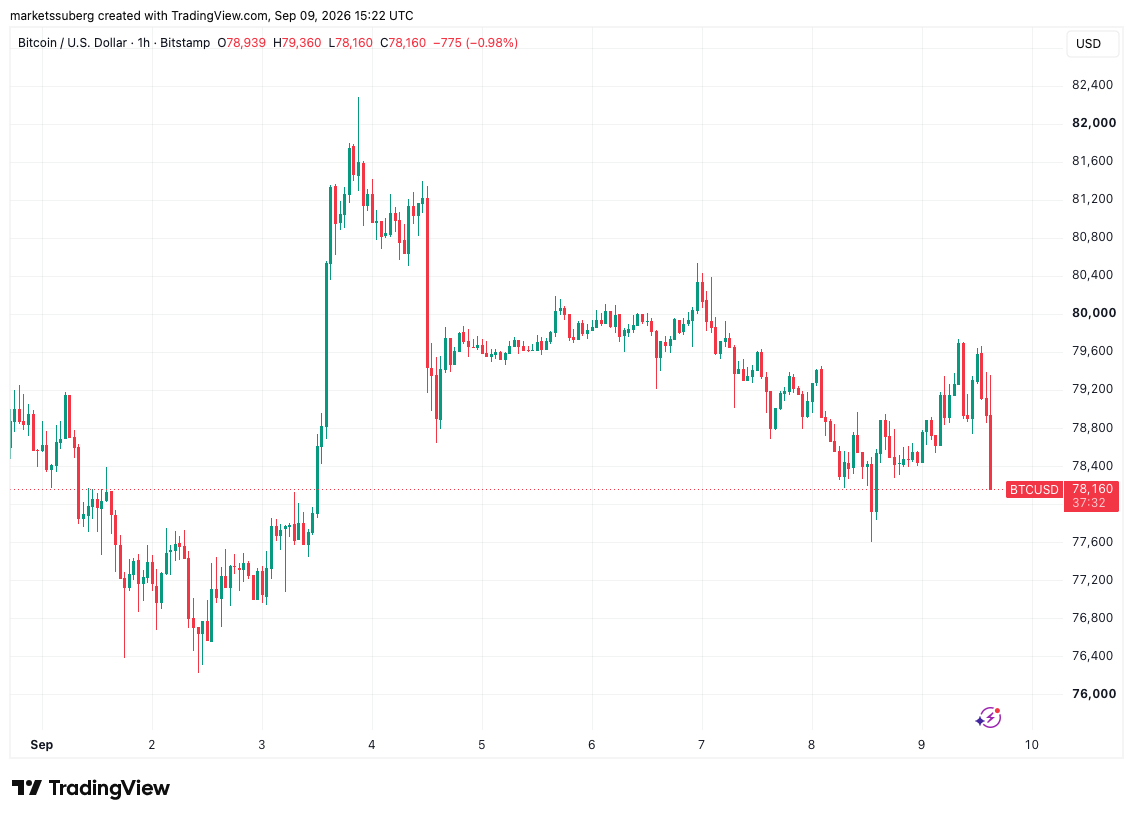
Bitcoin stayed below $80,000 on Wednesday as markets refocused on the yen and a broader deterioration in risk sentiment tied to the latest US-Iran escalation.
The move came as US Treasury Secretary Scott Bessent added to concerns over a possible unwind in yen carry trades, while oil prices jumped after fresh US strikes on Iranian oil tankers.
Bitcoin loses steam as Iran-linked escalation hits risk appetite
Data from TradingView showed BTC/USD reversing after a local push higher that sought to retest the $80,000 mark. At the time of writing, Bitcoin was down around 0.4% on the day.
US stocks also drifted lower at the Wall Street open. The decline followed fresh US strikes on Iranian oil tankers, which helped push oil to new three-month highs and extended gains from the previous day.
WTI crude traded above $96 per barrel, while Brent crude climbed above $101 per barrel for the first time since late July. Earlier in the report, Brent was described as moving above $100 per barrel as the US-Iran strikes added new macro headwinds for Bitcoin.
Yen strength returns to the center of attention
Traders were also watching the Japanese yen, which continued to trade around 153 per dollar, its strongest level since February. The report said the yen was at $0.0065, up 6.5% since the start of August.
Cointelegraph had previously reported on repeated joint foreign-exchange interventions by Japan and the US that led to a rapid strengthening in the currency. Those gains continued even as markets speculated that Washington might stop Japan from selling US Treasurys as part of future intervention efforts.
Yen short positions remain near record levels
Citing Bloomberg data on Wednesday, Barchart said yen short positioning at the start of September remained near record highs, with the total still above 5 trillion yen.
Reuters also cited comments from Charu Chanana, chief investment strategist at Saxo, who said sustained yen strength would matter for those short positions and could feed into an unwind of the yen carry trade. She said USD/JPY is important for liquidity conditions that may ultimately affect crypto markets.
"The carry trade is vulnerable because this unwind is happening before the BOJ has even delivered its expected hike," she said.
She added: "Some yen shorts have already been cut, but positioning still looks sizeable, so further yen strength can turn a gradual reduction in leverage into a much faster, self-reinforcing unwind."
That risk was amplified by expectations that the Bank of Japan will raise rates by 0.25% at its next meeting on Sept. 28.
Bessent reinforces intervention signal
Last month, US Treasury Secretary Scott Bessent said the door remained open to future yen intervention operations. This week, he repeated those hints and appeared to challenge traders betting against central banks.
Quoted by the Financial Times from an event at Southern Methodist University in Texas on Tuesday, Bessent said: "When we intervene with the Japanese yen, I have pretty good insight into what the Bank of Japan is going to do, what Japanese policymakers are going to do. I have asymmetric information. I am the house now."
With Bitcoin still lacking momentum, oil moving higher and the yen staying firm, macro conditions remained at the center of the market’s short-term focus.