Top stories
UK inflation accelerated in September
UK CPI rose 3.5% year over year in September, above August’s 3.1%. Core CPI increased 2.8%, compared with 2.6% previously. Motor fuel was cited as a major driver behind the faster headline reading, while service price growth moved up from 3.4% to 3.7%.
The report said firmer energy and services prices both added to concerns about inflation persistence. It said wages, consumption and energy costs remain key variables for judging the Bank of England’s policy path and the reaction in sterling and gilts.
Oil rebounded after U.S. inventory draw and Middle East developments
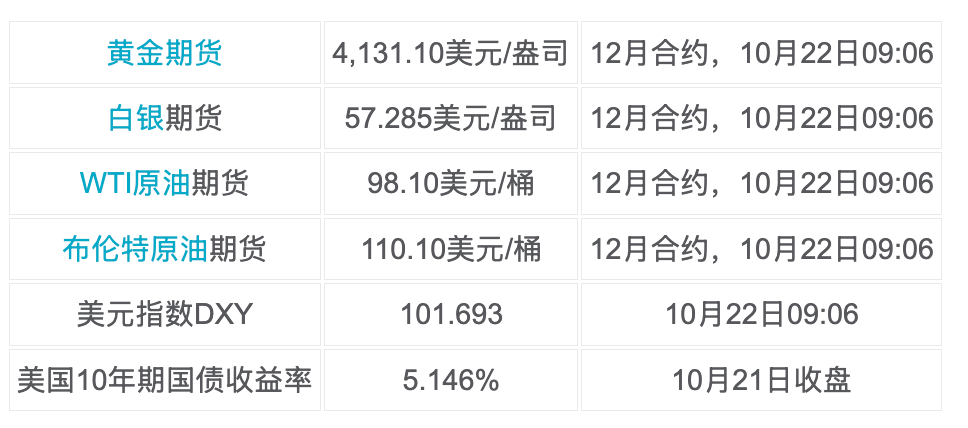
U.S. commercial crude inventories fell by 3.06 million barrels last week, while distillate inventories rose by 1.68 million barrels. On Oct. 21, Brent settled at $108.82 and the December WTI contract settled at $97.15. In early trading, they recovered to $110.10 and $98.10, respectively. Over the same period, the U.S. ordered the departure of some diplomatic personnel and family members from Saudi Arabia.
According to the report, crude pricing is being shaped by both inventory drawdowns and regional security risks, though crude and refined product inventories are not tightening in sync. It said actual shipments, shipping normalization and refinery supply still need to be watched to judge whether the risk premium can hold.
OCC released final implementation rules for the GENIUS Act
The U.S. Office of the Comptroller of the Currency on Oct. 21 released final rules covering payment stablecoin issuers under its supervision, foreign issuers and certain custody activities. The rules are scheduled to take effect on Jan. 18, 2027. Anti-money laundering, Bank Secrecy Act and sanctions-related provisions will be handled through separate rulemaking procedures.
The report said the rules give clearer guidance on reserves, redemption and risk management, offering a framework for banks and non-bank institutions planning related business lines. It also noted that publication of the rules is not the same as operational approval, leaving application procedures and implementation details as the next points to watch.
Market review
Commodities and FX
Oil moved higher again after pulling back in the previous session, while precious metals remained constrained by a high-yield environment. The report said markets still need to separate short-term safe-haven positioning from supply changes that can have a lasting effect on inflation.
Crypto market performance
BTC traded at 84,341.97 USDT, up 1.70% over 24 hours. ETH traded at 2,478.13 USDT, up 1.15%. Total crypto market capitalization was about $2.83 trillion, down 1.42% over 24 hours, with the market cap timestamp listed as 09:19 Beijing time.
Liquidation distance and cost-gap calculations were based on reference prices of $84,294.40 for BTC and $2,476.73 for ETH.
For BTC, the report identified a more visible potential short liquidation cluster at roughly $85,000-$85,600, or about 0.84%-1.55% above spot. On the downside, it placed a potential long liquidation cluster around $83,600-$83,950, or about 0.41%-0.82% below spot. Because the lower zone is closer, the report said traders should watch whether long deleveraging amplifies volatility on a pullback.
For ETH, the report placed a more visible potential short liquidation cluster at roughly $2,490-$2,530, or about 0.54%-2.15% above spot. A potential long liquidation cluster was identified around $2,420-$2,450, or about 1.08%-2.29% below spot. Since the upper zone is closer, the report said any continued rebound should be watched for short covering pressure.
On institutional cost bases, Glassnode said on Oct. 21 that the estimated average BTC cost for the treasury companies it tracks was about $80,200, based on holdings data through Oct. 19. The current BTC price was about 5.11% above that reference. Strategy held 848,517 BTC as of Oct. 18, with an all-in average cost including fees of $75,446. The current BTC price was about 11.73% above that level. The report added that these figures compare market price with BTC acquisition cost only and do not represent overall company investment returns.
Its short market takeaway was straightforward: for BTC, first watch downside risk near $83,600-$83,950, then upside liquidation pressure at $85,000-$85,600. For ETH, price was closer to the $2,490 area. The report said institutional cost references sit lower and should be analyzed separately from current liquidation zones rather than treated as fixed support or breakout targets.
U.S. equities and sector moves
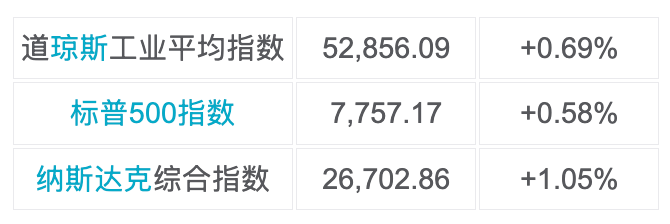
The three major U.S. indexes all closed higher, with the Nasdaq leading. AI server and semiconductor names were stronger, though some large-cap tech stocks still fell. The report said the market continued to differentiate based on earnings and how fully expectations had already been priced in.
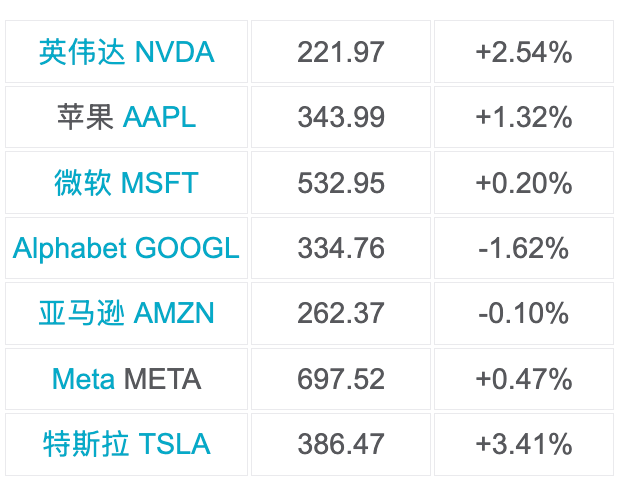
Among the Magnificent Seven, five stocks rose and two fell. Tesla and Nvidia led gains, while Alphabet and Amazon closed lower. The report noted that the table used regular-session closing prices before earnings, meaning Meta’s and Tesla’s after-hours results still needed to be judged against the next trading day’s price action.
In AI infrastructure, Super Micro Computer rose 9.55%, Nvidia gained 2.54%, AMD added 3.36% and Broadcom rose 1.03%. The report said Super Micro’s higher preliminary revenue and gross margin outlook offered fresh support for server demand, while order conversion, customer mix and cash collection still need monitoring.
Among crypto-linked stocks, Coinbase rose 3.65% and Strategy gained 7.54%. The report said progress in stablecoin regulation and the rebound in crypto assets offered useful signals, but the drivers behind exchange revenue and treasury-company valuations are different, so trading activity and financing conditions should be tracked separately.
Key U.S. stock analysis
Meta: strong ad growth, but capital spending kept pressure on cash flow
Meta closed regular trading at $697.52, up 0.47%. After the bell, it reported third-quarter revenue of $64.6 billion, up 26% year over year. Ad impressions rose 10% and average ad prices increased 14%.
The report said stronger volume and pricing supported the core business, but $34.91 billion in capital expenditures pushed quarterly free cash flow to negative $2.12 billion. Full-year capital expenditure guidance was narrowed to $135 billion-$145 billion, leaving AI-related cash spending at a high level.
It said the next focus is whether fourth-quarter revenue guidance of $73 billion-$76 billion can be met and whether AI spending continues to improve ad efficiency. About $9.9 billion in litigation expenses also affected quarterly profit, so one-off charges and ongoing operating costs should be separated in any earnings assessment.
Tesla: free cash flow turned positive, operating profit fell 56%
Tesla closed regular trading at $386.47, up 3.41%. After hours, it reported third-quarter revenue of $28.046 billion, little changed from a year earlier. Adjusted EPS was $0.48 and free cash flow came in at $1.531 billion.
The report said automotive gross margin excluding regulatory credits improved to 18.1% from the second quarter, but operating profit fell 56% year over year to $718 million, with an operating margin of 2.6%. It added that operational improvement and higher spending on AI and robotics are happening at the same time, so positive free cash flow does not mean profit pressure has disappeared.
What comes next, according to the report, is the durability of auto gross margin, deliveries and operating cash flow, along with the pace at which new-business investment turns into revenue. It also cautioned that the regular-session gain came before the earnings release and should not be treated as the market’s final verdict on the results.

Super Micro Computer: preliminary revenue and gross margin outlook both raised
Super Micro Computer closed at $35.57, up 9.55%. The company said after the close on Oct. 20 that preliminary first-quarter fiscal 2027 revenue is expected at $18.5 billion-$19.5 billion, above prior guidance of $14.5 billion-$15.5 billion. Gross margin is expected at 12.0%-12.5%, versus prior guidance of 10.4%-10.8%.
The report said simultaneous improvement in revenue and gross margin helps ease concerns about the quality of AI server growth. The company attributed the change to stronger demand for AI platforms and a better customer and product mix, though the figures remain unaudited preliminary estimates.
Its formal earnings release on Nov. 3 will offer a fuller test of growth quality. The report said customer concentration, delivery pace, accounts receivable and cash flow are the main items to watch in judging whether demand growth can convert into profit on a sustained basis.
Market and project updates
Solana activated the Alpenglow consensus upgrade
Anza said on Oct. 21 that Alpenglow had gone live on the Solana mainnet beta, cutting transaction finality from about 12.8 seconds to about 150 milliseconds. The report said faster settlement could improve payment and trading experience, while network stability and real-world adoption still need to be observed.
Grayscale expanded in-kind subscriptions to 10 products
Eligible investors can directly deliver the relevant digital assets in exchange for designated ETF or trust shares, covering assets including BTC, ETH, SOL and XRP. The report said the mechanism improves convenience for moving token holdings into investment products, but in-kind subscriptions should not be equated with new cash inflows.
Standard Chartered signed a final agreement to acquire Zodia Custody
Standard Chartered plans to acquire all equity in Zodia Custody, subject to regulatory approval and other closing conditions. After completion, the custody business will be folded into Standard Chartered’s securities services division, while the software business is intended to operate separately as Zodia Solutions. Financial terms were not disclosed.
Aerodrome and Velodrome merged to launch Aero
The combined on-chain spot trading platform will cover seven networks including Ethereum, Base and Robinhood Chain. Existing AERO and VELO will migrate to a new AERO token. The report said the cross-chain integration broadens business scope, while migration arrangements, liquidity distribution and governance changes remain key points to follow.
Today’s market calendar
Looking ahead, the report said labor market data will test employment resilience, while leading indicators and regional manufacturing surveys will add to the growth picture. Procter & Gamble’s volume, pricing and cost performance may also offer clues on whether consumer demand can absorb pressure from energy prices and financing costs.
On institutional views, Glassnode said in an Oct. 21 report that BTC still faces multiple layers of supply pressure in the $85,000-$87,500 range. It added that continued ETF inflows accompanied by higher trading volume would be a stronger sign of expanding demand. The Bitget UEX note treated that as a medium-term framework and said it should be kept separate from the short-term liquidation zones seen this morning.
This report is for market information only and does not constitute investment advice.
Disclaimer: Markets carry risk and investment decisions require caution. This article does not constitute investment advice. Readers should consider whether any opinion, view or conclusion in the article fits their own circumstances and bear responsibility for any decisions made on that basis.