
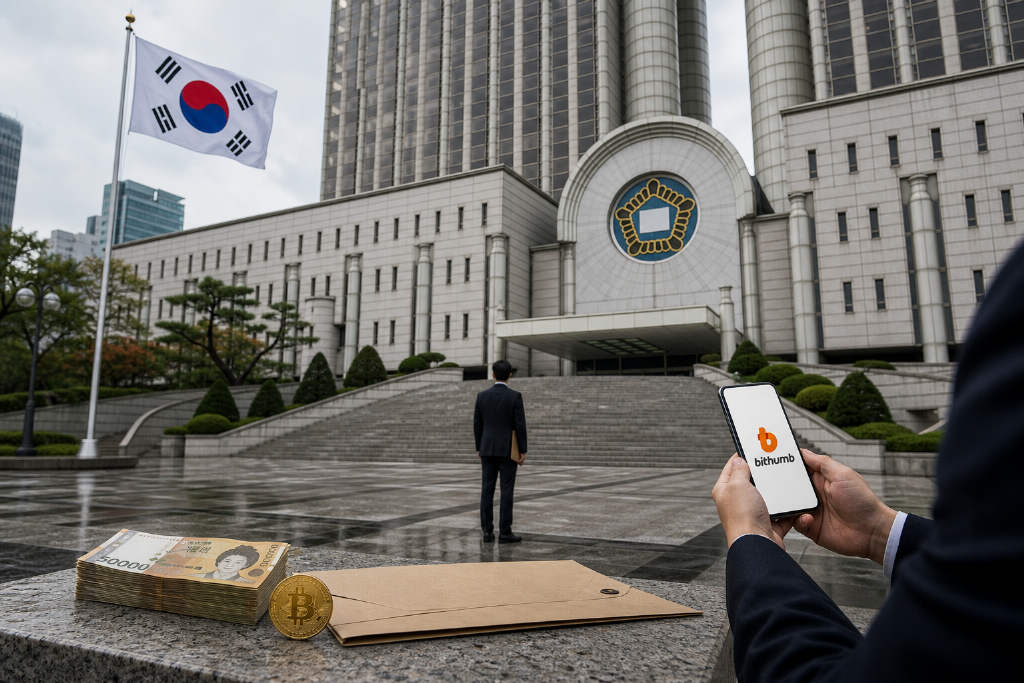
A Seoul court on Aug. 27 ruled for Bithumb and ordered one user to return KRW 194 million, about $140,000, in proceeds from selling bitcoin that had appeared in the account during the exchange’s February misallocation incident.
The decision was Bithumb’s second court win in two days after the exchange sued four users over the incident in March. On Aug. 26, the court also ruled for Bithumb in another case involving KRW 4,989,990, or about $3,600. The four lawsuits together seek about KRW 720 million, roughly $520,000.
Court ordered the return of cash proceeds
The ruling was issued Tuesday afternoon by Judge Kim Yoo-sung of the Civil Division 90 of the Seoul Central District Court. The court found that once the mistakenly credited bitcoin had been sold, the payment received from that sale had to be returned.
One detail stands out. The court ordered the return of the sale proceeds, not the return of the same amount of bitcoin. According to the report, BTC traded at about $62,778 on Feb. 6 and had risen to $78,825 by Aug. 27, a gain of about 26% over that period. Under that approach, Bithumb recovers the won value tied to the earlier sale rather than bitcoin priced at the later market level.
That point had been debated in South Korea’s legal community soon after the incident. Returning BTC by quantity would have forced defendants to buy it back at current prices. Returning cash instead effectively settles the matter at the price level on the day of the incident. The Seoul court chose the latter approach in this case.
620,000 BTC were credited after a staff input error
The incident happened at 7 p.m. on Feb. 6. Bithumb was distributing rewards for a lucky box event. Among 695 participants, 249 were supposed to receive rewards denominated in Korean won, with KRW 620,000 involved, but the employee handling the process entered bitcoin instead of won in the unit field.
The system then processed the transfer as entered, crediting 620,000 BTC to those 249 accounts. At about KRW 98.38 million per bitcoin that day, the book value came to KRW 61 trillion, or roughly $41.7 billion. South Korea’s Financial Services Commission later used that figure when explaining the scale of the incident publicly.
Bithumb itself held only about 46,000 BTC. The mistaken credit was 13 times that amount and close to 3% of bitcoin’s global supply. The report said the exchange was able to issue coins it did not actually hold because its internal ledger is, in practice, a numerical record rather than proof that the platform possesses the same quantity of BTC.
Lee Chan-jin, head of the Financial Supervisory Service, later said: 「The essence of the problem is that real transactions were completed using incorrectly entered data.」
Bithumb said it recovered 99%
Bithumb said it detected the problem in about 20 minutes, then immediately froze withdrawals and trading. It recovered 618,212 BTC. A total of 1,788 BTC were actually sold. In a report to the National Assembly in March, the company said it had recovered 99%, leaving less than 1% as the portion now at issue in court.
Defendants in the two decided cases did not appear
The report said both cases already decided were handled through service by public notice, meaning the court could not confirm the defendants’ addresses and treated notice as completed through public announcement. Neither defendant appeared in court or presented a defense.
Even so, South Korean legal sources interviewed by ZDNet Korea said the rulings still matter. Their reasoning was that the court clearly treated virtual assets as assets with property rights, and one prerequisite for restitution based on unjust enrichment is that the asset in question has economic value. One university professor interviewed said the ruling effectively reaffirmed that the civil-law principle of unjust enrichment also applies to virtual assets.
Two more lawsuits remain, while criminal liability is still unclear
The two remaining cases seek KRW 500 million, about $360,000, and KRW 14.8 million, about $11,000, and are still under review. The KRW 500 million case is the largest of the four.
On criminal liability, the report said a 2021 Supreme Court precedent in South Korea held that virtual assets are not easily treated the same as legal tender, making embezzlement charges difficult to apply. A fraud provision in the Act on the Protection of Virtual Asset Users could in theory reach conduct such as selling after recognizing that an account was abnormal, but no first precedent has emerged so far.
Other costs have already outweighed the lawsuit amounts
The combined claim across the four lawsuits is about KRW 720 million. Compared with the other costs Bithumb has faced over the incident, the report said that figure is almost negligible. The Financial Intelligence Unit, or FIU, imposed a KRW 36.8 billion fine, and the company pushed its IPO timetable beyond 2028 at a shareholders’ meeting.