

Crypto exchange closures are still spreading. On July 23, BitMEX said it would stop accepting new user registrations immediately and shut down on Sept. 23, 2026. Three days later, BitMart announced a phased wind-down of its trading platform. Earlier in July, AscendEX, formerly BitMax, had already said it would cease operations, citing MiCA regulation, market conditions and financial operating pressure.
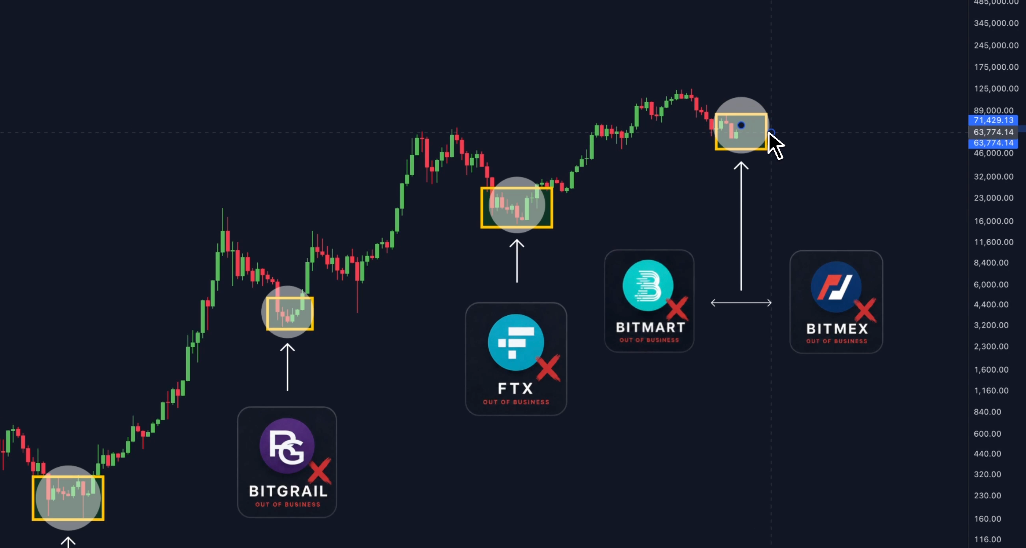
That sequence has drawn attention because exchanges have long been viewed as one of the few business lines in crypto with recurring cash flow. With two platforms announcing closures within three days, the discussion has shifted back to liquidity, user activity and whether another stage of exchange consolidation is underway.
Two exchange shutdown notices in three days
BitMEX said on the afternoon of July 23 that it will formally close at 12:00 Beijing time on Sept. 23 and that new user registration has already been halted. The company said the decision followed a strategic review by the board of its parent, HDR Global Trading Limited.
On the morning of July 26, BitMart published its own notice. It said that after a careful review of its operating conditions, market environment and future strategic direction, it had decided to orderly cease operation of its trading platform. Under the schedule in the statement, new registrations, deposits and new trading orders will be suspended from 01:30 UTC on July 26, 2026; all trading services will stop at 01:00 UTC on Aug. 26, 2026; and platform operations will formally end at 15:59 UTC on Jan. 31, 2027. BitMart said withdrawals will remain open.
The back-to-back announcements revived a familiar line of market discussion: when exchange activity weakens and platforms begin shutting down, some traders read it as a sign that the downturn has pushed deeper into core market infrastructure. That does not settle the question of a turning point, but it explains why the closures drew outsized attention.
Two different explanations emerged around BitMEX
CZ pointed to regulatory pressure
After the BitMEX news spread, Binance founder CZ said he was saddened by the closure. He wrote that BitMEX had introduced 100x leveraged perpetual contracts to the crypto market in 2014 and helped drive the industry forward. He also recalled that the exchange only supported BTC deposits, used a single-chain setup, and processed withdrawals once a day through a multisignature wallet system. Those design choices looked inconvenient at the time, he said, but also helped the platform avoid hacks over a long period.
CZ also noted that the four BitMEX co-founders admitted violating the Bank Secrecy Act one month before trial, with each fined $10 million and placed under home confinement, though none went to prison. In his view, BitMEX ultimately could not survive what he called the Biden-era “War on Crypto.”
That reading puts the focus on external pressure. Under it, the exchange’s ability to expand and keep operating was weakened by an aggressive regulatory environment.
Hasu focused on the insurance fund structure
Flashbots strategy lead Hasu offered a different explanation. He said structural issues in the BitMEX insurance fund may have been an important reason the company chose to shut down instead of being sold.
Hasu said he had warned as early as 2018 that the BitMEX insurance fund was not managed in segregated accounts and did not clearly define a cap on the fund size or how surplus assets would ultimately be handled. In his view, that structure could create incentives to liquidate users more aggressively, grow the insurance fund through liquidations, and eventually monetize those assets.
He estimated the fund may now be worth about $270 million. His argument centers on internal balance and market structure: if liquidation rules become too aggressive, the damage can eventually reach both the user base and the platform’s operating model.
BitMart debate turned to withdrawals and internal management
BitMart’s shutdown drew a different kind of response because the announcement appeared more sudden. The exchange has operated for eight years and, according to the company, has more than 13 million users. That left one immediate question hanging over the notice: whether users would be able to withdraw funds smoothly.
Community debate around BitMart has split into two broad lines. One is that the platform may have suffered some kind of funding blowup. The other is that poor internal management was the more direct cause.
Crypto KOL Joes said BitMart’s hot wallet address had shown unusual movement earlier and argued that the platform had not given clear answers on frozen user accounts, withdrawal anomalies and settlement issues.
DI, a BD manager at WEEX, wrote that “Bitmart’s internal culture is in complete chaos, constantly deceiving employees, traders, and key people, and refusing to pay them the salaries and bonuses they deserve.”
Other posts claimed BitMart had previously taken $30,000 from members of a meme coin community through listing fees. Some users also said the exchange had imposed multiple hurdles on withdrawals, disabling automatic withdrawals in favor of manual processing, which led to concerns about the handling of user funds.
At this stage, those claims remain unverified. The source material itself notes that it is still unclear whether the accusations reflect actual problems, attacks from competitors, or the kind of pile-on that often follows a high-profile shutdown.
After the shutdown notices, focus moved to losses and user migration
Beyond the closures themselves, users have been asking a more immediate question: who absorbs the damage, and what happens next to account holders.
BitMEX faces a proposed class action
BitMEX is in a more awkward position on that front. Because of its liquidation rules and platform design, it is facing a proposed class action in the Southern District of New York brought by BKX Services Inc. and David Namdar.
The plaintiffs allege that the exchange forcibly liquidated leveraged positions and retained 622.66 BTC that should have been returned to traders. Combined with the insurance fund controversy, that legal dispute has sharpened scrutiny of how BitMEX handled risk and customer positions.
Other platforms moved quickly to court BitMart users
BitMart users, meanwhile, became the target of open competition from other exchanges and crypto platforms almost as soon as the shutdown statement was released.
Huobi said BitMart users were welcome in its C2C trading market and added that BitMart employees would have a dedicated route to join Huobi HTX.
Bruce, founder of MSX.COM, posted a direct appeal: “Don’t shut down, I’ll acquire it.”
Websea Chinese said it had opened a relocation channel for BitMart users, and Blockfinex expressed a similar position.
Those responses turned the fallout from BitMart’s closure into a public battle for users, staff and traffic.
The shutdown wave is still expanding, and a market bottom remains unconfirmed
The exchange announcements did not come in isolation. The input says that since the crypto market entered a bear phase on Oct. 11 last year, dozens of projects have shut down across categories including DeFi platforms, crypto wallets, on-chain DEXs and research firms.
In the past week alone, research firm Hazeflow, Cardano ecosystem wallet SecondFi, DEX aggregator Odos and DeFi platform Dango have all ceased operations. The same source also mentions a number of quieter exits, with some teams simply stopping social media updates or disappearing altogether.
Even so, the recent exchange closures do not provide enough evidence on their own to call a definitive market bottom. The source notes that the industry has not yet seen a historical-scale collapse comparable to Mt.Gox or FTX during this stretch. BitMart’s final post said, “The future still belongs to blockchain.”