

BitMiracle AI Lab has published a 23-page paper saying its research agent ClawsGO Science proved a chemistry conjecture proposed in 1974. Under the workflow described in the paper, one Claude Opus 5.5 model handled decision-making, 136 GPT 6 Astra agents carried out execution, and the run lasted 11 days. The final result was released as 83 public Lean files.
The question centers on a familiar line from chemistry textbooks: in a closed container, does a reversible reaction with the same total quantity always end at the same equilibrium point, no matter how the initial ingredients are arranged? BitMiracle’s answer is yes, and it says the proof was produced by AI.
A half-century problem in chemical reaction network theory
The report says chemist Fritz Horn formally posed the problem in 1974, and that it remained on the list of hard questions in chemical reaction network theory for decades.
It illustrates the issue with a simple example. Put several substances into a closed container: A and B form C, and C breaks back down into A and B. The reaction keeps running and concentrations keep changing. The unresolved question was what happens in the end. Does the system keep oscillating? Does one substance get depleted? Can different starting points lead to different endpoints?
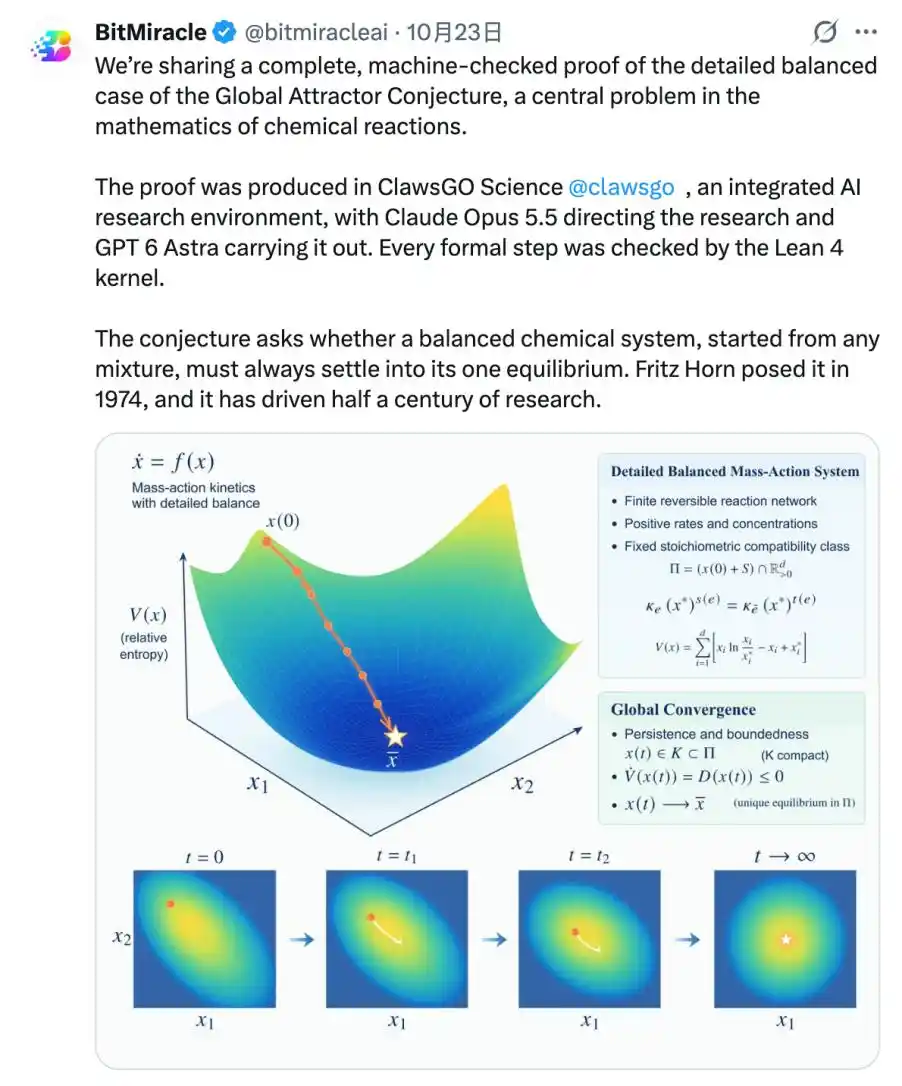
The article also looks back to work by Horn and Jackson in 1972. It says they found a quantity similar to entropy that only decreases as the reaction proceeds. In that picture, the system behaves like a ball rolling downhill, with the valley floor representing equilibrium.
But there was a trap near the boundary. The concentration of some substance could move arbitrarily close to zero, making the system appear to settle even though it had only reached a false endpoint on the boundary rather than the true equilibrium state. Ruling out that case completely became the hard part over the following decades.
One Opus model, 136 Astra agents
The paper lays out the division of labor inside ClawsGO Science.
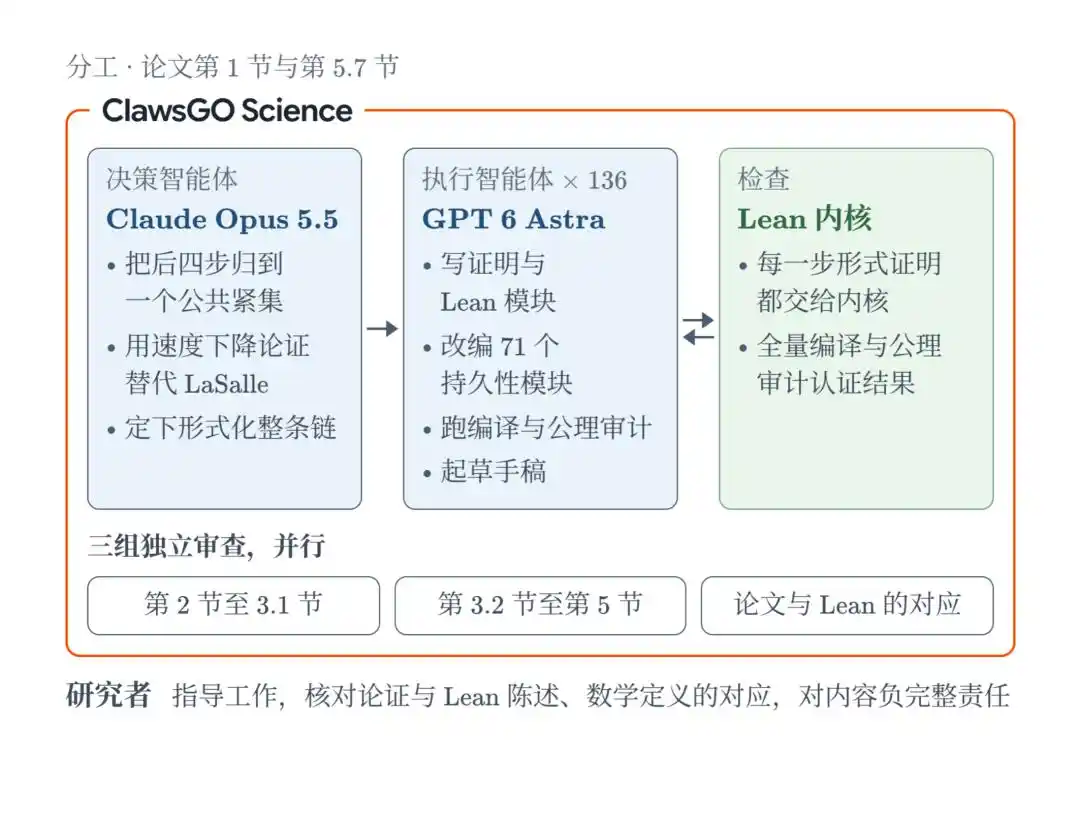
- Claude Opus 5.5 acted as the decision agent, choosing the route of the proof, replacing steps when needed, and sending the full argument for machine checking.
- 136 GPT 6 Astra agents served as execution agents, writing the proof, producing Lean code, compiling it, reading error messages, fixing issues, and compiling again.
- Lean’s kernel checked the proof step by step.
The report says the turning point came on day 6. Dozens of execution agents returned with the same issue: the textbook route required too much foundational work before the blocked step could be completed. The decision agent then switched to a different path. On the next day, the stuck step compiled successfully. The article says that step later became the key move in the paper.

Researchers were still involved. Their role was to set the problem, review the argument, and verify that the proposition checked by the machine was in fact the same problem under discussion. The portion that required human verification was described as fewer than 60 lines.
The paper also limits the scope of the result. Strictly speaking, it proves the conjecture for the class of cases that satisfy detailed balance, and the first step uses an existing theorem. From there to the end, the proof chain was machine-checked.
From mathematics to the natural sciences
The article places the result in a broader AI research context. It says AI first broke through in mathematics this year, with hundreds of mathematical manuscripts released and several long-standing problems pushed forward. One month ago, the WeChat account Xinzhiyuan wrote: “Physics, chemistry, and biology will get there sooner or later. Every discipline will have its day. Mathematics just got there first.”
BitMiracle is now framing chemistry as the next step. The article argues that mathematics mainly needs a system for checking proofs, while the natural sciences also depend on experimental and computational environments.
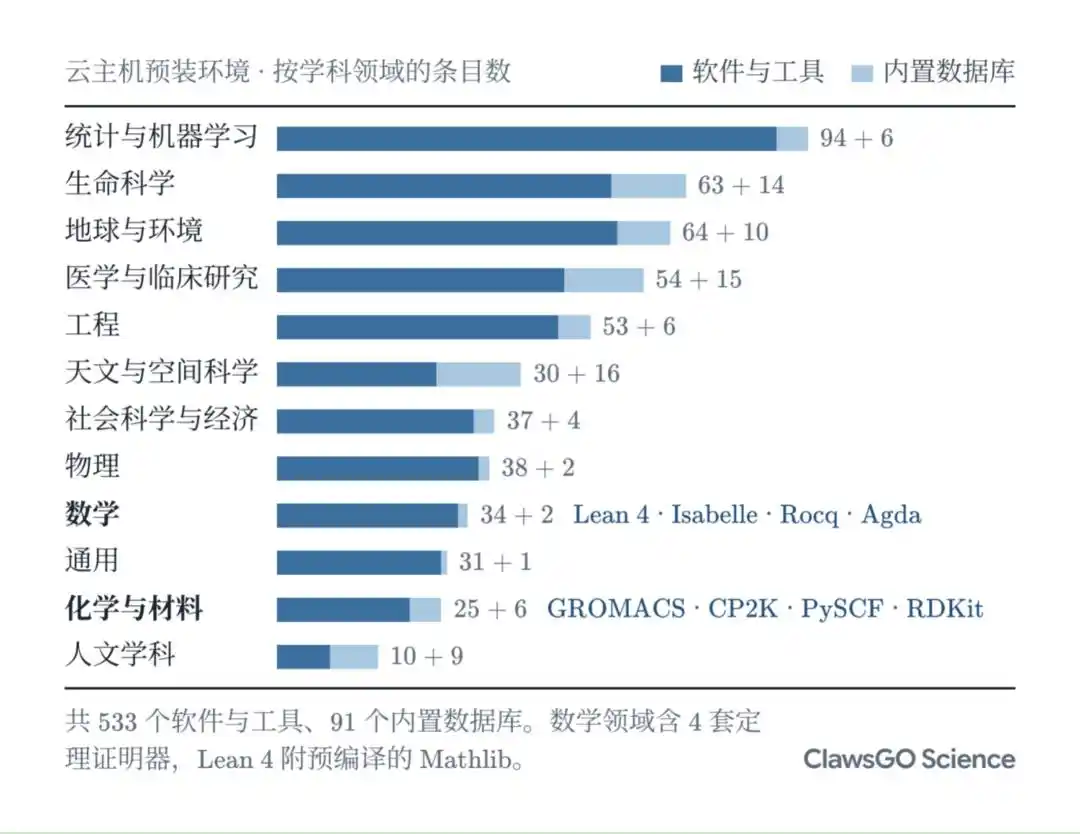
It lists examples. Chemists use GROMACS and LAMMPS, as well as PySCF and CP2K. Biologists use BLAST for sequence comparison and UniProt for protein lookup. A single WRF simulation in meteorology can run for days. Each workflow requires software installation, environment setup, data input, and compute resources. The report says many projects spend more time blocked by environment issues than by the ideas themselves.
Cloud workstations and preloaded research tools
According to the report, ClawsGO Science assigns a cloud workstation to each task. For this proof, Lean and its mathematics library were already installed and compiled, allowing the execution agents to start writing immediately.
The same workstation was said to come with 533 research software packages and tools, plus 91 built-in databases, covering 61 top-level disciplines. Tasks run in the cloud rather than on someone’s personal computer. Over the 11-day run, every command and every output was preserved in the task record for later review.
Use cases outlined by BitMiracle
The article gives several examples of how the system could be used across disciplines.
- Materials researchers could hand over simulations for a batch of candidate structures.
- Biology researchers could have it build and run a sequence analysis pipeline.
- Drug researchers could use RDKit to screen candidate molecules.
- Meteorology researchers could assign a WRF simulation and let the system track it through completion.
The report says that where a proof once required several experts to review it line by line over months, it can now come with a machine-checked record, along with a complete process log.
Product release and lab background
This research was completed during the internal testing phase of ClawsGO Science. BitMiracle says the formal version is now live at clawsgo.ai.
The article describes BitMiracle AI Lab as an independent AI research lab focused on long-horizon research agents, verifiable AI reasoning, and AI infrastructure for scientific research. It says ClawsGO Science is the lab’s end-to-end research automation agent.
The report also says the lab is raising an angel round and recruiting researchers and engineers.
The piece was originally published by the WeChat account Xinzhiyuan and credited to ASI启示录, then republished by MarsBit.



