

Bitwise on Oct. 28 published its latest long-term capital markets assumptions report for Bitcoin, raising its 2036 base-case price target to $1,599,766, or about $1.6 million. The forecast implies a 34.3% compound annual return over the next decade. The firm said it kept the same valuation framework used last year, but lifted the target because Bitcoin’s addressable market has expanded across store-of-value demand and institutional adoption.
The report said Bitcoin went through another volatile year, yet the move still fit its long-term expectations. From the October 2025 high to the June 2026 low, Bitcoin’s maximum drawdown reached 53%. Bitwise contrasted that with average peak-to-trough declines of more than 80% in earlier cycles and said the narrower drop suggests the asset is maturing.
Bitwise says the next decade could be Bitcoin’s strongest stretch
Bitwise argued that the coming 10 years could mark a “golden era” for Bitcoin, driven by three forces.
- Bitcoin continues to move into institutional portfolios, creating a source of long-term net inflows.
- With sovereign debt burdens climbing, institutions increasingly need hard assets to hedge inflation and currency debasement risk.
- Bitcoin’s total supply is capped, and its supply elasticity is close to zero.
On that basis, Bitwise said Bitcoin could become the best-performing mainstream institutional asset over the next decade. The new forecast is higher than the firm’s prior report, which projected $1.3 million by 2035 and a 28.3% annualized return.
The report also said Bitcoin should keep low to moderate correlations with major asset classes such as stocks and bonds. It is still expected to remain volatile, but Bitwise said volatility should continue the downward trend seen over the past 15 years. The firm added that the traditional four-year halving cycle is likely to weaken as the investor base broadens, though it does not expect the cycle to disappear.
Macro assumptions center on debt, deficits and currency debasement
Bitwise described Bitcoin as a macro-driven asset and said long-term capital market assumptions depend heavily on macro conditions. The report treated Bitcoin as “digital gold,” saying store-of-value demand remains the core investment case even if other use cases, including payments, may develop over time.
According to Bitwise, the most important macro variables are debt, fiscal deficits, currency debasement and changes in the U.S. dollar’s role as the world’s reserve currency. Those factors, it said, directly shape institutional demand for hard assets such as gold. The firm argued that debt loads in major economies, including the United States, are likely to keep rising. It cited investment strategist Lyn Alden, who said, “This train can’t be stopped.”
The report said the sharp rise in global sovereign bond yields in 2026 may signal that the trend is nearing a breaking point. Without strong political backing for aggressive tightening, many Western democracies have moved into a position where high debt and rising interest costs reinforce each other in what Bitwise described as a debt flywheel.
Bitwise also cited Ray Dalio’s June 2025 view: “When countries have high debt, policymakers tend to cut rates and devalue the currency that debt is denominated in. Betting on that trend is a good bet.” In that setting, the firm said, hard assets such as Bitcoin could take a larger role in portfolios.
U.S. debt figures are a central part of the case
In the U.S. section, Bitwise highlighted five figures:
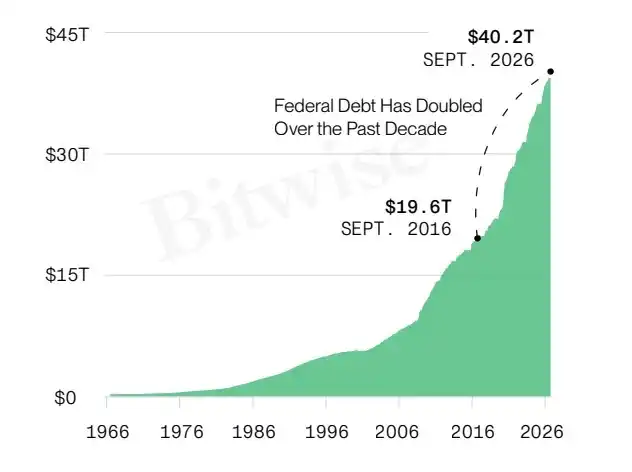
- From 1776 to 1976, the United States accumulated $650 billion in debt over 200 years. Federal debt now stands at $40.2 trillion.
- Half of all federal debt was accumulated in the past 10 years.
- Debt per U.S. citizen is more than $127,000.
- Federal debt equals 121% of GDP.
- Annual interest expense is $1.1 trillion, making it the third-largest item in the federal budget. If refinanced at current market rates, annual interest would approach $1.5 trillion.
Using U.S. Treasury data, the report said federal debt rose from $19.6 trillion in 2016 to $40.2 trillion in September 2026, doubling in a decade.
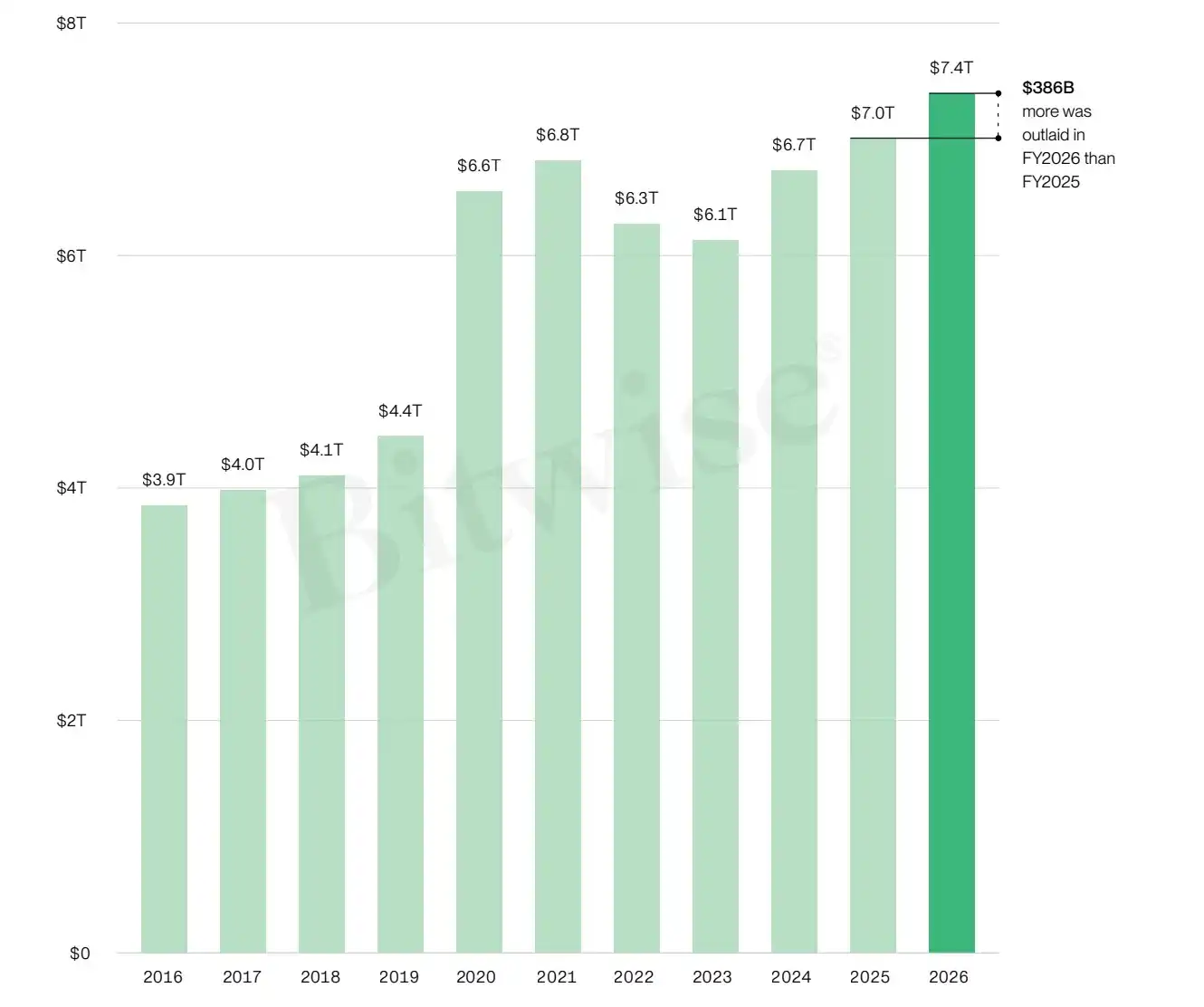
Bitwise said the picture is still worsening. For fiscal 2026 through September, the U.S. budget deficit reached $2 trillion, up $218 billion from a year earlier and $140 billion above the Congressional Budget Office forecast issued in February. The report said President Donald Trump created the Department of Government Efficiency, or DOGE, in early 2025 with a goal of cutting $2 trillion in spending, but the effort ended in less than a year after reducing only $215 billion, about 10% of the target.
Total U.S. government spending in fiscal 2026 hit a record $7.4 trillion, up $386 billion from the prior year, while the deficit reached 6.2% of GDP. Bitwise said those figures came during a period of strong economic growth and warned that a recession would likely push deficits much higher.
Debt is not just a U.S. story, and hard-asset demand is already rising
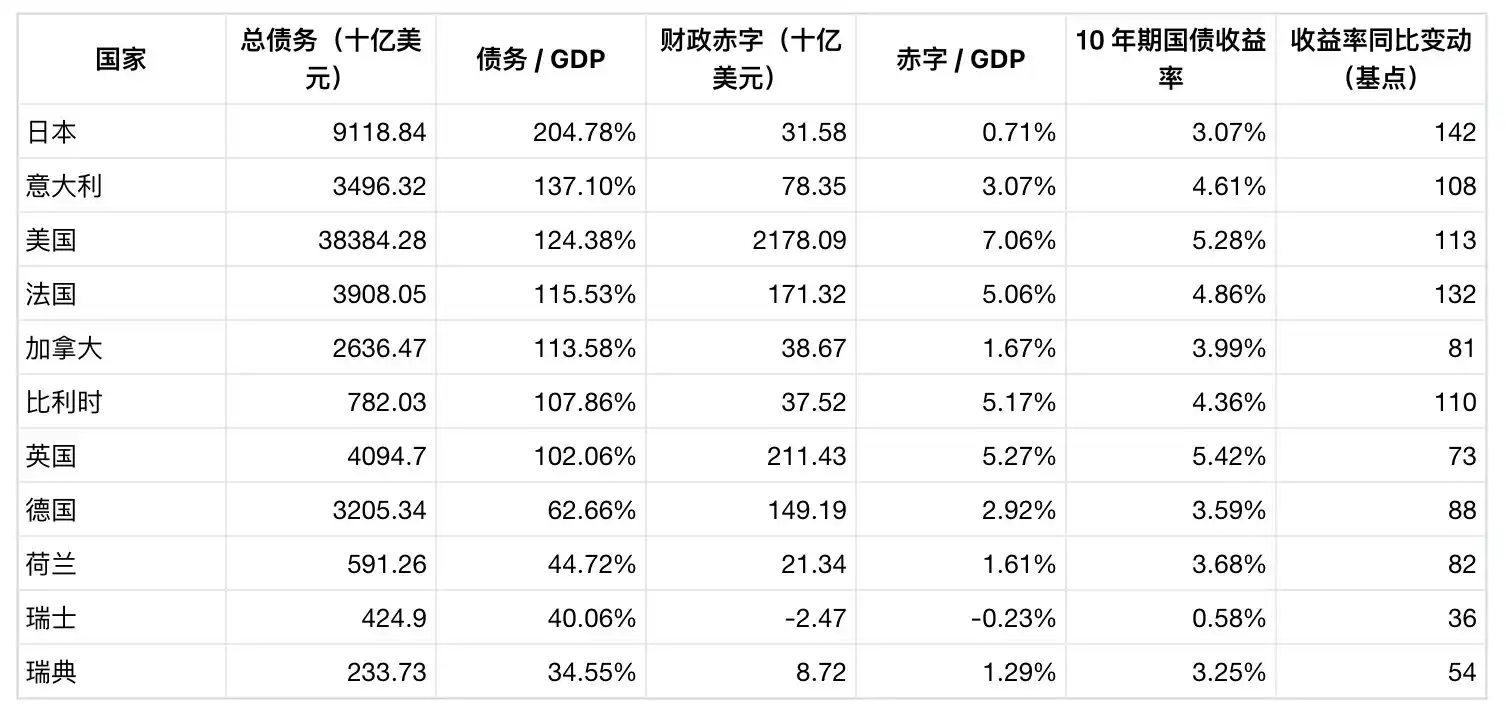
Bitwise said heavy debt burdens are a global phenomenon, especially across developed economies with broad social welfare systems. The report referred to a table covering G10 countries and comparing total debt, debt-to-GDP ratios, annual deficits, 10-year government bond yields and year-over-year changes. It said the figures were based on IMF data for year-end 2025, with Japan shown as an IMF estimate.
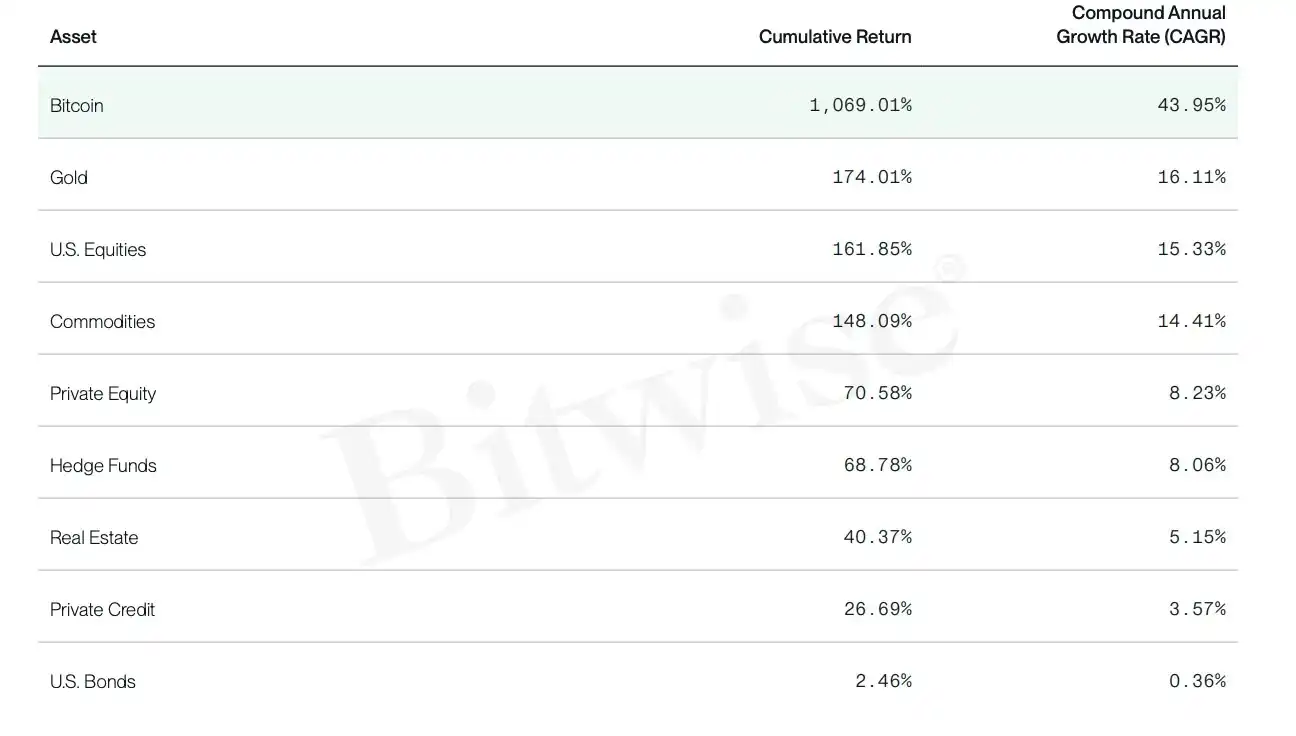
On asset performance, Bitwise said investors have already started adjusting portfolios to reflect the macro shift. Since 2020, Bitcoin and gold have been the best-performing major asset classes globally. The report stressed that hard assets do not need an extreme inflation shock to outperform. In its view, a continuation of the post-pandemic macro backdrop is enough to support further allocation shifts. Its model assumes current trends continue and does not rely on a hyperinflation scenario.
Reserve assets, central bank gold buying and the changing monetary order
Another key macro trend, Bitwise said, is the weakening of the dollar’s dominance in global reserves. IMF data cited in the report showed the dollar’s share of global foreign exchange reserves falling from 71.0% in 1999 to 56.7% in June 2026, a decline of 14.3 percentage points.
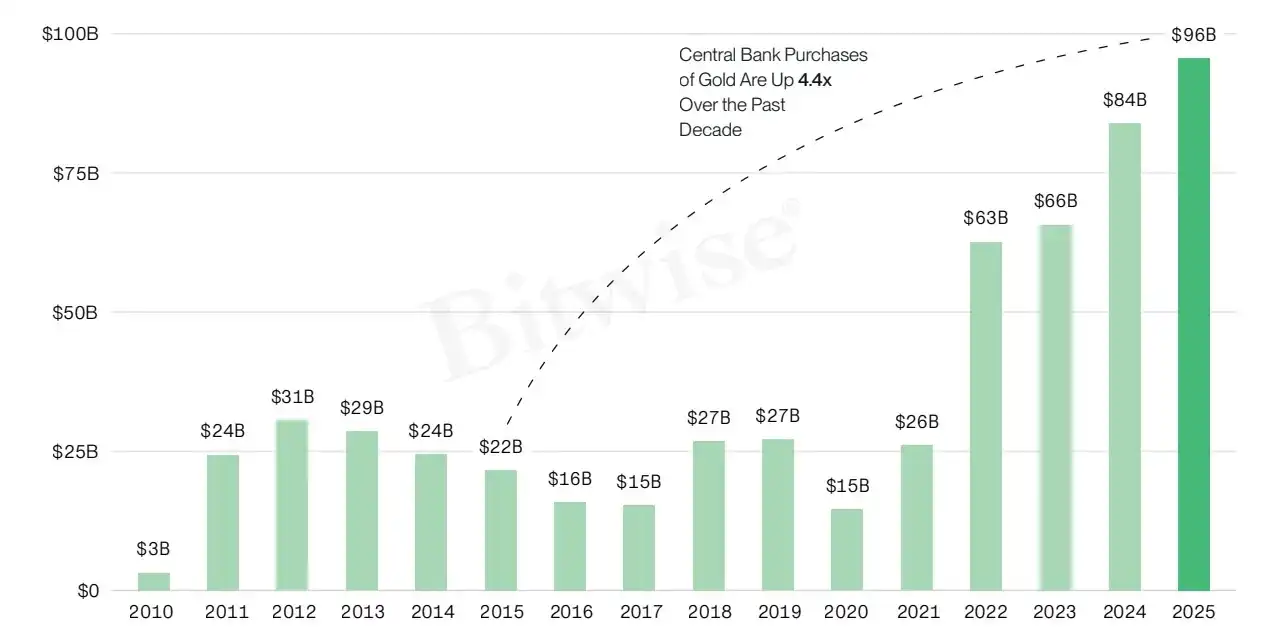
At the same time, central banks have been buying more gold. Bitwise said net global central bank gold purchases reached $96 billion in 2025, a record high. That was four times the level of a decade earlier and 14% above 2024.
The report also said more than 10 countries, including the United States, have already established Bitcoin reserves. It described sovereign adoption over the past year as slow but real:
- In November 2025, the Czech central bank became the first central bank in Europe to buy Bitcoin, allocating $1 million. In April 2026, its governor said internal research showed that putting 1% Bitcoin into its $180 billion portfolio could raise expected returns without increasing risk, and called Bitcoin an “asset of the future.”
- In October 2025, Luxembourg’s sovereign wealth fund became the first sovereign fund in the euro area to allocate to a Bitcoin ETF, with a 1% position.
- Deutsche Bank published a report saying both gold and Bitcoin would become part of central bank balance sheets by 2030.
Bitwise said these are still small steps, but they show Bitcoin is entering normal reserve-asset discussions at central banks, much like the way wealth managers began accepting Bitcoin several years ago.
Regulation has improved, though legislative risk remains
Bitwise said the global regulatory backdrop for crypto has continued to improve. In the United States, it said the anti-crypto administration left office after the 2024 election, followed by leadership changes at the Securities and Exchange Commission, the Office of the Comptroller of the Currency, the Commodity Futures Trading Commission and the Treasury Department. Over the past year, regulators introduced several crypto-friendly policies that made institutional allocation easier.
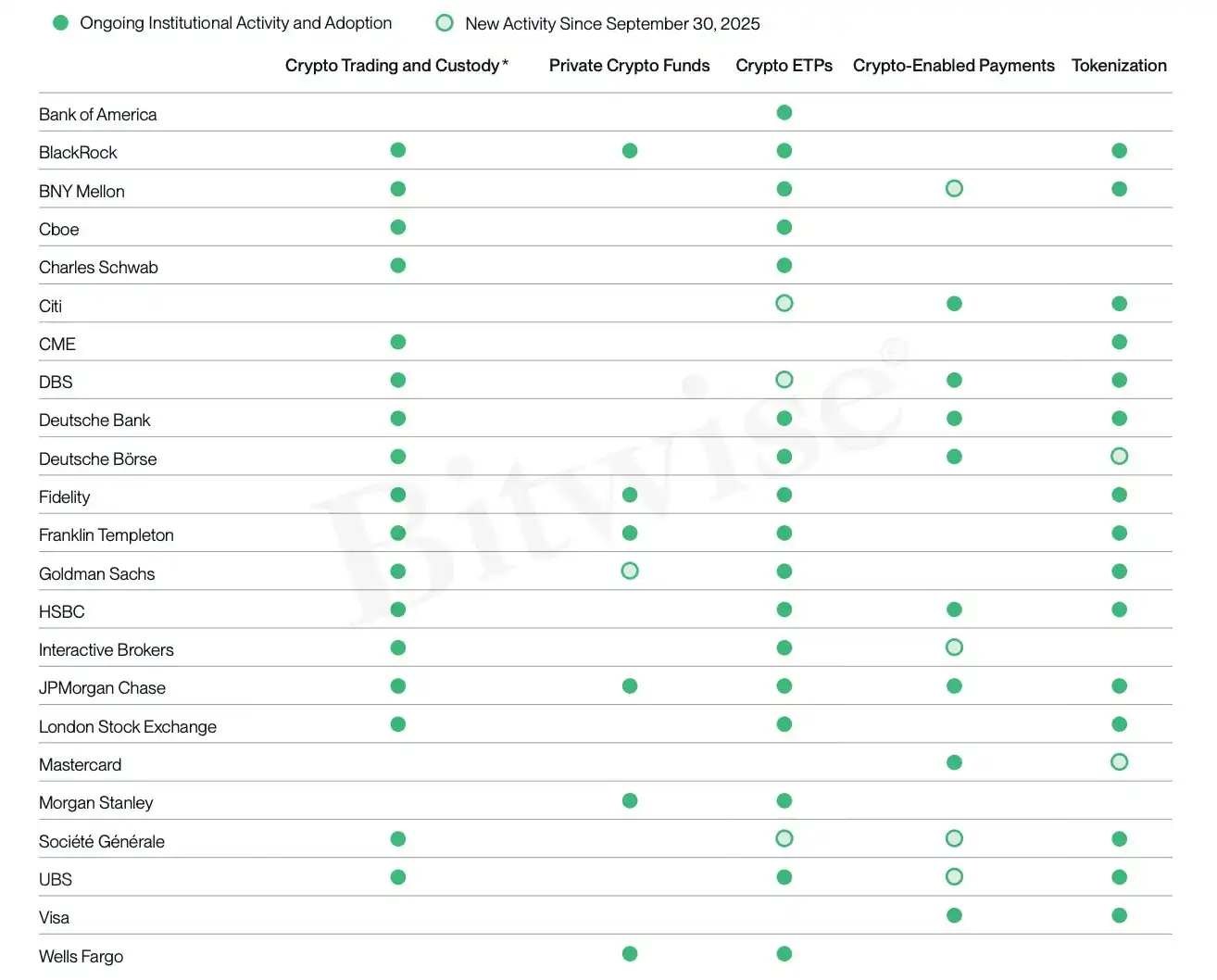
The report said the shift is not limited to the United States. It pointed to positive developments in the Middle East, Hong Kong and the United Kingdom. Nearly every major U.S. financial institution now has some form of crypto business, according to Bitwise, including BlackRock, JPMorgan and Morgan Stanley. With broad participation from corporations and tens of millions of Americans, the firm said, a full policy reversal would be difficult.
Still, 2026 was not smooth on every front. Bitwise said the closely watched Clarity Act failed to advance in Congress, mainly because Democrats had concerns about the bill’s ethics provisions. The setback, it said, shows that regulatory risk remains real.
Return assumptions: institutional demand, rigid supply and fiat concerns
Bitwise said Bitcoin could be the world’s best-performing major asset class over the next decade, with a 34.3% compound annual growth rate. It tied that view to three core drivers.
Institutional demand
Bitcoin is unusual, the report said, because retail investors led adoption first. Traditional assets such as private equity and private credit were adopted by institutions before retail investors entered. Bitcoin developed in the opposite order.
Bitwise said Bitcoin has a fixed supply of 21 million coins, with 96% already in circulation and much of it held by retail investors, while most institutions still have a 0 allocation. Citing Boston Consulting Group data, the report said global institutional assets under management total about $147 trillion. Bitwise estimated that if institutions allocate 1% to 5% of portfolios to Bitcoin over the next decade, that would translate into $1.5 trillion to $7.4 trillion of potential demand.
Against that, annual new Bitcoin issuance is only about $14 billion. Bitwise said the gap between new supply and potential demand is large, and price appreciation would be the mechanism that closes it.
The report said institutional inflows are already underway. U.S. spot Bitcoin ETPs have gathered $108 billion in assets in less than three years, with a large share coming from institutions. Bitwise expects inflows to accelerate after 2027. It also said several major wealth management platforms launched spot Bitcoin ETF products in 2026, which should support further adoption.
Highly limited and inelastic supply
Bitwise said Bitcoin’s supply cap remains 21 million, with 20.10 million coins already in circulation, or 95.7% of the total. Its annual inflation rate is just 0.8%, falling to 0.4% after the 2028 halving and 0.2% after 2032. By comparison, annual gold supply growth is about 2%.
The key feature, the report said, is that Bitcoin’s supply is completely inelastic. No matter how high demand rises or how far the price climbs, more Bitcoin cannot be produced. Bitwise said that combination of rising institutional demand and rigid supply forms the basic economic case behind its bullish long-term view.

Growing concern over fiat debasement
Bitwise said worries about global debt, fiscal deficits and currency debasement are becoming more widespread, pushing investors toward hard assets as hedges. The report cited Paul Tudor Jones from “The Great Monetary Inflation,” saying, “If I had to make one bet, it would be Bitcoin.”
It again pointed to U.S. federal debt rising by $11.7 trillion over five years to $40.2 trillion, along with annual interest expense of $1.1 trillion, as evidence that fiat-related concerns are building. In Bitwise’s view, institutional demand, rigid supply and fiat debasement fears reinforce each other. That would allow Bitcoin to gain share within the store-of-value market while also benefiting from growth in that market itself.
Valuation model: three scenarios
Bitwise said Bitcoin valuation remains an evolving field with no single accepted academic standard. The firm uses a total addressable market, or TAM, framework. It estimates the future size of markets Bitcoin can enter, applies expected penetration rates and then derives a price based on Bitcoin’s fixed supply.
That framework produced three scenarios:
- Bear case: $130,686 in 2036, with a 4.6% annualized return.
- Base case: $1,599,766 in 2036, with a 34.3% annualized return.
- Bull case: $3,667,911 in 2036, with a 46.0% annualized return.
Bitwise said the base case is the most likely outcome. It also compared its outlook with forecasts from other firms: AllianceBernstein sees Bitcoin above $1 million by 2033; Standard Chartered sees it above $500,000 by 2030; ARK Invest’s bull case is about $1.2 million by 2030; and Michael Saylor’s Strategy projects $21 million by 2046.
Correlation and volatility assumptions
Bitwise said Bitcoin has maintained low correlations with most major asset classes over the past decade. The report pushed back on the common media description of Bitcoin as a high-beta risk asset tightly tied to equities. Historically, it said, Bitcoin’s 90-day rolling correlation with U.S. stocks has almost never exceeded 0.5, well below the threshold for what it called “high correlation.”
That said, Bitwise acknowledged that Bitcoin’s correlation with equities has been drifting higher in recent years. It described that as a natural sign of maturation as more traditional investors enter the market.
The report said Bitcoin’s long-term correlation with U.S. Treasuries is close to zero and has spent most of the time between -0.25 and 0.25, which it said is meaningful for portfolio diversification. Bitwise gave two reasons. First, Bitcoin is still going through a one-time structural shift from niche asset to mainstream alternative asset, bringing in asymmetric inflows from first-time buyers. Second, Bitcoin is driven by factors that differ from those behind stocks and bonds, including adoption, regulation and concerns over fiat debasement.
On the other side, Bitwise said Bitcoin’s correlation with gold has been rising and reached a record 0.58 on Sept. 11, 2026. As the store-of-value narrative spreads further, the firm expects that relationship to deepen.
For volatility, Bitwise said Bitcoin’s volatility has trended lower over the past 10 years, and the volatility of that volatility has narrowed as well. In its view, that points to lower asset risk and a broader investor base. The latest cycle’s 53% drawdown was presented as another sign of the same shift.
Bitwise said the pace of volatility decline should slow to about half the historical rate because major risks tied to regulation, custody and liquidity have already been priced in to a large extent. Its model uses 27.8% as the 10-year volatility assumption, taking the midpoint between current volatility and its expected 2036 level.
The four-year cycle still matters, but less than before
Bitwise said Bitcoin has historically followed a four-year pattern: three years of strong gains followed by one year of sharp correction. Calendar-year returns made 2025 look like a break in that pattern, with a full-year return of -6%. But the price path still fit the cycle, the report said.
Bitcoin reached $126,080 on Oct. 6, 2025 after a 696% advance, then fell to $58,717 on June 30, 2026, a drawdown of 53.4%. Bitwise said that would make it the shallowest bear market in Bitcoin’s history if the low is confirmed, and an important signal of Bitcoin’s transition toward an institutional asset.
The report said the fundamental forces behind the four-year cycle are weakening, but the cycle remains deeply embedded in investor psychology. Its conclusion: the effect should fade, not vanish.
Risks: regulation, technology and limited history
Bitwise said Bitcoin’s short history, high volatility, changing regulation, early-stage institutional adoption and technical foundations dating back to 2008-2009 all make long-term forecasting highly uncertain.
The report listed several major risks:
- Limited historical sample size. Bitcoin only began trading at scale in 2010, institutional products started in 2014, and spot ETPs did not launch until 2024.
- Regulatory and legislative risk. Global crypto rules remain immature and could shift sharply in either direction.
- Institutional, corporate and sovereign adoption is still a new trend and may not continue.
- Technology and quantum-computing risk. Bitwise said quantum computing and AI-accelerated mathematical breakthroughs could threaten Bitcoin’s cryptographic security, potentially forcing a major upgrade to quantum-resistant cryptography.
The report added that even if the protocol is upgraded, users who do not move wallets to quantum-resistant addresses could still face risk. It said the community has already started work in this area, but many issues remain unresolved. Macro conditions, market structure and self-custody security were also cited as important risks.
Bitwise’s bottom line
In its conclusion, Bitwise said Bitcoin has grown from a fringe investment into a $1.7 trillion asset in just 17 years and is now studied and allocated by top global institutions. As more institutions add Bitcoin to portfolios, the firm said, robust long-term assumptions matter more.
Its core conclusions were:
- Expected annualized return of 34.3%, with Bitcoin potentially becoming the best-performing mainstream asset class over the next decade.
- Volatility should keep falling, though Bitcoin is still likely to remain the most volatile mainstream asset.
- Bitcoin offers diversification because it keeps low to moderate correlations with most assets while becoming more correlated with gold.
- Institutional allocations of 1% to 5% could generate $1.5 trillion to $7.4 trillion in inflows.
- Rising government debt, fiscal expansion and currency debasement continue to support demand for hard assets such as gold and Bitcoin.
- With Wall Street and the broader market now deeply involved in crypto, current regulatory gains may be difficult to fully reverse.
Bitwise also stressed that the forecast is scenario analysis, not certainty, and that Bitcoin still faces material regulatory, technological and macro risks.


