

Bitwise’s 2026 Q2 report said the crypto market remained under pressure in the second quarter, even as tokenized real-world assets, prediction markets and parts of the listed crypto equity universe continued to expand.
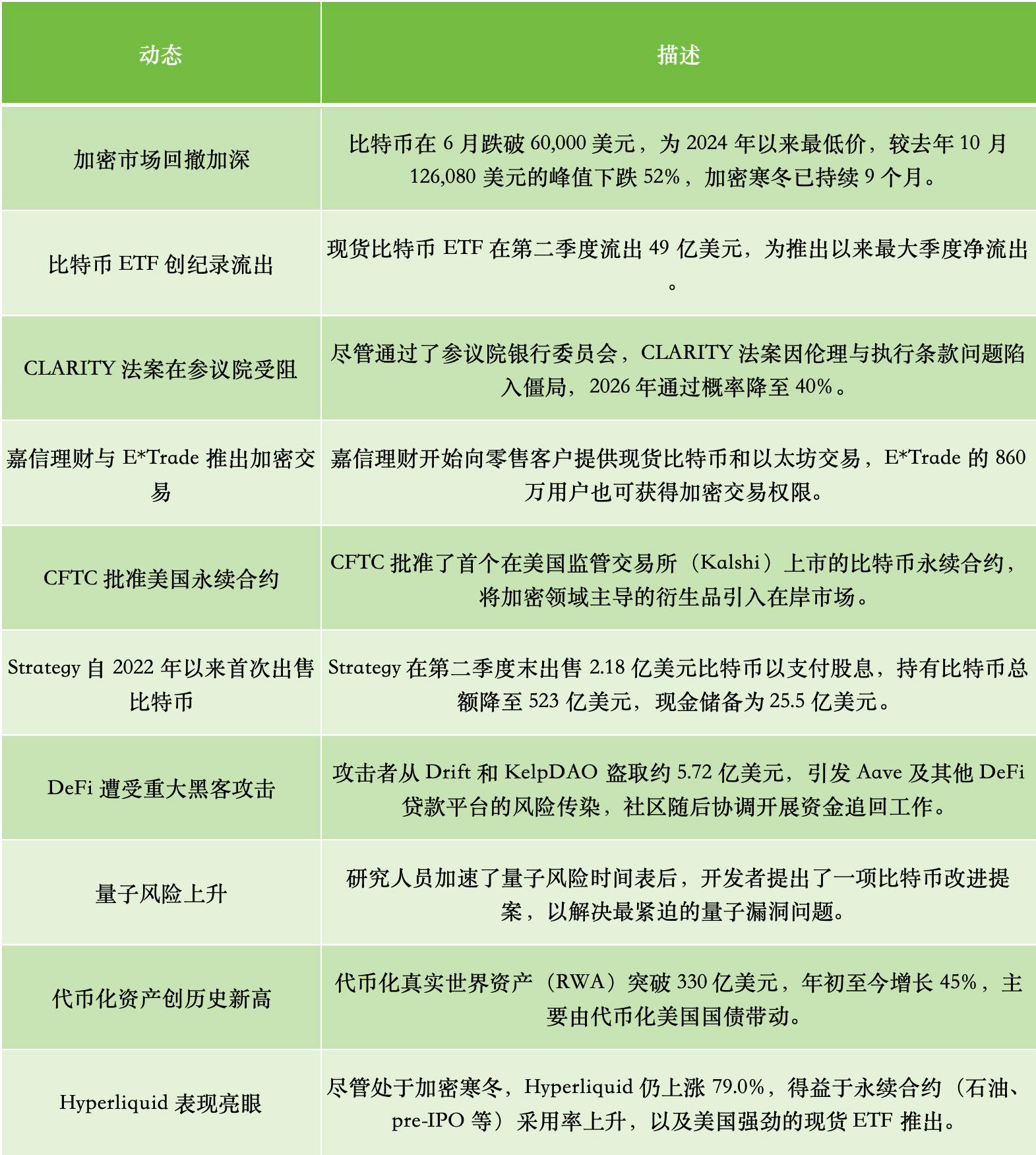
According to the report, the Bitwise top-10 market-cap crypto index fell 15.4% in Q2, and eight of its 10 constituents posted negative returns. Spot Bitcoin exchange-traded funds recorded $4.9 billion in net outflows, their worst quarter since launch. On-chain transaction activity, trading volume and DeFi assets also moved lower.
There were bright spots. Prediction market open interest reached a record $1.8 billion, while quarterly volume hit $43 billion. Tokenized real-world assets, or RWA, climbed to $33 billion in the second quarter, up 45% from the start of the year. The Bitwise Crypto Innovators 30 Index rose 30.6%, driven mainly by AI-related Bitcoin miners.
Matt Hougan, Bitwise’s chief investment officer, wrote: “Overall, things are tough. Worse, they feel tough too. There’s no statistical measure of vibes, but the mood in crypto right now is one of the worst I’ve seen in my eight years in the industry. One reason is this: We’ve now had three straight quarters of negative returns, the longest losing streak since 2022, when we had four consecutive negative quarters.”
Q2 pressure points: Strategy sold Bitcoin, BTC fell below $60,000, ETF outflows worsened
Bitwise said one of the quarter’s headline developments was that Strategy, despite earlier saying it would “never sell,” sold Bitcoin during the period. The company first carried out a small test and then sold $218 million worth of Bitcoin at the end of June to pay dividends.
The report tied that selling activity to market weakness. Bitcoin fell below $60,000 in June, its lowest level since 2024. It also stood 52% below the peak of $126,080 reached in October last year, and Bitwise said the crypto winter had now lasted nine months. Over the same quarter, spot Bitcoin ETFs posted $4.9 billion in net outflows, the largest quarterly net outflow since those products launched.
On the policy side, the closely watched CLARITY Act made little progress in the Senate. Bitwise said the bill was stuck over ethics and enforcement provisions, and prediction markets had cut the probability of passage in 2026 to 40%.
What Bitwise is watching in Q3
Bitwise called the third quarter pivotal for the CLARITY Act. The market-structure bill passed the Senate Banking Committee in Q2, according to the report, but stalled over ethics language tied to the president’s family’s crypto interests. Prediction markets now put the odds of passage in 2026 near 40%, down from 75% in mid-May. Bitwise said it does not think the bill is likely to pass before the November midterm elections, though it added that bills carrying that kind of probability often still get through.
The firm said passage of the bill “could mark the bottom of this bear market.” If it fails, Bitwise expects short-term volatility, followed by a gradual reduction in uncertainty as the industry continues to move forward under what it described as a crypto-supportive Securities and Exchange Commission and Commodity Futures Trading Commission.
Stablecoins were another major focus. Bitwise said July marks the final sprint before the GENIUS Act takes effect in January 2027, with regulators needing to finalize rules in Q3. The report said it expects many large companies to announce stablecoin projects before formal launches and pointed to OpenUSD, which it said was recently unveiled with support from Stripe, BlackRock, Visa, Coinbase and roughly 140 other companies.
Bitwise said stablecoin supply has stayed near $300 billion since last autumn and has shown resilience during the broader crypto sell-off. In the firm’s view, faster stablecoin growth heading into the January effective date could act as a catalyst for public blockchains such as Ethereum and Solana in the third quarter.
The report also flagged the Federal Reserve under new chair Kevin Warsh as an important macro variable. Bitwise said the market still knows little about his governing style, and that the July Federal Open Market Committee meeting and the Fed’s Jackson Hole gathering in late August should provide the first meaningful signals. So far, Warsh has kept rates unchanged and suggested there is no rush to cut. Bitwise said the market should have a clearer sense of the Fed’s direction by quarter-end.
Bitwise says DeFi may be undergoing a quiet re-rating
Over the past month, Bitcoin fell about 22%, while the Bitwise DeFi Index declined only 4%, the report said. Bitwise noted that DeFi usually shows much higher volatility than Bitcoin, making that relative resilience unusual and, in its view, largely overlooked.
The firm argued that DeFi is being repriced as token economics improve and the gap between usage and token value narrows. It also said real institutions are building on protocols such as Morpho and Jupiter. Aave alone generated about $900 million in revenue over the past year, according to the report. Bitwise expects DeFi’s stronger performance to continue in Q3.
Crypto stocks and crypto assets moved in very different directions
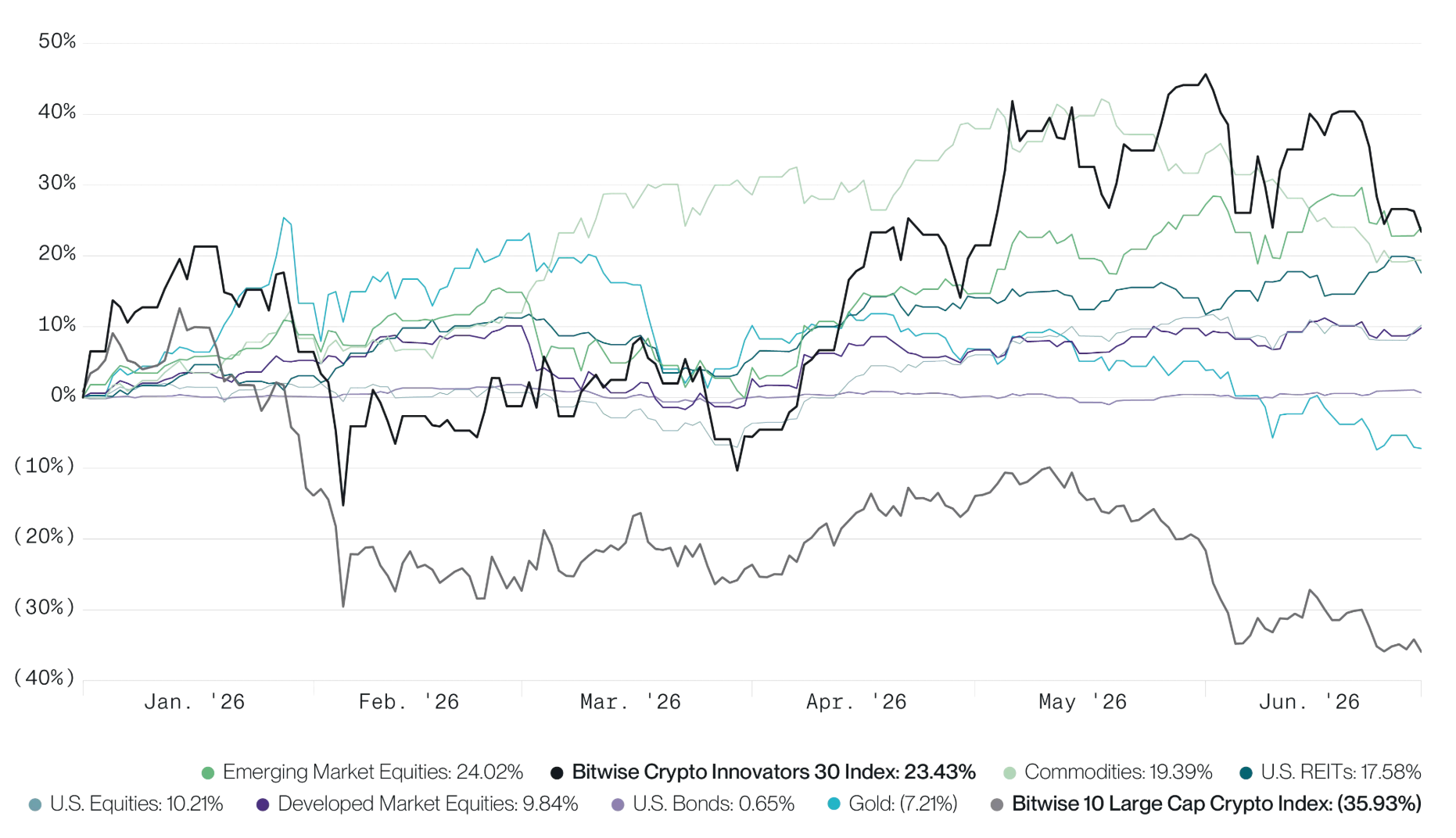
Bitwise said crypto asset prices were down 36% for the first half of 2026. Among other major asset classes, gold was the only one that also posted a loss, down 7%, while the rest were positive. The report said that is one reason this crypto winter has felt especially painful: in its words, it has been a lonely one.
Crypto stocks told a different story. Bitwise said crypto equities returned 23% in the first half, outperforming every major asset class except emerging-market stocks. Its Crypto Innovators 30 Index, which tracks 30 of the largest publicly listed companies tied to the crypto economy, delivered returns more than twice those of U.S. equities.
The firm said that performance shows investment opportunities are still emerging inside the sector even during a bear market. It pointed to Bitcoin miners benefiting from AI demand, stablecoin issuers and tokenization platforms riding Wall Street adoption, and closer links between traditional finance and crypto. Hougan wrote that although he expects crypto assets to rebound in the second half, the first half reinforced a broader point: crypto is not one thing, but a diverse and dynamic field.
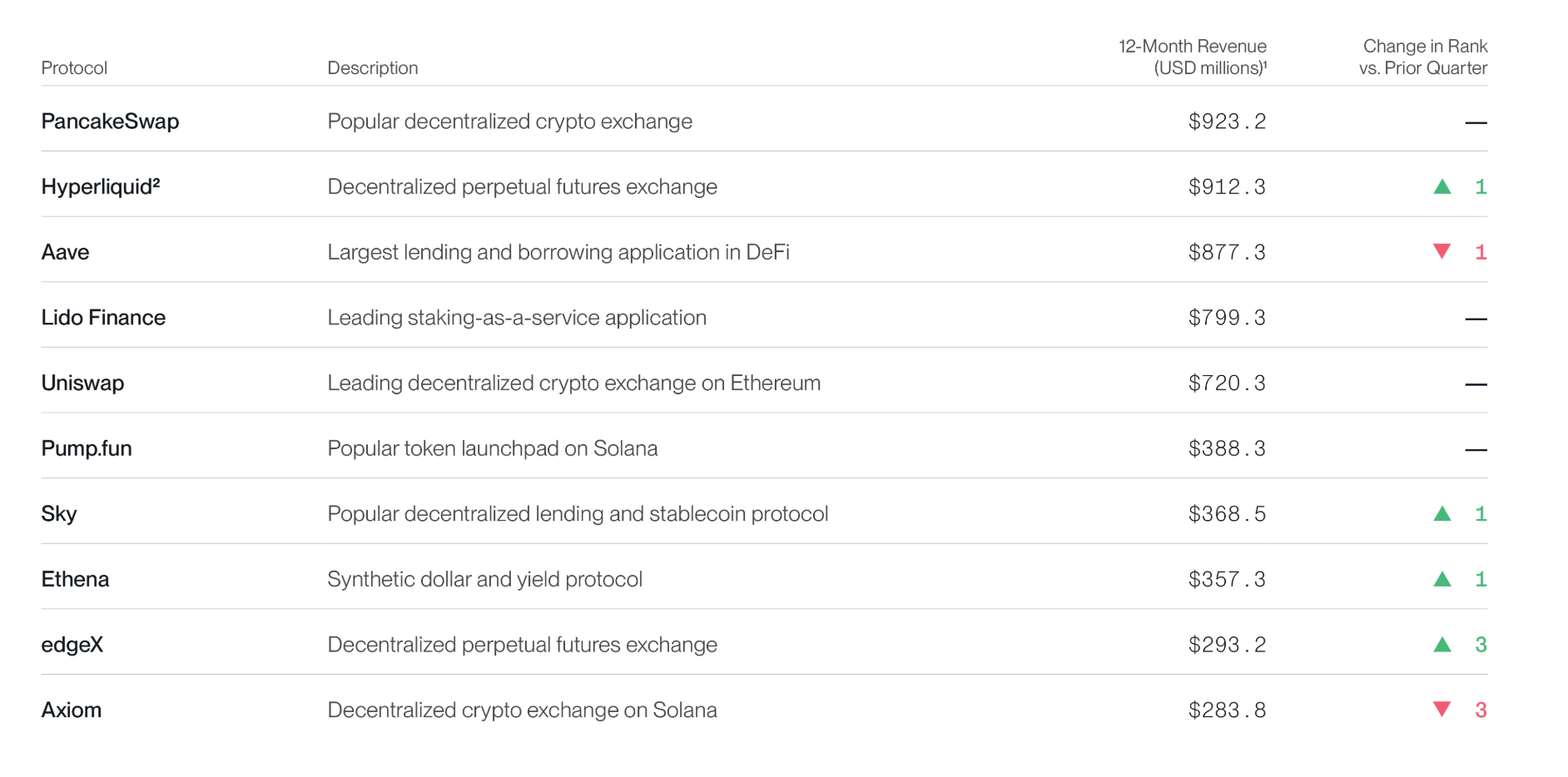
Top 10 crypto applications generated $5.9 billion in the past 12 months
The report said the 10 largest crypto applications produced a combined $5.9 billion in revenue over the last 12 months. PancakeSwap, Hyperliquid and Aave ranked in the top three, and each generated revenue close to $1 billion.
Bitwise described these as operating businesses that collect fees from trading, lending and staking, and said those revenue streams continue even in a bear market.
The report noted that revenue here refers to total fees paid by users. It also said Hyperliquid revenue excludes HyperEVM fees. The data came from Token Terminal and covered the period from Jan. 1, 2025 to June 30, 2026.
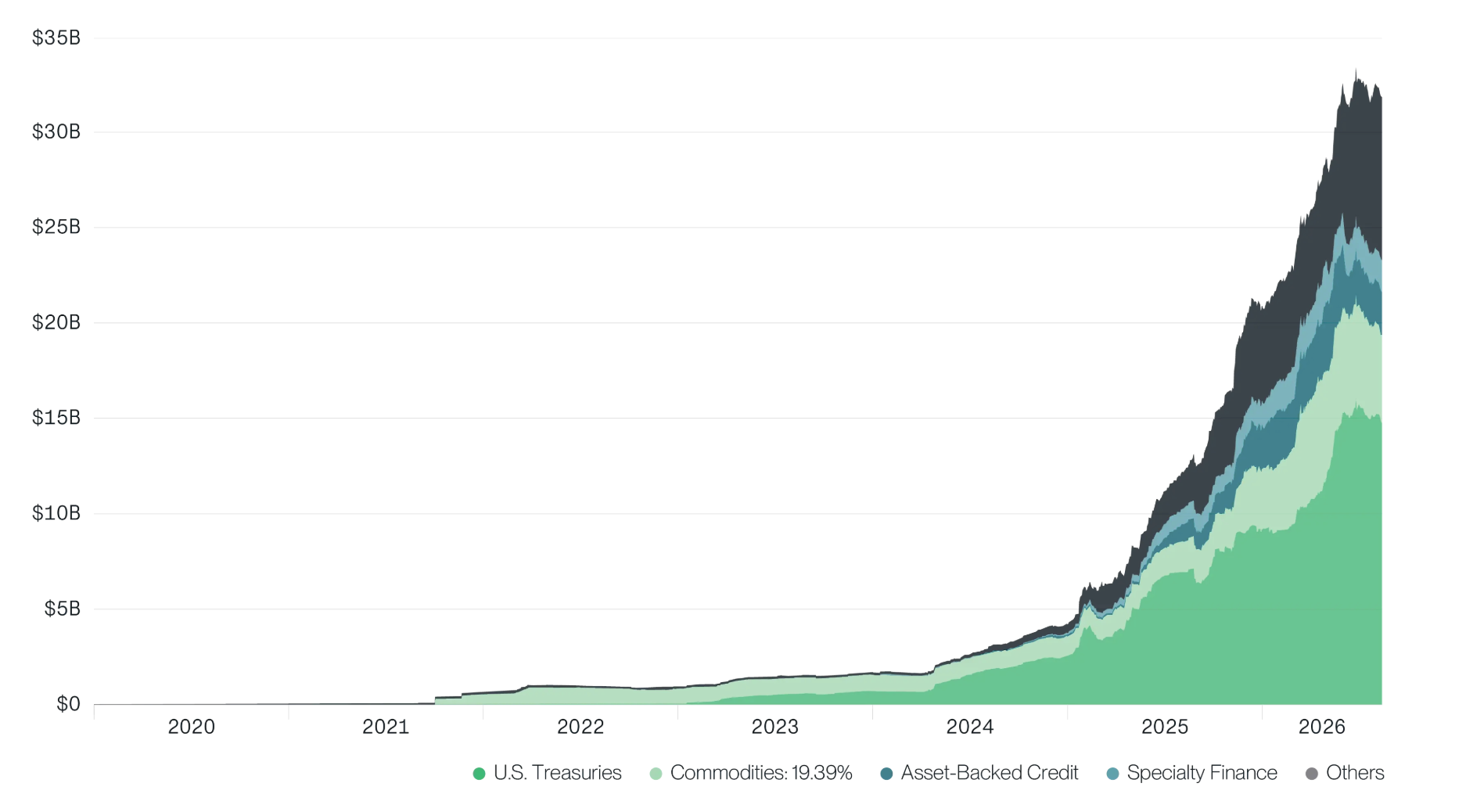
RWA reached $33 billion in Q2
In the RWA section, Bitwise cited a recent remark from U.S. Treasury Secretary Scott Bessent: “Digital assets, stablecoins, tokenization, and new payment systems will help shape the future of money.”
Bitwise said that future is already showing up on-chain. Tokenized real-world assets climbed to a record $33 billion in the second quarter, up 12% over the quarter and 45% year to date. The fastest growth came from tokenized U.S. Treasuries, corporate credit, equities and venture capital.
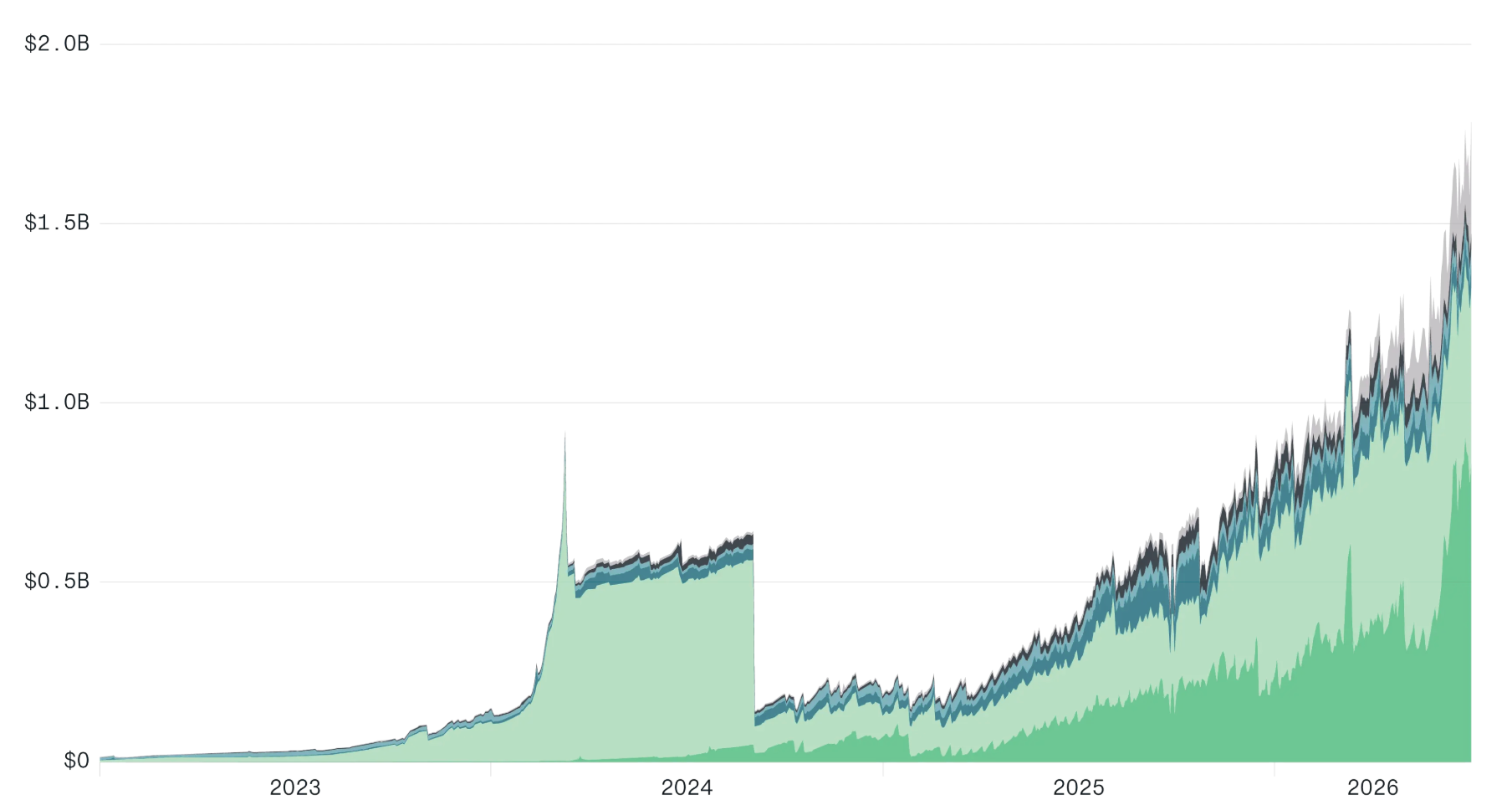
Hougan wrote that when he looks at the chart, he sees the world’s largest asset managers moving assets on-chain at full speed and at scale. The report said the RWA figures came from RWA.xyz, covering Jan. 1, 2020 through June 30, 2026, and noted that the chart excluded stablecoin issuers such as Circle and Tether.
Prediction markets set records for open interest and volume
Prediction markets were one of the clearest growth areas in the report. Bitwise said open interest in the second quarter reached an all-time high of $1.8 billion, with sports becoming the largest weighted segment. Quarterly trading volume also hit a record, at $43 billion.
The report used Polymarket as an example of what it called the hidden nature of retail crypto adoption. Millions of users are trading on real-world outcomes through crypto-based infrastructure, Bitwise said, but most of them either do not know or do not care that crypto is the underlying technology.
Bitwise expects both volume and open interest in prediction markets to set new records multiple times this year as the U.S. midterm elections approach. It said politics was the category that brought prediction markets into the mainstream in 2024, and that the market has tripled in size since then. The data came from Blockworks Research and covered Jan. 1, 2023 through June 30, 2026.
Crypto equities showed lower correlation with most major asset classes
Bitwise also highlighted the 90-day rolling correlation of its Crypto Innovators 30 Index against other major asset classes. The report said that, apart from U.S. equities, the index had lower correlation with nearly every other category, including developed-market stocks, emerging-market stocks, U.S. REITs, U.S. bonds and gold. Commodities were the only exception because both correlations were negative.
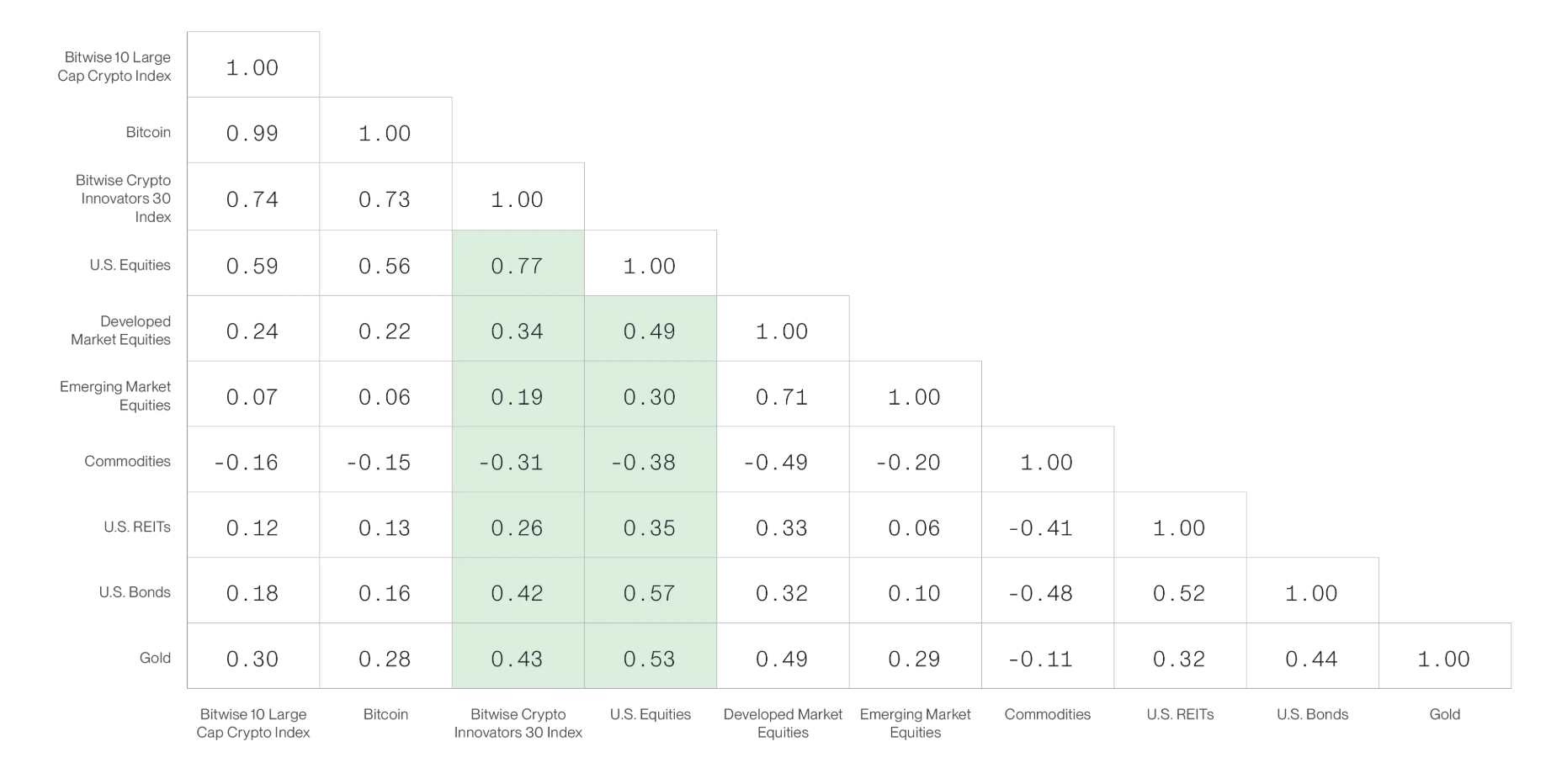
In practical terms, Bitwise said crypto stocks produced returns more than twice those of U.S. equities in the first half of 2026 while also showing lower correlation with almost every other portfolio asset. That combination of return and diversification, the firm said, should attract investor attention. The figures were sourced from Bloomberg and were current as of June 30, 2026.
Bitwise’s conclusion: prices are weak, but fundamentals are stronger than they were at the 2022 bottom
Hougan closed the report by urging readers to look carefully at the charts. Most indicators — prices, on-chain activity and trading volume — remain well below their historical highs. Given that prices are down more than 50% from the October peak, he said, that is not surprising.
But Bitwise said the picture changes when current data is compared with the last bear-market bottom in 2022. Ethereum transaction activity is about 13 times higher than it was in the second quarter of 2022. DeFi total value locked is up more than 60%. Stablecoin size has roughly doubled. In the report’s framing, price is the main metric that has not kept pace.
Hougan wrote that the market is pricing the sector as if it were still at bear-market lows even though the industry is now twice the size it was at the bottom of the previous cycle, with deeper liquidity, stronger fundamentals and Wall Street finally moving on-chain.
He added that the more than 50 charts in the report cannot answer the question investors ask most often — whether crypto prices have bottomed — but they do point to an industry where usage, revenue and adoption are still growing during a bear market. For Bitwise, that is the foundation on which the next cycle will be built.