
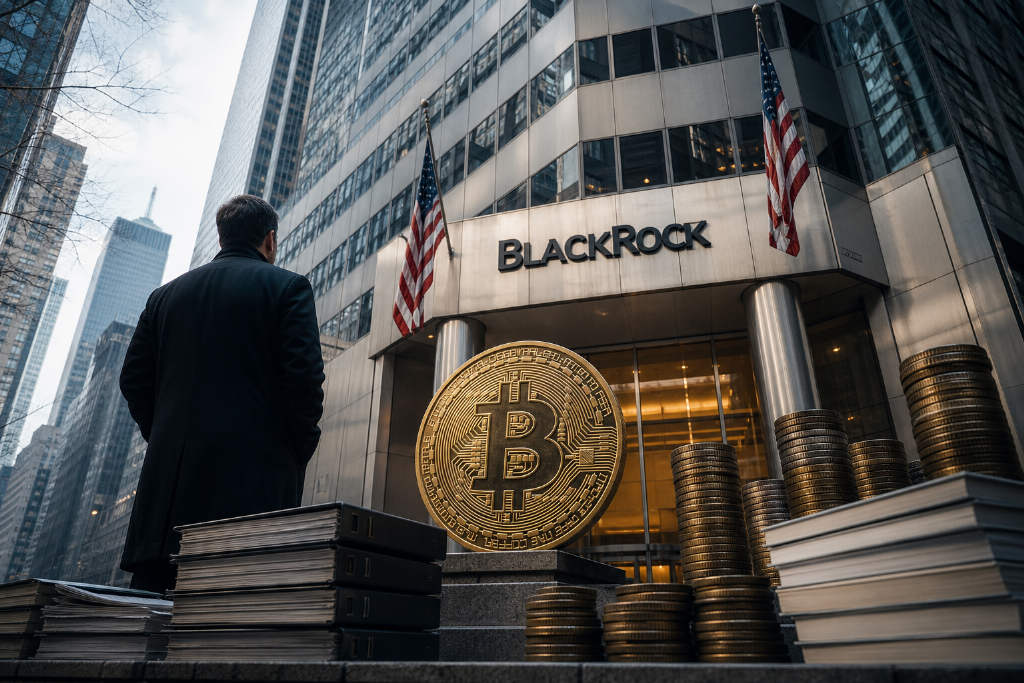
BlackRock has revisited Bitcoin’s place in institutional portfolios and concluded that the asset’s long-term investment case remains intact, even though it is still highly volatile. In its report, titled Re-Underwriting Bitcoin: Still a Portfolio Diversifier After the Pullback?, the firm argues that Bitcoin continues to merit consideration both as a potential global monetary alternative and as a portfolio diversifier.
The paper was written by Will Su, head of digital assets research at BlackRock, and Robert Mitchnick, BlackRock’s head of digital assets. WuBlockchain published a Chinese translation. BlackRock frames its argument around five main points: Bitcoin’s potential role as a hedge against currency debasement, its relatively low long-term correlation with traditional assets, its positively skewed return distribution, a decline in long-term volatility, and the continued buildout of market infrastructure.
Debt and deficits strengthen the case for scarce assets
BlackRock says one reason institutions are paying closer attention to Bitcoin is that it is increasingly being viewed as a potential global monetary alternative. The report places that view in the context of rising government debt and fiscal deficits in the U.S. and around the world, trends that have pushed investors to focus more closely on long-term risks tied to monetary expansion, fiat debasement, and erosion in purchasing power.
If major economies cannot establish a credible path to fiscal consolidation, the report says, assets whose supply is not subject to discretionary expansion by central banks could become strategically more important. BlackRock compares Bitcoin with gold on that point. Gold’s scarcity comes from geology and extraction costs; Bitcoin’s scarcity comes from mathematical rules and code. The two assets differ sharply in history and market size, but both share a supply constraint that governments and central banks cannot arbitrarily increase.
To illustrate the point, the report looks back over more than a century of fiat currency performance relative to gold. BlackRock says wars and economic disruptions in the first half of the 20th century triggered repeated inflationary episodes that steadily weakened the real purchasing power of paper currencies. It also points to the collapse of the Bretton Woods system, established in 1944, after which major currencies were no longer linked to gold and depreciated further against it.
Measured in gold, BlackRock says, fiat currencies issued by major economies since the start of the 20th century have each lost more than 99% of their value. The report adds that purchasing power deterioration was even more severe in economies including Turkey, Argentina, Brazil, and Russia, where some countries also went through repeated bouts of high inflation, hyperinflation, and currency resets.
Bitcoin, by contrast, only launched in 2009 and has a far shorter history than gold. Even so, BlackRock says it has gradually developed market recognition as a global monetary alternative. For investors concerned about long-term currency debasement, the asset’s fixed-supply mechanism remains one of its core investment arguments.
Bitcoin and global liquidity have shown a longer-term link
The report also examines the relationship between Bitcoin and global money supply. Over the past decade, BlackRock says Bitcoin’s performance has generally shown some connection with changes in money supply across major economies, and it has tended to perform better when global M2 growth accelerated.
The global M2 data used in the report covers the U.S., the euro area, China, Japan, and the U.K. BlackRock notes that M2 typically includes cash in circulation, checking and savings deposits, money market funds, and certain time deposits, making it a useful gauge of liquidity and money within the financial system.
BlackRock also cautions that this relationship has not been stable across all periods. Short-term Bitcoin performance can be affected by positioning, leverage, fund flows, and market liquidity. For that reason, the firm does not treat global M2 as a direct forecasting tool for Bitcoin prices.
Still, over longer horizons, the report says Bitcoin’s value behavior has often moved in the same direction as global financial liquidity. In BlackRock’s view, that gives Bitcoin a second layer beyond digital scarcity: it may also remain sensitive to broad changes in the global monetary environment.
Return distribution is more positively skewed than other major assets
BlackRock says Bitcoin’s portfolio role is not only about strong historical returns. It also comes from the shape of those returns relative to stocks, bonds, and gold.
Using monthly return data over the past decade, the report finds that Bitcoin has displayed a more pronounced positive skew than other major asset classes. Large upside months may not happen often, but when they do, the gains have tended to be substantial.
Stocks, by comparison, have more often delivered smaller gains with greater frequency, while still seeing occasional larger losses. Bitcoin, BlackRock says, has been more likely to produce significant upside tail returns. That difference in return distribution is one reason the firm says Bitcoin may complement portfolios with heavy equity exposure.
At the same time, the report is explicit that positive skew does not mean low risk. Bitcoin can still go through deep drawdowns, and its historical returns came with high volatility. BlackRock says any real-world allocation has to be matched to an investor’s own tolerance for risk.
Long-run correlation with the S&P 500 remains low
On correlation, BlackRock says Bitcoin’s average correlation with the S&P 500 over the past decade has been about 0.18. That is higher than the correlation seen for gold and U.S. investment-grade bonds, but still well below the levels observed for commodities, emerging-market equities, and U.S. high-yield bonds relative to U.S. stocks.
In BlackRock’s reading, the long-run data shows that Bitcoin has not persistently moved in lockstep with the stock market. That leaves room for it to serve as a diversifying asset in a multi-asset portfolio.
The firm acknowledges that Bitcoin has shown much stronger risk-asset behavior during certain shorter periods. In phases marked by tighter macro liquidity, a rapid drop in market risk appetite, or concentrated deleveraging, Bitcoin can fall alongside equities. BlackRock argues, though, that these spikes in correlation look episodic rather than structural.
The report compares Bitcoin’s underlying investment case with gold’s. Both, BlackRock says, can be viewed as potential global monetary alternatives and as assets used to address inflation, geopolitical instability, and declining confidence in fiat currencies. Even gold, which is often treated as a low-correlation safe-haven asset, briefly showed elevated correlation with stocks during episodes such as the COVID-19 shock and shifts in monetary policy.
That is why BlackRock says a short-term rise in correlation, by itself, is not enough to dismiss an asset’s long-term diversification value.
Bitcoin may hedge in some geopolitical or financial shocks, but not immediately or consistently
BlackRock also compares how Bitcoin, gold, and the S&P 500 performed after several major geopolitical and financial disruptions, including the COVID-19 pandemic, the disputed 2020 U.S. election, the Russia-Ukraine war, the U.S. regional banking crisis, and changes in global trade policy.
The report says Bitcoin does not behave like an instant safe haven in every shock. In the early phase of a disruption, a scramble for liquidity can push down several assets at once, including Bitcoin and gold.
Even so, BlackRock says that in the weeks or months following some events, Bitcoin outperformed both stocks and gold. On that basis, the firm argues that Bitcoin may provide some hedging value when global political or financial order is under stress, though the effect is not stable and should not be equated with a traditional immediate safe haven.
The report describes this as a “dual nature.” During broad deleveraging, Bitcoin can trade like a high-risk asset. When investors shift their attention to monetary systems, capital flows, or geopolitical risk, it can start to behave more like a global monetary alternative.
More developed market structure has helped bring down long-term volatility
BlackRock says Bitcoin still carries high volatility by the standards of traditional financial assets, but its long-term volatility has dropped meaningfully. A decade ago, its annualized volatility often ran above 100%. As the market has grown and trading infrastructure has improved, overall volatility in recent years has been materially lower than in the early period.
The firm attributes that change to a more mature market structure. Early Bitcoin trading was driven mainly by offshore spot exchanges and retail flows, with relatively weak liquidity and imbalanced order books. That setup made the market more prone to rapid rallies, liquidity vacuums, and repeated waves of forced liquidation.
BlackRock lays out a sequence of infrastructure development: perpetual futures emerged in 2016; regulated CME Bitcoin futures launched in 2017; CME Bitcoin options followed in 2020; and U.S. spot Bitcoin ETPs and related options products arrived in 2024.
With spot, futures, options, and ETP markets now operating together, institutional investors have a broader set of tools for arbitrage, hedging, and risk management. Cross-market trading has added two-way liquidity and improved the market’s ability to absorb large trades and price shocks.
BlackRock says that maturing structure is a key reason long-term volatility has trended lower. It also adds that high-leverage products such as perpetual futures can still trigger concentrated liquidations, so sharp swings are not going away entirely. What has changed, in the firm’s view, is the market’s capacity to handle larger dislocations and funding shifts than it could in earlier years.
The classic 60/40 portfolio faces a tougher diversification problem
The report then evaluates Bitcoin inside a traditional portfolio framework. BlackRock says the classic 60/40 stock-bond allocation now faces a more complicated diversification challenge. Stocks and bonds historically offset each other to some degree, but their correlation has risen at times in recent years, reducing the diversification effect investors once relied on.
At the same time, returns in major U.S. equity indexes have become increasingly concentrated in a small group of large companies. If those names move sharply, the impact can spread across the full equity allocation. BlackRock says investors therefore have reason to look for assets with different return drivers from both stocks and bonds.
Because Bitcoin has shown lower long-run correlation with U.S. equities and a different return distribution, the firm says a small allocation may work as a complementary diversifier in a traditional portfolio.
Backtests show 1% to 2% Bitcoin changed results noticeably
BlackRock ran a 10-year historical backtest on a traditional U.S. 60/40 portfolio. The base portfolio was made up of 60% S&P 500 and 40% U.S. Aggregate Bond Index.
In one scenario, BlackRock carved 1% from the equity sleeve, creating a portfolio of 59% stocks, 40% bonds, and 1% Bitcoin. In the second scenario, the mix became 58% stocks, 40% bonds, and 2% Bitcoin.
The report says adding 1% to 2% Bitcoin historically improved annualized returns and risk-adjusted returns, while keeping overall risk and maximum drawdown broadly close to the original 60/40 portfolio.
- The historical Sharpe ratio for the standard 60/40 portfolio was 0.81
- With a 1% Bitcoin allocation, the Sharpe ratio rose to 0.90
- With a 2% Bitcoin allocation, it increased again to 0.96
- Maximum drawdowns during the backtest were about 20.3%, 20.6%, and 20.9% for the three portfolios
BlackRock says those figures show that even a small Bitcoin allocation can have an observable impact on a portfolio’s return and risk profile because Bitcoin itself is highly volatile. The point of the exercise, the firm says, is not to argue for a large allocation, but to test Bitcoin as a modest complementary asset inside a traditional framework.
The report also stresses that these findings come from hypothetical backtests based on historical data and the benefit of hindsight. They do not represent future performance. Whether to allocate to Bitcoin, and how much, should depend on an investor’s objectives, risk tolerance, and applicable regulatory limits.
BlackRock’s bottom line
BlackRock says Bitcoin is evolving from a high-volatility asset once dominated by offshore exchanges and retail trading into a more mature asset class supported by spot, futures, options, and ETP infrastructure.
Its long-term investment case, according to the report, rests on several pillars: fixed-supply scarcity, a potential role as a hedge against currency debasement and falling fiat purchasing power, relatively low long-run correlation with stocks and other traditional assets, a positively skewed return profile, and a decline in volatility tied to market-structure development.
That does not make Bitcoin a low-risk asset, nor does it mean it will act as a reliable haven in every market shock. BlackRock’s conclusion is narrower. Based on long-term historical data, the firm says a small Bitcoin allocation may improve return and risk-adjusted return in a portfolio without materially changing the portfolio’s overall risk profile.
The report closes with a familiar warning: any Bitcoin allocation decision should be driven by the investor’s own goals, risk tolerance, and regulatory requirements, and historical results or backtests are not guarantees of what comes next.