

By Thejaswini M A
Translated by Saoirse, Foresight News
BlackRock’s presence in crypto is usually reduced to one headline: ETFs. The article argues that this misses the more important part of the firm’s positioning. In its telling, the real story sits beneath the trading products, in the buildout around BUIDL and the extension of Aladdin into on-chain finance.
BUIDL is backed by Treasuries, but access and redemption are controlled
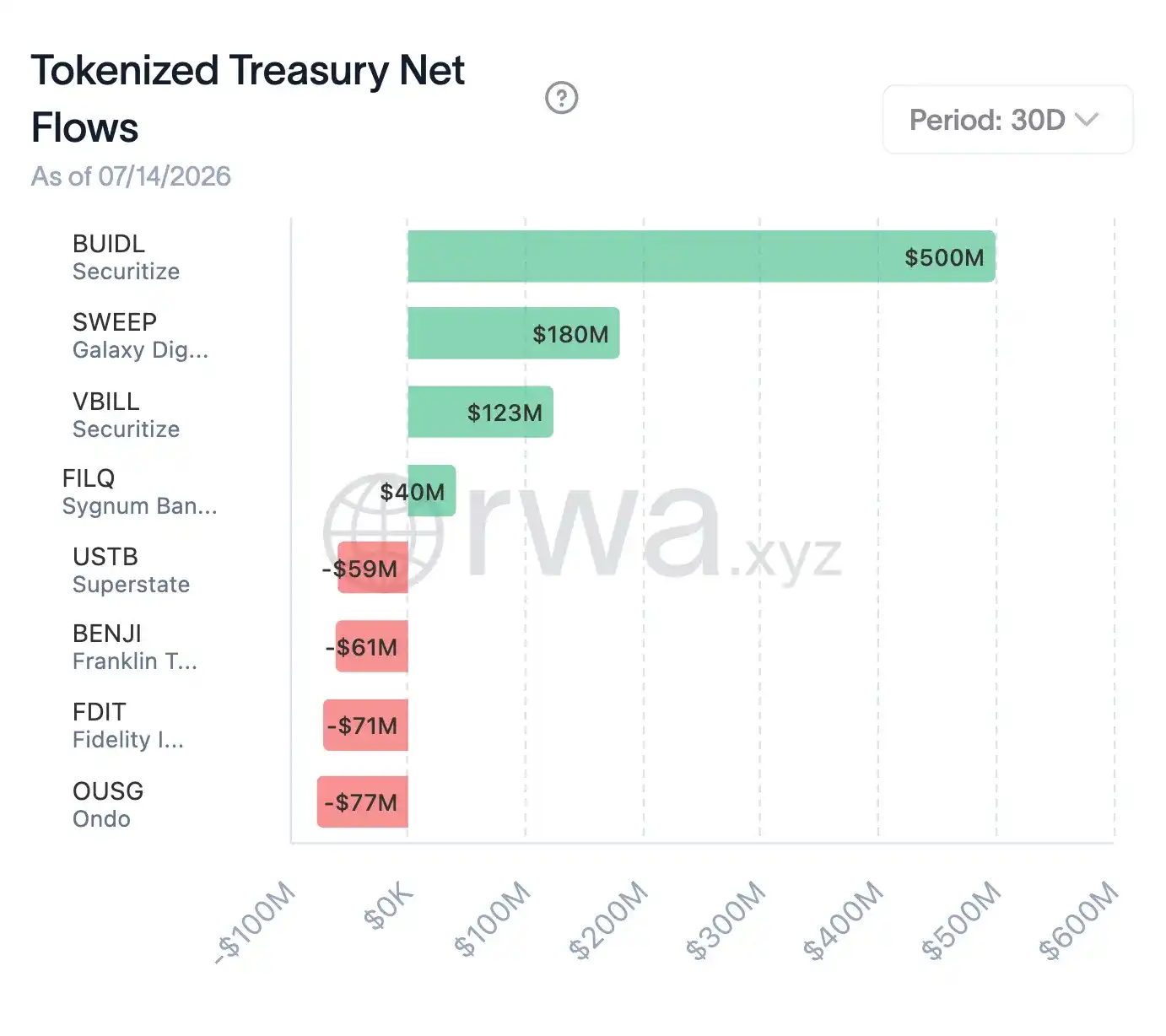
BUIDL is BlackRock’s tokenized money market fund. Its underlying assets are short-term U.S. Treasuries and cash, packaged into on-chain tokens that allow holders to earn yield directly. The product launched in 2024 with an initial size of about $2.5 billion. The article says that figure does not look huge on its own, yet BUIDL is starting to matter because it is moving into the collateral layer of crypto finance.
The risk described in the piece does not center on the underlying assets themselves. U.S. Treasuries are presented as top-tier collateral. The concern, instead, lies in the rules that govern entry and exit. BUIDL is a permissioned asset. Only wallets approved by BlackRock and its partner Securitize can hold or transfer it, and the whitelist is fully controlled by BlackRock. Investors can redeem only during specified windows and under terms set by BlackRock. The article says the firm can freeze wallets or suspend redemptions, whether through internal compliance decisions or regulatory pressure.
That creates a different risk profile from ordinary crypto tokens, which can usually be transferred freely at any time. In the article’s framing, if a single party can shut off liquidity, every product built on top of that collateral inherits the same weakness.
That is why the piece treats BUIDL not as a niche yield product but as a possible foundation block. Its central argument is that a quiet shift in base-layer control may already be underway.
Ethena, USDtb and OKX margin use show where BUIDL is landing
The article first turns to Ethena and USDe. It describes USDe as the third-largest synthetic dollar stablecoin by market value. Ethena also issues another dollar token, USDtb, and more than 90% of USDtb’s reserves are said to be held in BUIDL. When market volatility puts pressure on the USDe mechanism, USDtb serves as a shock absorber, according to the piece. In practical terms, that means BlackRock’s Treasury-backed fund is already sitting under one of crypto’s largest dollar-linked products.
It then says the arrangement expanded a few weeks ago. Ethena began offering white-label stablecoins for third-party businesses, and BUIDL became the core reserve asset for those customized stablecoins across the product line.
The source also draws a distinction between normal conditions and stress periods. In calm markets, USDe rarely needs to rely on BUIDL directly. Its reserves are built mainly from crypto assets combined with short futures positions, while only about 7% of funds are allocated to conventional stablecoins, including USDtb. USDe has a circulating supply of $6 billion, but only $65 million to $80 million of its own reserves are set aside to absorb losses. The article argues that if carry income disappears, that buffer may not be enough, leaving Ethena to shift capital into the Treasury fund for shelter. At that point, BlackRock-linked assets become the final support structure.
Its warning is blunt: the most dangerous moment is discovering during a market breakdown that the backstop is controlled by someone else.
BUIDL has also begun to enter the exchange margin business. Since April, institutional clients at OKX have been able to use BUIDL as trading collateral to back open positions. The token is custodied by Standard Chartered, and idle margin continues to earn Treasury yield. The article presents this as the first time a traditional global bank has participated in this type of crypto activity at such scale. Idle collateral becomes a yield-bearing asset, and that asset is BUIDL.
USDe in Aladdin extends BlackRock’s reach from assets to risk data
A few weeks ago, BlackRock brought USDe into Aladdin, the article says.
Aladdin is BlackRock’s in-house risk management platform, used to monitor portfolios and model potential stress. The piece argues that adding USDe should not be read simply as support for crypto. It frames the move as a way for BlackRock to pull internal data, risk exposure and operating patterns from on-chain finance into its own central risk system.
That, in the article’s account, would give BlackRock a clearer view of leverage across the market and help it estimate the price levels at which forced liquidations could cascade. If selling begins, the firm would be in a stronger position to understand how the dominoes may fall. The article also says that even crypto founders who view their protocols as independent may still end up measuring risk with BlackRock’s models.
It adds another link in the chain: USDC, the second-largest stablecoin with a market value of about $78 billion, has most of its cash reserves managed by BlackRock funds.
From there, the piece sketches a broader structure. Traders hold USDe. USDe’s risk buffer leans on USDtb. Most of USDtb is backed by BUIDL. Those same traders may then use USDe as collateral to borrow and add fresh leverage. The collateral is buried at the base while borrowing layers accumulate on top of it. If redemption or settlement at the bottom stops working, the liquidity strain can spread through the entire stack at once.
The article links the strategy to BlackRock’s old playbook
Ethena may be the most visible example, but the article says it is not the only one. Other exchanges have started accepting tokenized Treasury products as collateral, including BlackRock’s BUIDL and offerings from competitors such as Franklin Templeton. For now, BUIDL is described as the largest product in that segment. Capital tends to gather around the most liquid instrument, and that concentration can reinforce the lead of the biggest issuer.
The source ties this to BlackRock’s broader history. Index funds were once treated as plain, almost featureless products, yet BlackRock used iShares to build a dominant global presence. Today, BlackRock, Vanguard and State Street are large shareholders in close to 90% of S&P 500 companies, according to the article. The point is not that these firms must always dominate the front page, but that controlling the infrastructure beneath the market can be enough.
The article says Aladdin followed the same path on the operating side. The platform covers more than $20 trillion in assets, or roughly one-tenth of global financial assets. Many institutions that compete with BlackRock still pay to use it for risk management. In the article’s view, that means rivals are relying on BlackRock’s systems to assess their own limits while BlackRock gains a broader picture of the market.
It also revisits two periods of crisis, the 2008 financial crisis and the 2020 bond market turmoil during the pandemic. In both cases, the article says the U.S. government asked BlackRock to help handle distressed assets and implement rescue programs, while large amounts of that support eventually flowed into BlackRock products. Issuing the collateral on one side and running the pricing and risk engine on the other is, in the article’s framing, the structure BlackRock now appears to be building in crypto.
Why the article says this matters more than ETFs
The piece argues that if tokenized dollars increasingly use BUIDL as reserve collateral, if DeFi keeps parking funds in that layer, and if market risk is increasingly measured and priced through Aladdin, BlackRock could become the operating system beneath crypto finance.
That is where it draws the sharpest distinction from ETFs. An ETF reflects investment demand. Investors can buy or sell it, but that does not necessarily alter the foundation of the market. Collateral works differently. Once stablecoins, lending protocols and leveraged positions rely on BUIDL as a base asset, removing it becomes much harder. Exiting a trading product is one thing. Pulling out a core reserve asset means unwinding all the borrowing and leverage built on top of it, and the article says that kind of move could trigger system-wide stress. In that sense, an ETF can be sold, but the foundation under a live system is not easy to replace.
The source also notes that this remains an early-stage story. At about $2.5 billion, BUIDL is still small relative to a stablecoin market above $300 billion, most of which is controlled by Tether and Circle. On current numbers alone, BlackRock cannot yet be described as the foundation of the market.
Safer collateral, or a transfer of control
The article closes with two competing views. The constructive case is straightforward. Crypto has gone through repeated blowups tied to poor-quality tokens being used as collateral for one another. Building synthetic dollars on U.S. Treasuries held through a globally recognized institution could lower risk and improve credibility.
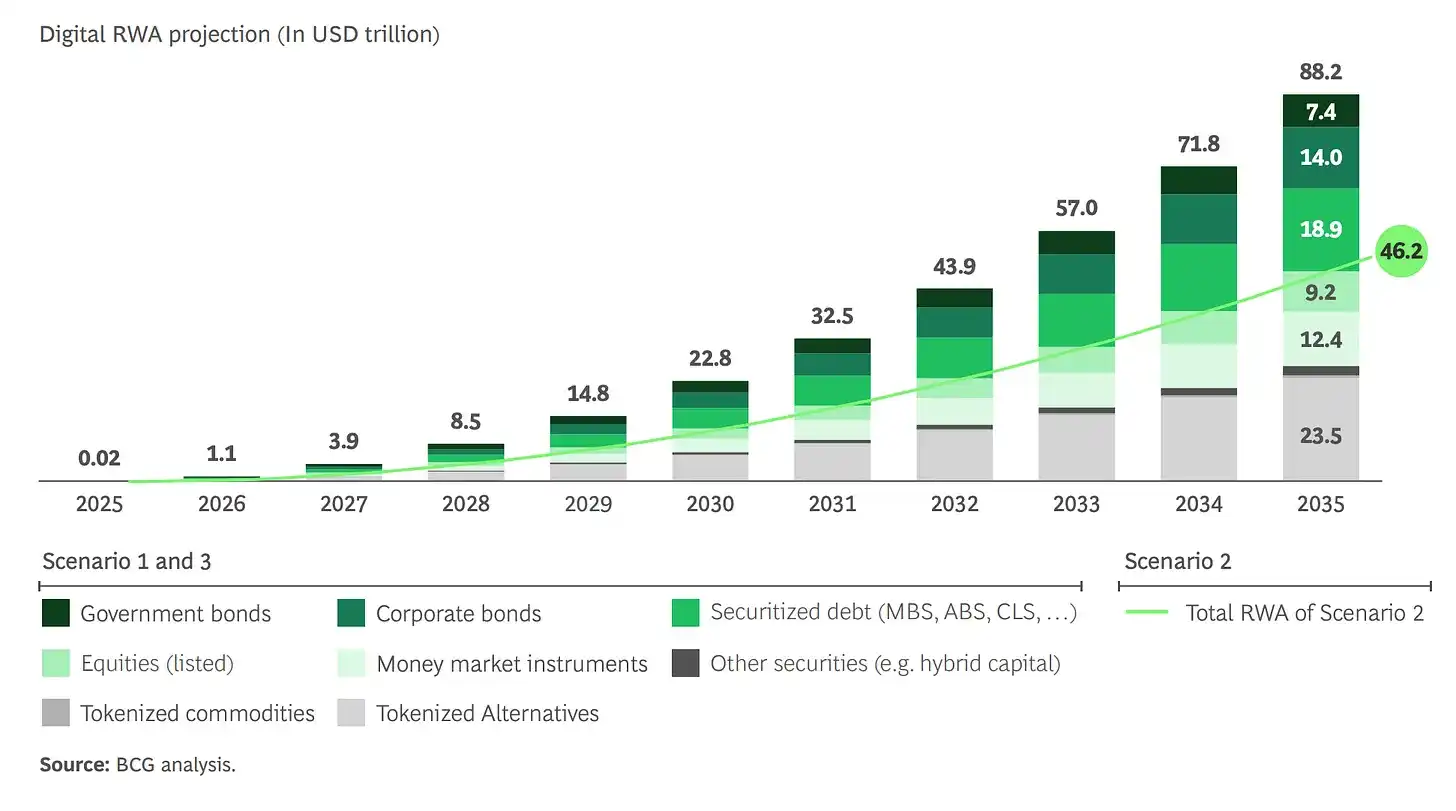
The warning case has two parts. First, the right metric is not just asset size but structural position. A smaller asset embedded beneath dozens of higher-layer products may matter more than a larger one that nothing depends on. The article cites a Boston Consulting Group forecast that tokenized real-world assets could reach $16 trillion by 2030, and says BUIDL is trying to secure the base layer early. Second, this is presented as a trade-off in power. The market gets more stable assets, but gives up control over the infrastructure beneath them. Yield and stability are easy to see. The risk of concentrated permissions is harder to notice at the start. The article’s conclusion is that BUIDL remains, from top to bottom, a permissioned asset governed by BlackRock’s rules, enforced through whitelist access and centralized redemption control.