

BlackRock’s iShares Trust has filed Form 485APOS to launch the iShares Bitcoin Managed Protection ETF, with the proposed ticker PBIT. The filing describes a buffered ETF registered under the Investment Company Act of 1940. It would not directly hold Bitcoin or any Bitcoin exchange-traded product. Instead, it would use IBIT as the reference asset and build exposure through FLEX options alongside short-duration fixed-income assets.
The structure is straightforward on paper: each options tranche is designed with an initial maximum loss of about 10%, while upside is capped at the strike price of the call options the fund sells. The product is planned for January 2027, but the listing exchange, launch date, management fee, and total expense ratio have not been disclosed.
What PBIT is designed to do
PBIT is an actively managed ETF, with BlackRock Fund Advisors listed as the investment adviser. Its stated objective in the prospectus is to provide upside participation tied to IBIT and or similar Bitcoin exposure while seeking a degree of downside protection.
The fund would not hold Bitcoin directly and would not buy Bitcoin ETPs. All market exposure would come from options. Custody and administration would be handled by BNY Mellon. The prospectus leaves both the management fee and total expense ratio blank. On timing, the filing says it becomes effective 75 days after submission, though no exchange or issuance date has been named.
How the strategy works
The prospectus calls the structure the Bitcoin Managed Protection Strategy. It has three parts.
First, the fund buys in-the-money call options. In each tranche, it purchases calls with strike prices below the starting price in order to capture Bitcoin-linked upside and provide protection once the price falls below that strike. The filing says the strike is typically set at about 90% of the initial price, which is why the initial maximum loss for a single tranche is about 10%.
Second, the fund sells call options with higher strike prices. The premium collected from those short calls helps offset the cost of buying the in-the-money calls. The trade-off is the cap: the strike on the short calls sets the rough upper limit of upside participation. The filing does not provide a specific cap because it depends on market conditions when positions are opened.
Third, the fund uses fixed-income instruments for cash management. Assets would be allocated to cash, money market funds, short-term U.S. Treasuries, and short-term investment-grade bonds. Interest income from those holdings would help offset options costs and absorb part of any losses.
In practical terms, the product can be viewed as a discounted form of Bitcoin exposure. Investors get a portion of the upside when Bitcoin rises. Losses are kept within a limited range when prices fall. The cost is that gains above a certain level no longer belong to the fund.
Why downside is limited and upside is capped
The fund would not own Bitcoin. Most of its capital would sit in Treasuries, money market funds, and similar instruments, while part of the portfolio would be used to buy call options. At expiry, if IBIT is above the strike price, the holder receives the difference. If it is below the strike, the option expires worthless and the loss is limited to the premium paid.
PBIT’s long calls would be struck at roughly 90% of the opening price. As long as the price does not fall below that level, the fund’s net asset value would broadly move with the Bitcoin ETF. Once the price drops through that line, the option value goes to zero, but the remaining capital is still held in Treasuries and similar assets. That is where the roughly 10% downside floor comes from.
The complication is cost. In-the-money calls are expensive because they are already close to being profitable. To reduce that cost, the fund would also sell another call with a higher strike. The exact level would depend on market conditions at the time of entry. Selling that option brings in premium income, which offsets the cost of the long call. But if the price rises above the higher strike, the excess upside goes to the buyer of the short call. That is where the cap comes from.
Put simply, the structure trades away part of the upside in exchange for protection. The floor is bought through options, and the cap is one way to pay for it. Part of the cost is covered by surrendering upside, and part is covered by interest earned on Treasuries and money market holdings.
Why the fund uses three tranches
The strategy is not built around a single options position. Options expire, and a one-time entry would make performance heavily dependent on timing. PBIT splits exposure into three tranches and staggers them on a monthly rolling basis, which spreads out the effect of any single entry point.
Each tranche can have a different floor and a different cap. What investors receive in the end is a blended outcome across all three tranches rather than the payoff of one isolated position.
Illustrative payoff example
The report gives a simple example. Assume one tranche is opened when IBIT is at 100, with a long call struck at 90 and a short call struck at 125. Ignoring fees and interest, the rough outcomes at expiry would look like this:
- If IBIT rises to 140, up 40% from the starting level, the tranche would capture only about 25% because gains are capped at 125. The 90-strike call would be worth 50, while the 125-strike short call would require a payout of 15. Netting the two leaves 35. If the combined net cost of the options is about 10, the remaining gain is about 25, or roughly 25% on the initial price of 100.
- If IBIT rises to 110, up 10%, the tranche would also make about 10%.
- If IBIT falls to 80, down 20%, the tranche would lose about 10%, which is the floor.
- Even if IBIT falls to 40, a 60% drop, the tranche loss would still stay around 10%.
The actual fund would combine three tranches, so realized performance would reflect the aggregate of those positions.
How it differs from a spot Bitcoin ETF
Compared with a spot Bitcoin ETF such as IBIT, the key difference is that PBIT exchanges part of Bitcoin’s uncertain upside for a more defined downside boundary.
By design, the initial maximum loss for a single tranche is about 10%, while a spot ETF moves in line with Bitcoin itself. For institutions and wealth-management clients that operate under drawdown limits, that makes the product easier to fit into a risk-control framework.
The report says the likely buyers could include institutions that have stayed on the sidelines of digital assets, as well as institutions and family offices that want exposure but cannot tolerate Bitcoin’s volatility. For that group, spot ETFs still carry open-ended drawdowns and much higher volatility than U.S. equities. PBIT, by contrast, places the initial loss of a single tranche at about 10%, making the loss range easier to model in advance and easier to fit into a risk budget.
BlackRock’s third Bitcoin-related ETF filing
Bloomberg Intelligence analyst James Seyffart said this is BlackRock’s third Bitcoin-related ETF application and described it as a buffer product in which investors give up part of the upside in exchange for protection.
The first two were the spot Bitcoin ETF IBIT and the iShares Bitcoin Premium Income ETF, or BITA, which launched in June and generates income by selling call options. Both newer products limit Bitcoin upside, but they do so for different reasons: BITA is built to generate income, while PBIT is built to limit losses.
The report also notes that similar products already exist in the market, including Calamos’ CBOJ, FT Vest’s BFJA, and Innovator’s QBF.
Spot Bitcoin ETF flow data
According to SoSoValue data cited in the report, U.S. spot Bitcoin ETFs recorded about $3.52 billion in net inflows in August, the highest monthly total this year. Total net assets for the category rose from $76.29 billion at the end of July to $99.61 billion.
September also remained positive, with about $2.6 billion in net inflows. As of publication in October, the group had seen about $200 million in net outflows for the month.
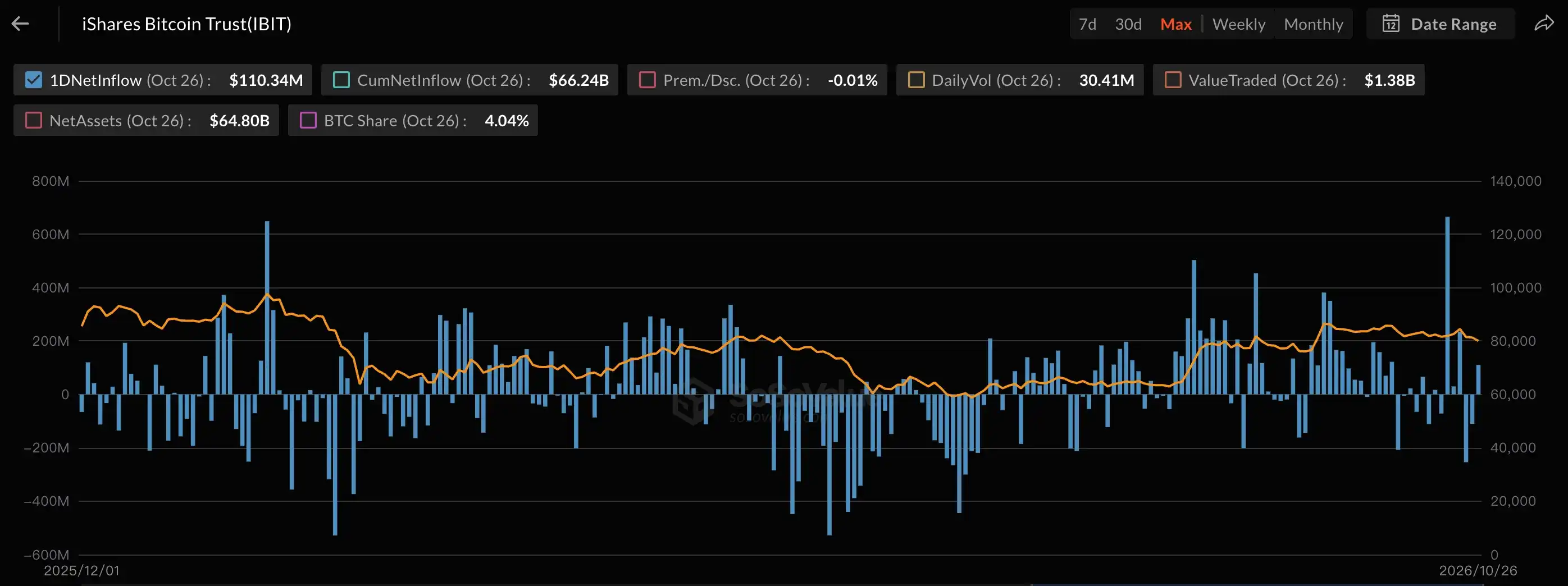
Within that, IBIT’s historical net inflows stood at about $63.1 billion at the end of August and reached $66.24 billion on Oct. 26, an increase of about $3 billion over two months.



