



BSTR and CEPO scrap the original merger structure
BSTR Holdings, the bitcoin treasury company tied to Adam Back, and special purpose acquisition company Cantor Equity Partners I (Nasdaq: CEPO) said on July 8 that they will not complete their merger under the original agreement signed in July 2025.

In an 8-K filed with the U.S. Securities and Exchange Commission, CEPO said the two sides are discussing revised deal terms and a modified transaction structure to better reflect current market conditions. A company announcement released the same day added two more points: the shareholder meeting set for July 10 has been postponed indefinitely, and public shares that had submitted redemption requests will be returned and not redeemed.
The original plan was to take BSTR public with 30,021 BTC on its balance sheet and as much as $1.5 billion in fiat PIPE financing. The report said bitcoin was trading at about $64,000, down sharply from the record level near $126,000 cited for last October.
The original deal was built around scale
From the start, BSTR’s pitch rested on the size of the treasury. According to a company release filed with the SEC in July 2025, BSTR expected to debut with 30,021 BTC, up to $1.5 billion in fiat PIPE funding, 5,021 BTC of in-kind PIPE financing, 25,000 BTC from founding shareholders, and up to about $200 million in cash from Cantor Equity Partners I, depending on shareholder redemptions.
The merger documents broke the 30,021 BTC figure into three parts: 25,000 BTC contributed by the seller, 4,156.11 BTC from the CEPO bitcoin equity PIPE, and 865 BTC from the Newco equity PIPE. The transaction also included cash equity, convertible debt, preferred stock, and bitcoin-denominated subscription commitments, all of them conditional on closing.
The report described those commitments as the load-bearing part of the structure. Together, common equity, convertible debt, preferred shares, bitcoin subscriptions, and a SPAC shareholder base with redemption rights formed a multi-source funding machine. Adam Back was set to serve as BSTR’s CEO, and the deal narrative centered on bitcoin per share rather than passive BTC exposure. Once the July 8 announcement said the PIPE no longer had to close, attention shifted to whether revised terms can bring that capital back.
The pressure point is the premium, not bitcoin alone
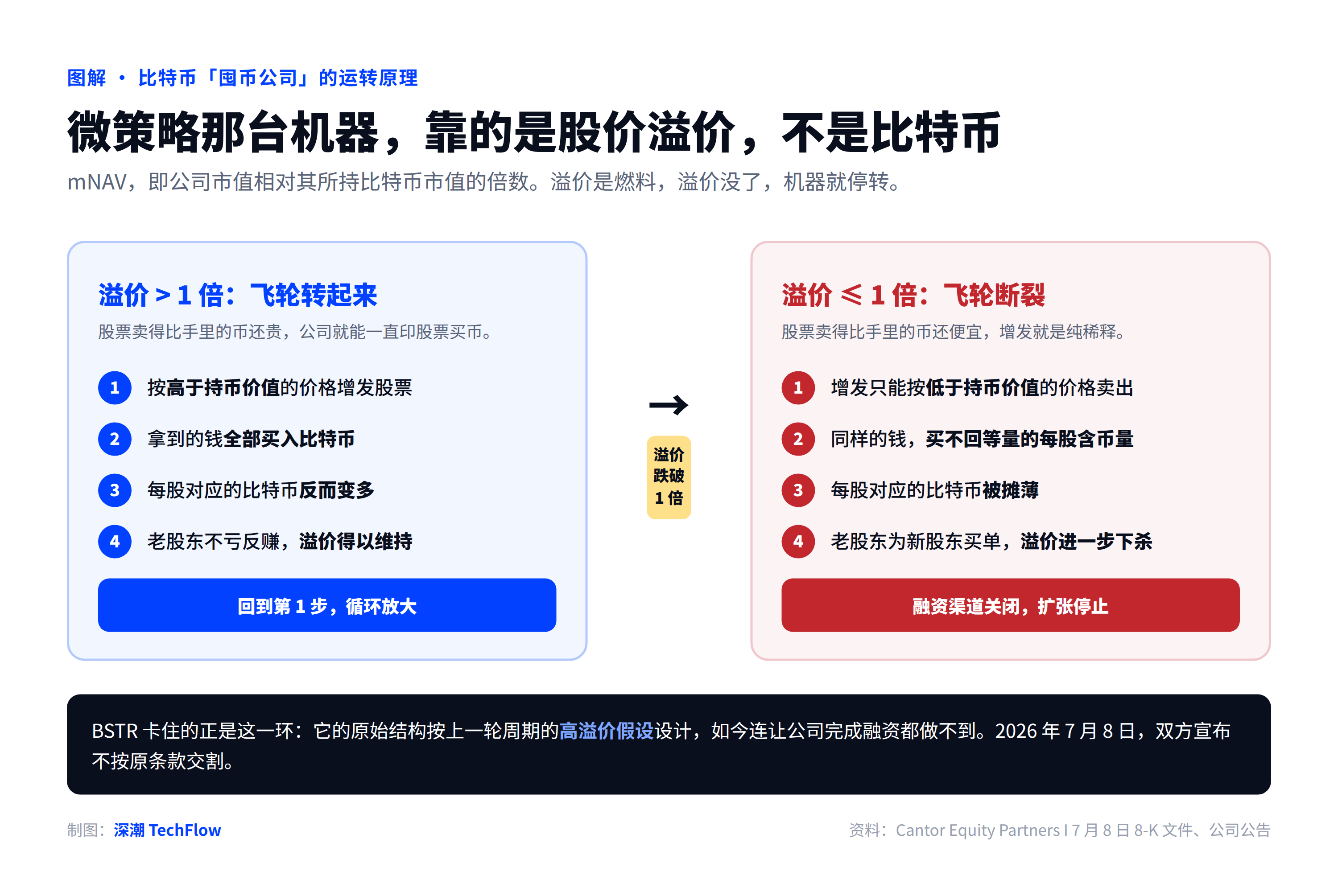
The report said the bitcoin treasury company model runs on a market premium rather than on bitcoin’s spot price alone. The key metric is mNAV, the ratio of a company’s stock market value to the market value of the bitcoin it holds. If a company trades at twice the value of its BTC holdings, its mNAV is 2.
That premium is what makes the model work. A company can issue stock above net asset value, use the proceeds to buy more bitcoin, and still raise bitcoin per share. Strategy, formerly MicroStrategy, was cited as the best-known example of that loop. Once the premium falls to 1x or below, the cycle breaks. Selling new equity no longer adds to bitcoin per share and starts diluting existing holders instead.
That is where BSTR appears to have run into trouble. The report said the original structure was designed around premium assumptions from the last cycle, and investors are no longer willing to fund the deal on that basis. In that reading, the problem is no longer whether the stock can hold a premium after listing. It is whether the old premium assumption can get the financing done at all.
Stress is showing up across the sector
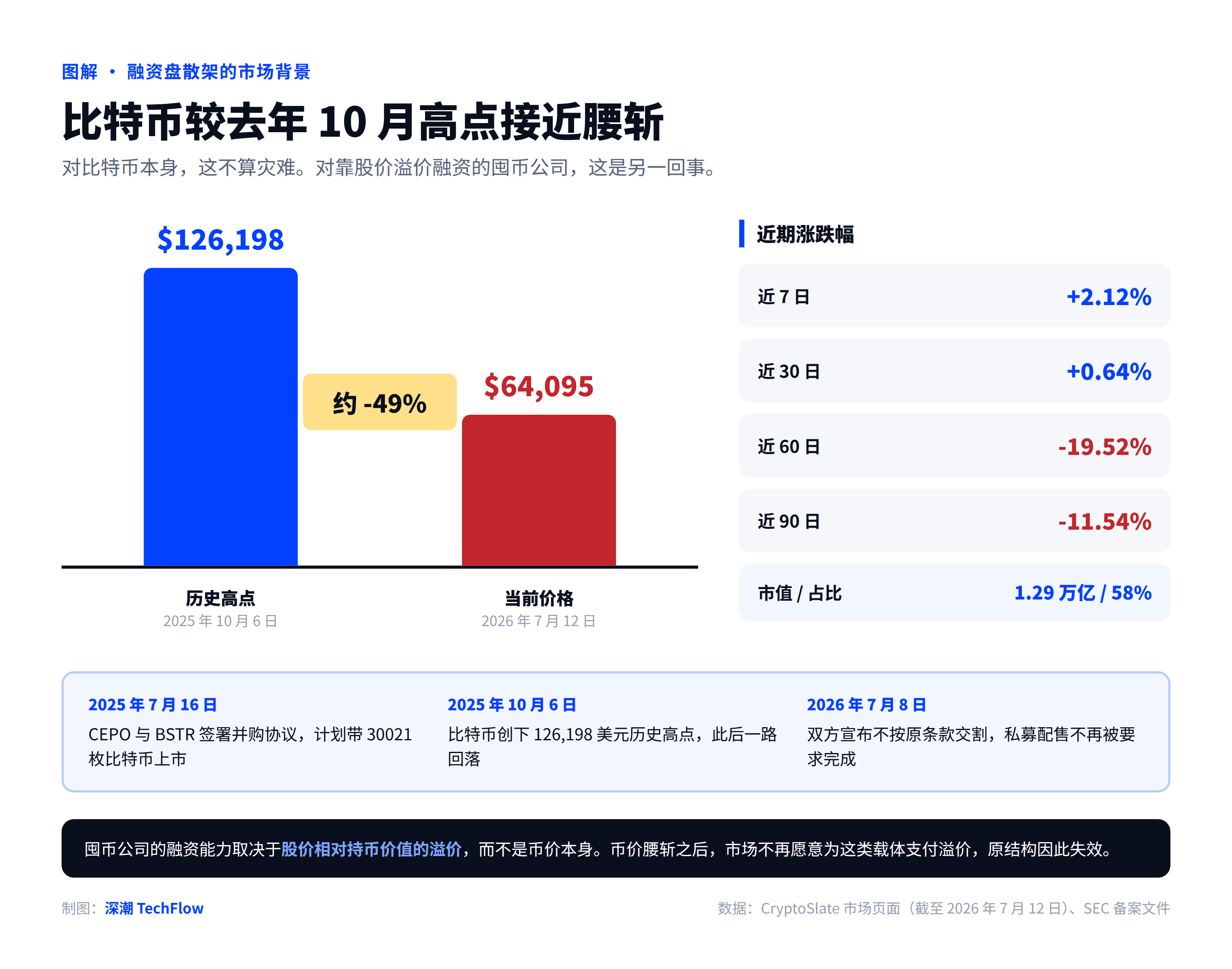
As of July 12, bitcoin was quoted at about $64,000, with a market capitalization of roughly $1.27 trillion and a market share of about 58% of the crypto market, according to the report. It said the asset was down about 49% from the all-time high of $126,200 set on Oct. 6 last year, and down about 19.5% over the past 60 days.
For bitcoin itself, the report did not frame that as a collapse. For treasury companies that rely on premium-driven fundraising, it is a different story. In the same week, American Bitcoin, which the report said involves Eric Trump, carried out a 1-for-15 reverse stock split to maintain Nasdaq’s minimum price requirement and held about 8,000 BTC. Strategy’s preferred shares briefly traded below par in June. Metaplanet’s stock had fallen below the value of its bitcoin holdings. The report also said another U.S. bitcoin treasury company liquidated its entire BTC position in early July under debt and Nasdaq compliance pressure.
Capital has also been moving elsewhere. The report pointed to AI compute company CoreWeave, which recently completed a $20 billion financing round.
The next SEC filing is the key document
Cantor and BSTR are still in talks, but the original terms are no longer in force. If they reach a revised agreement, a new SEC filing would amend or supplement the registration statement and proxy materials.
The report said that filing should answer three questions: how much of the 30,021 BTC target remains, how much of the original PIPE support is still in place, and what price investors now demand to participate. Citing market data referenced by TFTC, the article said CEPO shares were trading around $10.5, close to trust value, which it treated as a sign that the market is assigning no premium to the transaction.
The July 8 filing listed a familiar set of risks: public shareholder redemptions, public float, liquidity, exchange listing, bitcoin price volatility, competition, regulatory uncertainty, and the difficulty of expanding bitcoin accumulation and treasury operations.
The outcome now depends on the revised terms. If they preserve a treasury close to 30,000 BTC, keep meaningful investor commitments in place, and avoid shifting heavy costs onto new shareholders, the model may still be repriced in a lower-premium market. If the new package shrinks the bitcoin stack, raises funding costs, weakens investor protections, or leans harder on dilution, the report suggests the result will read as a public stress test for the whole trade.