
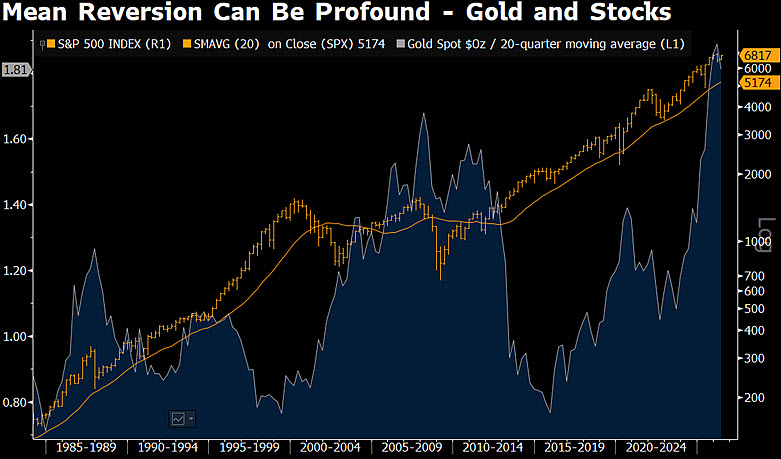
Bloomberg senior commodity strategist Mike McGlone said gold’s first-quarter high reached 1.9 times its 20-quarter moving average, topping the 1.7 times level seen before the 2008 financial crisis and marking the richest premium to that trend line since 1980. In a post on X, he argued that similar parabolic peaks in gold have often been followed by sharp corrections in U.S. equities.
Gold’s premium now exceeds the level seen before 2008
McGlone framed the warning through a historical comparison. In 2008, when gold traded at 1.7 times its 20-quarter moving average, the S&P 500 went on to suffer a decline of nearly 60%. Using his latest chart, the same metric now stands at 1.9 times, about 12 percentage points above that earlier peak. The setup is unusual. His conclusion is blunt.
He said even a simple mean reversion would carry meaningful downside for stocks. Based on April 10 closing data, the S&P 500 stood at 6,817, while its 20-quarter moving average was 5,162, leaving a gap of 24.3%. A move back to that long-term average would translate into a loss of almost one quarter from current levels.
A break below the long-term average would raise recession concerns
McGlone’s concern goes beyond a pullback toward trend. He said that if the S&P 500 were to fall below its 20-quarter average, that could point to a recession signal. In his framework, returning to the mean is one issue; breaking under it suggests a deeper macro deterioration.
He did not dismiss the fundamentals that have supported both gold and stocks on the way up. McGlone said strong underlying drivers helped push both major asset classes to elevated levels, yet stretched valuations do not remove the pressure of mean reversion. If an external shock hits at the same time, the resulting deleveraging across markets could be more severe than a correction in one asset alone.
The view fits his long-running caution on richly valued assets
McGlone has consistently taken a cautious stance on expensive assets. In bitcoin, he has repeatedly warned that the price could fall back to $10,000. His current take on gold and U.S. equities follows the same logic centered on historical cycles and mean reversion.
The source also noted the limits of that framework. It may offer value at major long-cycle turning points, but it has shown clear timing errors in past market calls. What stands out now is the fact itself: gold at 1.9 times its 20-quarter moving average is in a historically rare zone, while the broader read-through for equities still depends on monetary policy, inflation trends, and global demand conditions.