
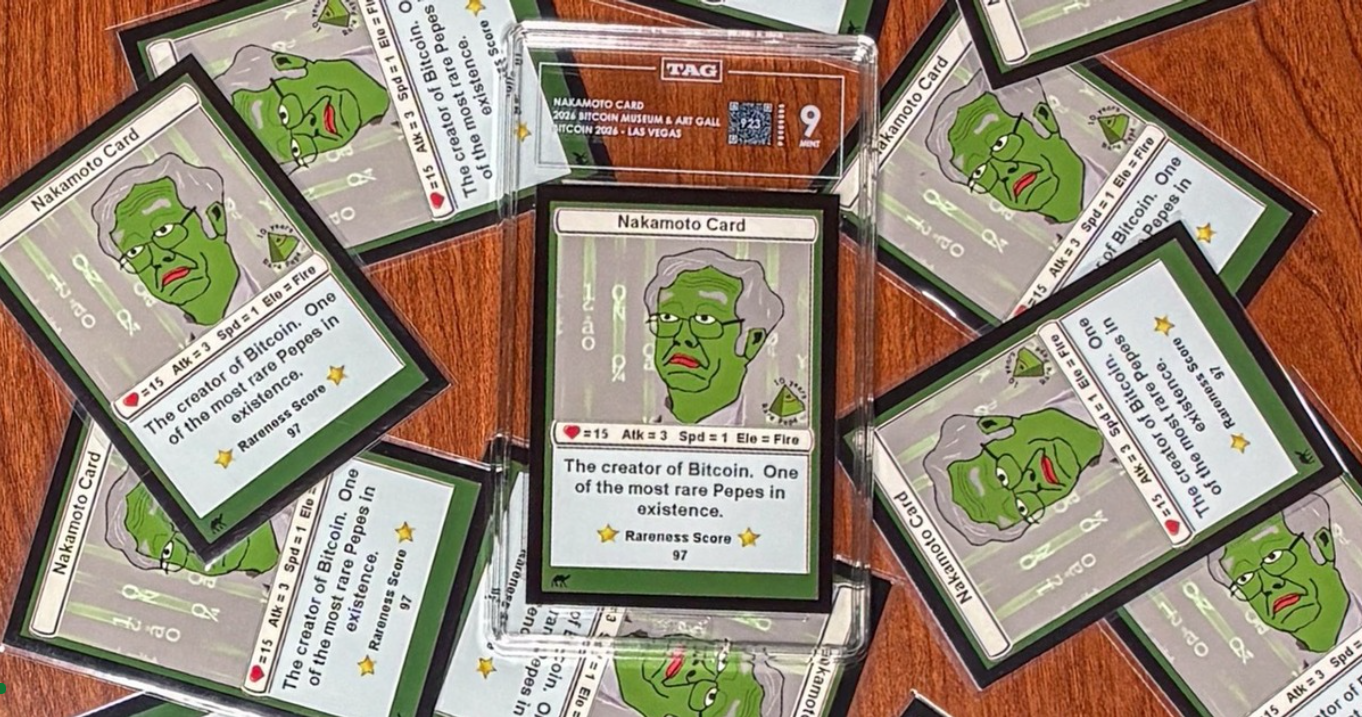
BMAG, short for Bitcoin Museum and Art Gallery, is putting trading cards at the center of its program and plans to launch a full Trading Card Expo at Bitcoin Asia 2026, scheduled for Aug. 27-28, 2026 at the Hong Kong Convention and Exhibition Centre.
In the Bitcoin Magazine article, Dennis Koch frames the current card boom around a familiar tension for bitcoiners: verification. He opens with the spectacle of livestreamed pack openings, where hundreds of viewers watch someone tear into foil wrappers in real time. Card prices, he writes, are at all-time highs, values are being repriced constantly, and rare cards have sold for eight figures. But the audience, in his telling, is not simply looking at images on cardboard. It is watching anticipation unfold.
Grading sits at the center of the trust debate
The article says the past year brought scrutiny for the hobby’s dominant grading company after grades changed once cards passed through its own buyback program. That, Koch writes, pushed collectors to ask a blunt question: who grades the grader?
His argument is straightforward. If one subjective number can create a tenfold difference in value, and the party assigning that number also has a position in the asset, then the market has a verification problem. Koch describes this in terms bitcoin users will recognize as a trusted-third-party problem. In both worlds, he writes, the same three questions keep resurfacing: what is real, what is rare, and what holds value.
He draws the comparison even tighter by saying a graded slab and a confirmed transaction on the timechain answer the same underlying anxiety. Collectors who want transparent grading and provenance that cannot be quietly revised are, in effect, asking for verification instead of trust, whether or not they use that language.
Why BMAG is leaning into cards
That overlap is the reason BMAG says it is treating trading cards as a serious part of its work. The article describes BMAG as the cultural wing of the Bitcoin Conference for the last seven years. It also says the group has recorded more than 130 BTC in art and collectibles sales, worth more than $8 million.
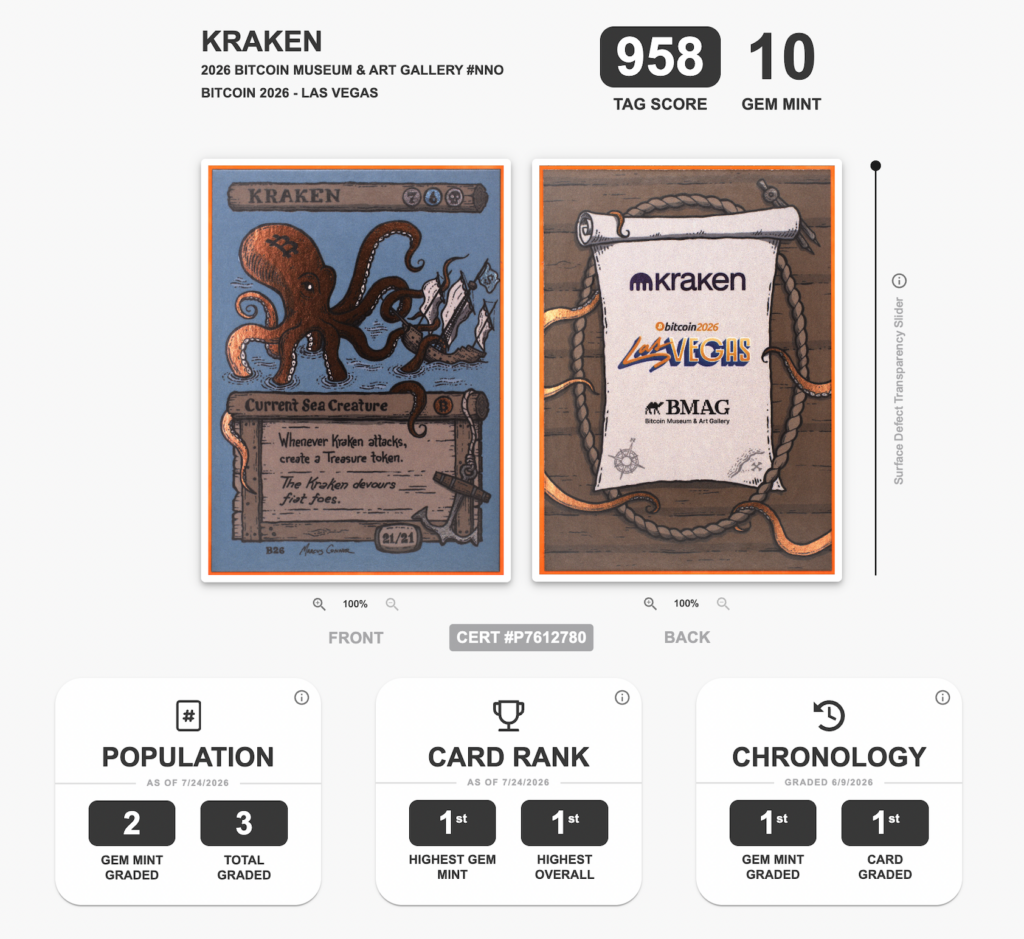
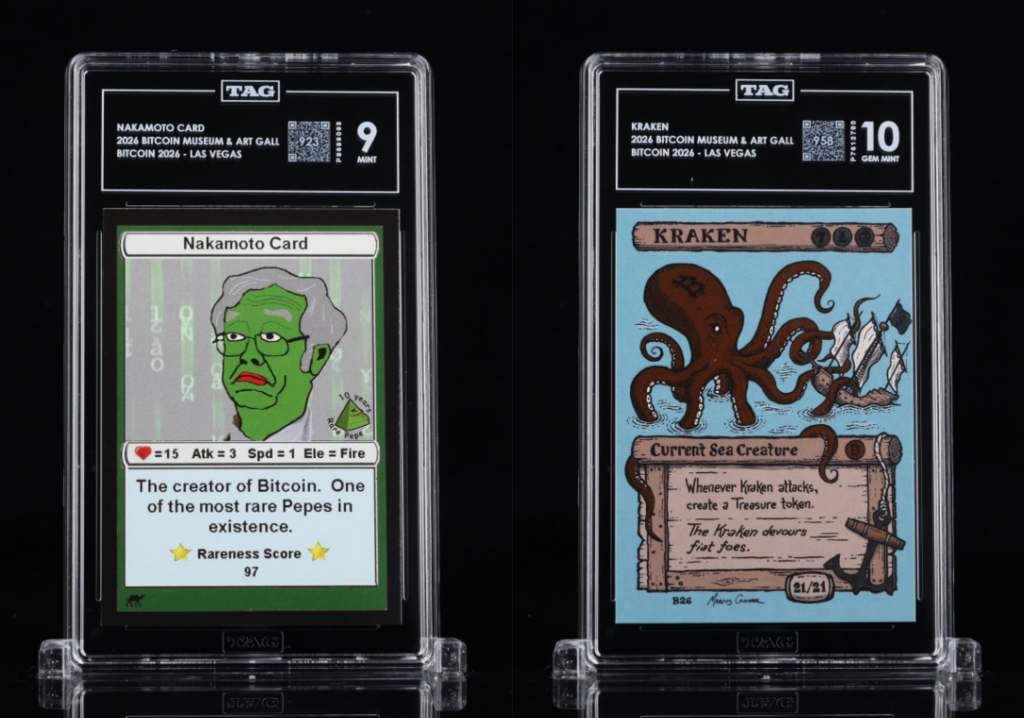
Koch also points to earlier efforts in Las Vegas, where BMAG worked with Kraken and hosted what it calls the first Magic: The Gathering tournament at a Bitcoin Conference, with on-site TAG grading. The source link cited in the piece is https://my.taggrading.com/card/P7612780. The broader claim is that cards are now confronting the same issues bitcoin already addressed.
A full card expo is coming to Bitcoin Asia 2026
BMAG says the clearest expression of that plan will arrive this August. At Bitcoin Asia 2026 in Hong Kong, the organization will debut a full Trading Card Expo on the conference floor.
According to the article, the expo will be built around a marketplace featuring established vendors from across Hong Kong and Southeast Asia. It will also include live activations, grading and authentication services, card auctions, and a curated gallery presentation around the broader event. Cards and collectibles will be available for purchase, and attendees are invited to bring their own cards for grading or resale to more than 40 card vendors.
Koch writes that Hong Kong is one of the most active card markets in the world, making a bitcoin conference a natural venue for the format. Still, he argues that the marketplace itself is not the whole point.
The article’s case for cards as an art medium
The feature spends considerable time placing trading cards inside a longer art history. It points to Jefferson Burdick, described as the father of American card collecting, who spent his final years transferring thousands of cards into albums at the Metropolitan Museum of Art, where that collection remains.
It also notes that Art Spiegelman worked at Topps and helped create series including Garbage Pail Kids before his later mainstream graphic novel success.
Koch then cites critic Brian Droitcour, who argued that a Magic card is “an image that does something,” with rarity and function tied together. NFTs, in this view, inherited that logic but captured only the rarity side of it. Droitcour’s broader argument, as summarized in the piece, is that NFTs dissolved the old hierarchy between artwork and collectible, and that many of the most interesting artists working now are producing objects that are both at once.
Crypto-native artists and “schizocollage”
The article says a loose scene of mostly pseudonymous artists has emerged over the last few years across crypto subcultures, Twitter timelines, and private group chats. Koch describes it as one of the more genuine artistic rebellions of the decade.
Where more established crypto-art circles brought polished generative work into galleries, he writes, these artists moved the other way. Their images are crowded with meme references, anime, veiled art-history cues, and internet debris stacked in layers. Critics, he says, eventually gave the style a name: schizocollage.
The piece also references Spike Art Magazine, where Dean Kissick placed this work in the lineage of deliberately bad painting. Koch adds that Marcia Tucker gave that tradition institutional footing when she opened the New Museum with an exhibition of that name in 1978.
From there, the article argues, the work is moving away from gallery walls and toward cardboard itself. The pack, the pull, the sleeve, and the slab are no longer treated as merchandising accessories. They are becoming the medium.
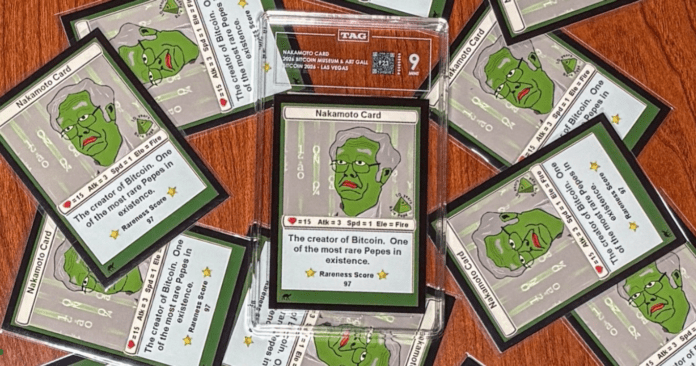
BMAG links that shift to its own recent work
Koch says BMAG has spent years operating in a space the traditional art world largely ignored: the gallery inside a Bitcoin conference.
He gives one example from Bitcoin MENA 2024, where painter Nardo showed work and discussed memes as units of cultural transmission, along with the internet’s layered debris as a legitimate subject for painting. A year later, the article says, Nardo’s Citadel — a seven-foot oil painting built from a 4chan meme — debuted at the Bitcoin Conference in Las Vegas. Koch describes it as a monument to an internet shitpost.
He sees the trading-card movement as part of the same current, just at a smaller scale, small enough to fit inside a penny sleeve.
The article says BMAG has been carrying that conversation through its pages this year, including with Alladan Flinn, founder of Based Trading Cards, who describes cards as physical timestamps of the Bitcoin movement.
Event details and next steps
The feature closes by repeating the launch details for the Card Expo at Bitcoin Asia 2026, set for Aug. 27-28 at the Hong Kong Convention and Exhibition Centre. Vendors selling cards, collectibles, and related goods can apply for a table, though the article says tables are limited.
BMAG also asks readers to follow its X account, @BMAG_HQ, for partnership announcements, auction updates, and previews of the artists coming to Hong Kong.
The post first appeared on Bitcoin Magazine and is credited to Dennis Koch.