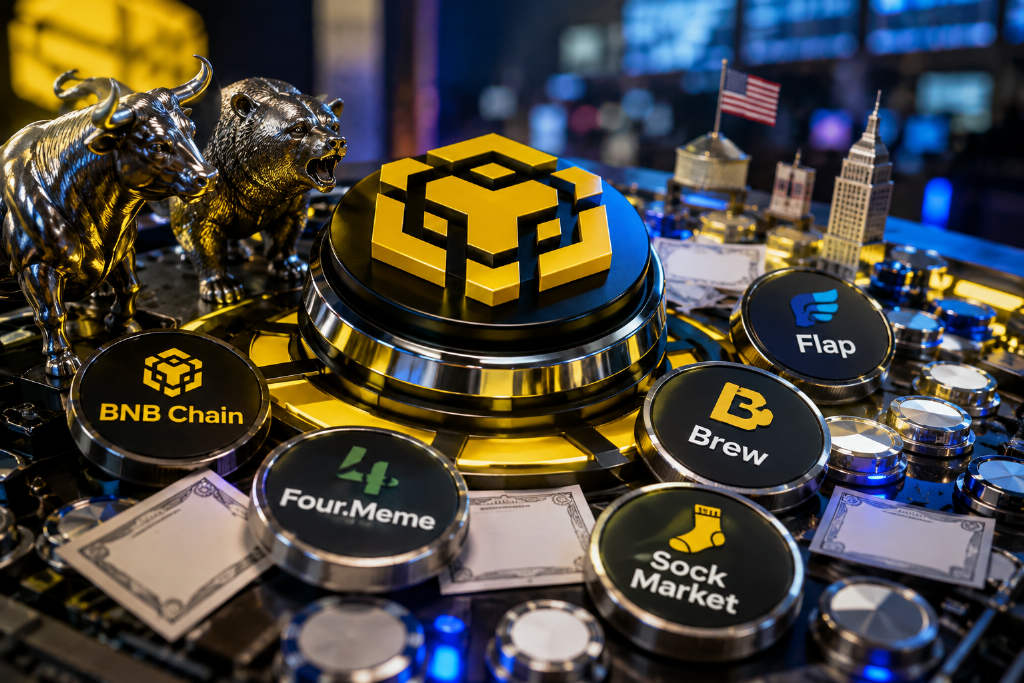
BNB Chain’s launchpad scene is entering a different era, one built around tokenized equities. Sept. 7 made that impossible to miss. GMGN data cited in the source article shows BREW, the platform token of the newly launched launchpad Brew, went from nowhere to a $30 million market cap in four hours early that day, a gain of more than 1,100%. Then later in the afternoon, SOCK, the platform token of another almost simultaneous newcomer, Sock Market, jumped more than 1,200% in one hour and briefly hit a $2.78 million market cap.
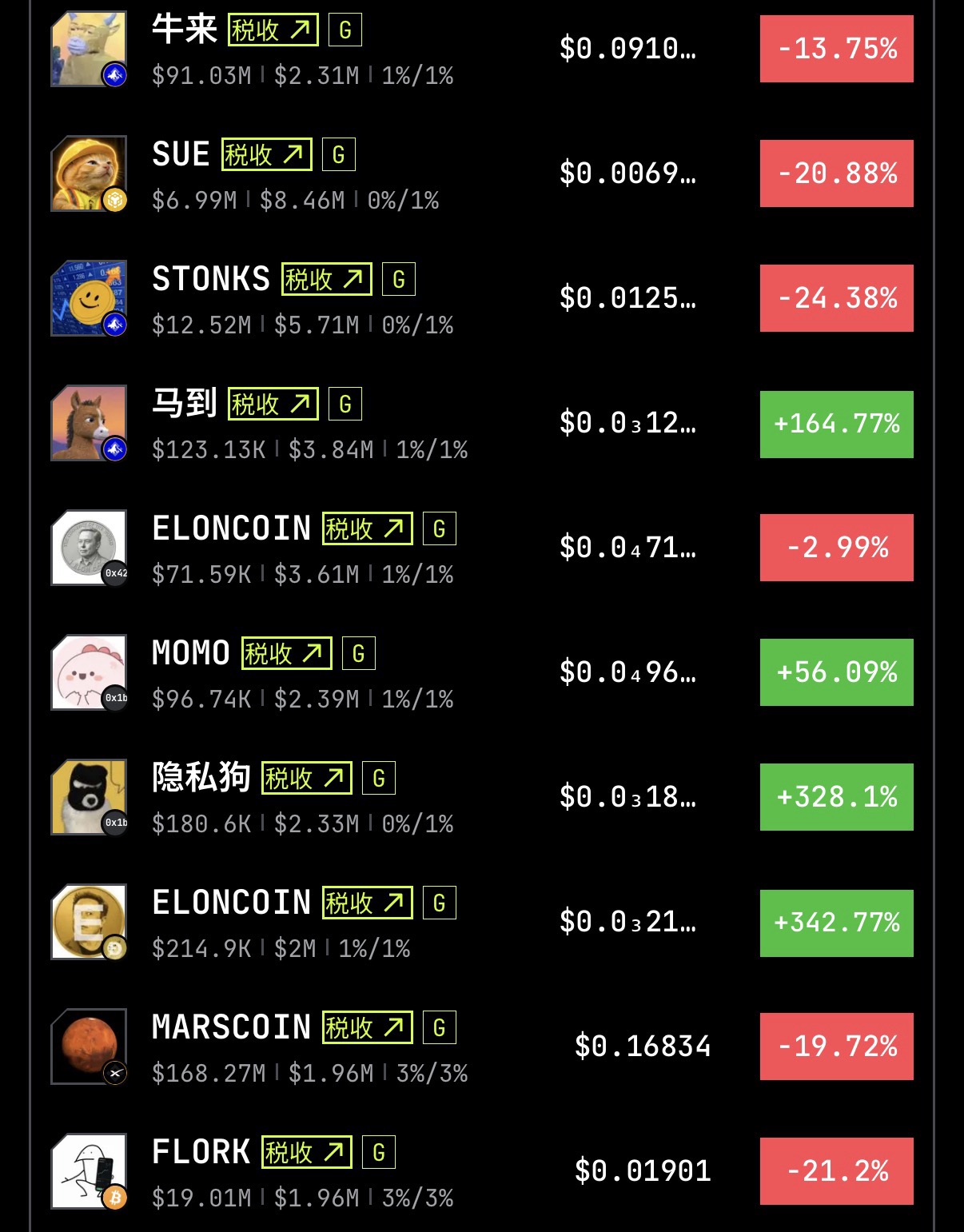
Both projects were built by anonymous teams. Their sudden lift pointed to the same theme now forming on BNB Chain and in parts of the wider crypto market: Meme tokens are no longer stuck trading only against standard assets like BNB or USDT. Now they can be paired directly on-chain with tokenized stocks.
bStocks created the base layer for stock-backed launchpads
This setup goes back to June, when Binance rolled out bStocks. The source says the product put more than 7,000 U.S. stocks, options, and ETFs on-chain in tokenized form, with 1:1 redemption into the underlying securities. Official data cited in the article says cumulative bStocks trading volume had already topped $30 billion as of Sept. 7.
For BNB Chain launchpads, that opened a new liquidity-pool option. Before bStocks, Meme token liquidity was priced almost entirely in BNB or USDT. After that, a cat token or dog token could trade straight against tokenized shares like NVIDIA or SpaceX, so trading the Meme also meant taking on price exposure to U.S. equities. Simple idea. Big shift. In that structure, Meme assets and real-world assets, or RWA, ended up in the same lane.
Flap was first to prove the model on BNB Chain
The first project to grab that opening was Flap. The article says founder Cedric started it from an ETHGlobal hackathon, and the team has fewer than 10 people. Its Chinese name, Butterfly, was picked through a community vote.
Flap changed the standard bonding-curve launchpad format by letting tokens use bStocks as liquidity pool assets and by treating those stocks as dividend-producing assets. Holders are not just sitting on the Meme coin. They also receive on-chain stock tokens over time based on their holdings, creating what the article describes as a dual-yield setup: trading Meme exposure while collecting stock distributions.
On Sept. 4, Binance listed a spot trading pair for MarsCoin. The token moved above $0.26 on Sept. 5 and hit a $260 million market cap, up more than 100% in two days. Data from Flap’s website cited in the article shows that Bull Is Coming, a Meme token already listed on Binance futures, has distributed 2,033 QQQB worth about $1.4655 million. MarsCoin, which has been listed on Binance spot, has distributed 29,703 SPCXB worth about $4.473 million.
DefiLlama data cited in the report shows Flap is currently generating around $2.88 million in fees over 24 hours and about $575,000 in revenue, putting it in first place among all BNB Chain launchpads. After Bull Is Coming and MarsCoin both made it onto Binance, the wealth effect tied to this model sped up hard.
Brew removed graduation and opened quote-asset choice
Brew showed up after Flap had already proved there was real demand for the theme. Its response was simpler. Much simpler. It removes both the bonding curve and the graduation migration step, pushing newly created tokens directly into PancakeSwap V3 pools. Liquidity is permanently locked through Brew’s locker function, and creators cannot pull principal or move the position somewhere else.
On Brew, the trading pair is picked entirely by the creator. It can be BNB, USDT, another Meme token, or a bStocks token. The launch pool charges a fixed 1% trading fee. The token side is fully burned, while the paired-asset side is split between the creator and the protocol, with the protocol taking as much as 50%.
According to data on Brew’s website cited in the source, the two largest tokens on the platform by market cap are BREW and COLD, at about $16.40 million and $79,800. COLD is paired against BREW. The creator fees accumulated by BREW total about 30.58 WBNB, worth roughly $22,700, and 39.61 million BREW have been burned, equal to about 3.96% of total supply. The article also says Brew’s documentation does not promise ongoing buybacks. It only says protocol fees are allocated to the protocol.
The report adds that Fomo wallet data shows well-known trader Bonk Guy holds around 2 million BREW, worth roughly $28,000. The wallet data shows the position was transferred in from an external wallet, and the article says his purchase was made when BREW’s market cap was about $626,000.
The real gap between Brew and Flap is not just whether the launch flow is lighter or heavier. It is the openness of the pool asset itself. Flap was first to bring bStocks into a launchpad, but for a long time its quote assets depended on a preset list, meaning creators could only choose stock tokens approved by the platform. Brew gave that choice to creators from day one. Any compatible BEP20 token can be used as the paired asset, including major crypto assets such as ZEC, which the article says has recently drawn more market attention.
So tokens on Brew can trade against ZEC, or against any Meme token, or any standard token with enough liquidity, instead of being boxed into a stock-only story. As BREW pulled in market attention early on Sept. 7, Flap moved fast to answer.
Flap answered with permissionless launches
In the early hours of Sept. 7, Flap announced a permissionless launch function on BNB Chain. The update supports custom quote tokens, with pricing assets that can include RWA tokens, major crypto assets, and popular Meme tokens rather than only a preset list. It also allows users to combine those custom pairs with Flap’s programmable features, including creator wallets, dividends, burns, and liquidity settings.
The timing said plenty on its own. Flap clearly understood, as described in the article, that if it did not quickly open up quote-asset flexibility, then projects and traders wanting to use ZEC or other crypto assets as liquidity pools could shift both money and attention to Brew and other newer platforms.
Sock Market pushed the design toward stock baskets
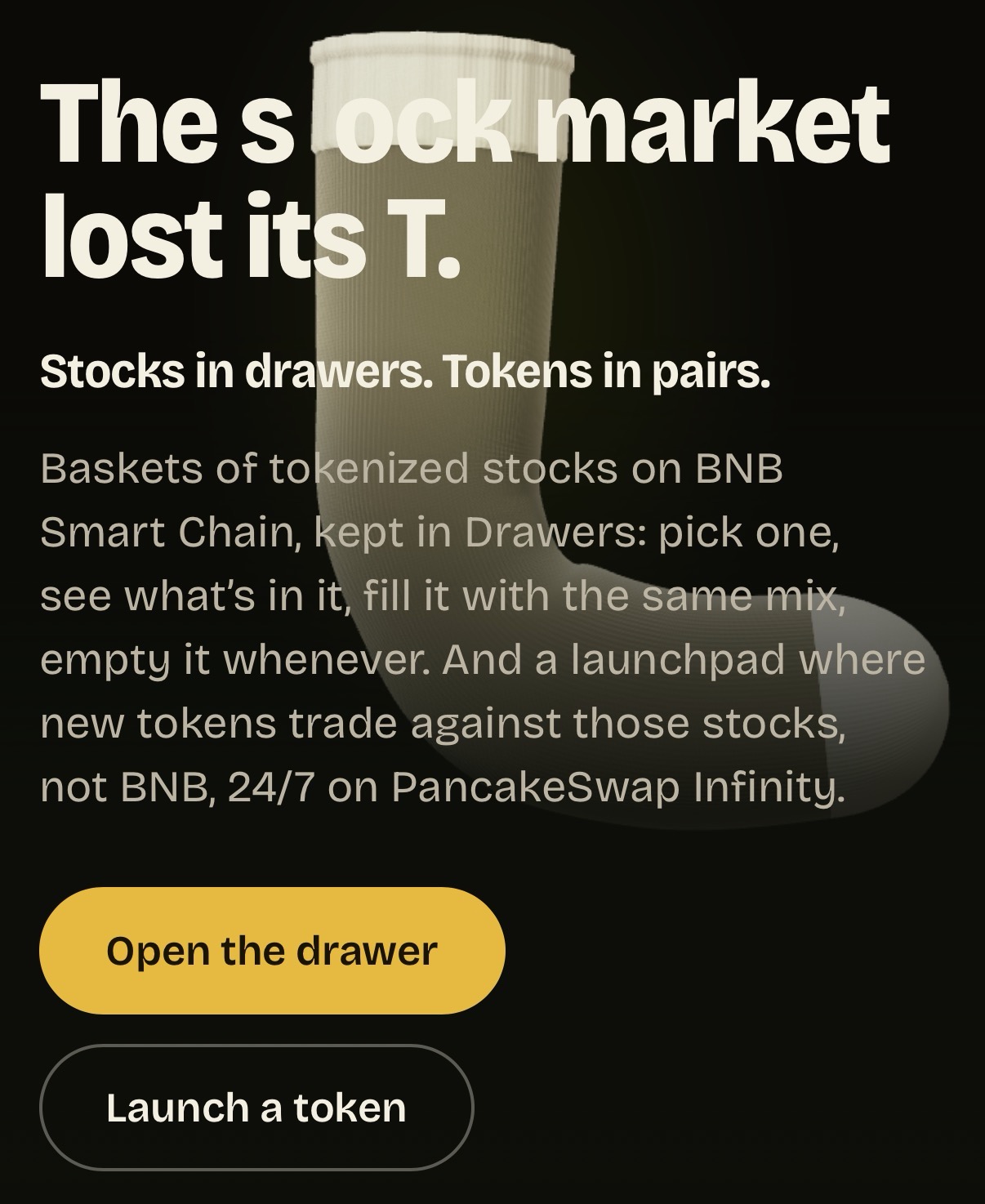
If Brew is the stripped-down version of open-asset launch mechanics, Sock Market went the other way. The article says the official website explains the name as stock without the letter t, leaving sock, tied to a Drawer metaphor about putting stocks into a container.
Sock’s main mechanism lets users create a Drawer made up of 2 to 10 bStocks. In practice, that produces an on-chain stock basket that looks a lot like a mini ETF. When a new token launches, the platform opens a separate PancakeSwap Infinity pool for each stock in the basket, allowing trading against live stock liquidity from the first block. On buys, the system purchases multiple stocks according to assigned weights. On sells, each pool settles on its own.
That gives the token exposure to several assets instead of one quoted instrument. On fees, the Infinity phase charges a 1% base fee per trade, with 70% going to the creator and 30% to the platform. Creators can also add an extra tax from 0% to 10%, and that setting cannot be changed after launch. Once the cumulative value of stocks locked in the pool reaches about $10,000, the token migrates to PancakeSwap V3. At that point, the extra tax disappears and only the 1% pool fee remains, still split 70/30.
Like BREW, the platform token SOCK has no standing buyback plan. But Sock said on Sept. 7 that it had burned 1% of total SOCK supply using platform revenue. GMGN data cited in the article shows SOCK currently has a market cap of about $970,000 and 24-hour trading volume of about $3.9 million. For now, SOCK is also the only token on the platform that has finished the launch migration process.
Anonymous teams remain a risk as Four.Meme falls behind
Brew and Sock have one more thing in common: neither has revealed its team. The article says Brew’s website and official accounts do not identify its founder, and Sock is in the same spot. Because both platforms depend on complex fee-allocation and liquidity-management systems, that anonymity brings higher operating risk. Still, the report argues that anonymity has never blocked entry in this niche. The bigger filter is whether a platform can turn out enough breakout assets within a cycle.
That broader shift has hurt Four.Meme, once the mainstream launchpad on BNB Chain. Four.Meme was incubated and launched by GameFi project BinaryX in July 2024. Its original model was simple: tokens traded on an internal bonding curve and, once the target was reached, graduated to PancakeSwap. Creators could choose a 1%, 3%, 5%, or 10% transaction tax, and that tax could be directed to holder dividends, burns, or liquidity additions. During the BNB Chain Meme boom from 2024 to 2025, that structure was enough and, as the article puts it, close to an industry standard.
But the story changed. The market is no longer focused only on which launchpad can graduate a token. More and more, it is about which platform can launch a token directly against stocks. DefiLlama data cited in the story shows Four.Meme’s current 24-hour fees are only about $9,578, roughly one three-hundred-and-twentieth of Flap’s $2.88 million.
Binance listings still favor easier-to-assess legacy tokens
The article also points to Binance’s latest futures listing pick. On Sept. 6, the token Hajimi was listed on Binance futures. GMGN data cited in the report shows its market cap briefly reached $90.56 million that day, with a one-day gain of 251%. Hajimi came from Four.Meme and was issued on Oct. 7, 2025, with almost no link to the current stock-pool theme.
Another Four.Meme token, Binance Life, had already reached Binance spot and futures and at one point in June came close to a $900 million market cap.
The source argues that the timing gap makes sense. Meme tokens built around stock-backed liquidity structures are tied to real equities, which makes compliance review and market-making arrangements more complicated than for plain BNB-quoted tokens. Although Bull Is Coming and MarsCoin were listed on Binance, both were already leading Flap assets with enough liquidity and market consensus, not brand-new tokens from freshly launched platforms. By contrast, older tokens such as Hajimi from established launchpads come with more predictable token structures, market-making history, and community size, which lowers listing risk. The article says that dynamic also reflects Flap’s current position as the leading launchpad in the BNB Chain market.
A fast-changing launchpad hierarchy
From Flap’s butterfly branding to Brew’s coffee identity to Sock’s wordplay, this round of launchpad competition is reshaping a market structure that Four.Meme had controlled for a long time. Flap opened the stock-pool story through product design. Brew grabbed instant attention with broader asset choice. Sock is trying to define the next phase with a heavier, more structured system.
In the article’s framing, the winner will not be decided by the name or by mechanism cleverness alone. The real test is which platform can produce assets with steadier market caps and enough trading depth to support sustained secondary-market pricing as bStocks and Meme tokens become more tightly linked on BNB Chain.