
Wall Street is waiting for the August nonfarm payrolls report, but Bank of America does not see it as the deciding factor for the Federal Reserve’s September meeting. In a rates and FX research report dated Sept. 2, the bank said payrolls are only a warm-up and that the real line for a September rate hike will be the inflation data that follows, especially CPI.
According to Chase the Trend Pro, BofA said markets are currently pricing about a 70% chance of a September hike, but the final call still depends on next week’s CPI and PPI releases.
BofA expects 40,000 jobs added in August
The bank forecast August nonfarm payroll growth of just 40,000, with 35,000 of that coming from the private sector. That is below market consensus. It also expects the unemployment rate to stay at 4.1%.
BofA tied that call to the seasonal softness often seen in August labor data. It said historical patterns show August payrolls have often produced downside surprises, with residual summer seasonality weighing on the series in recent years. ADP data has also remained soft.
Even so, the bank said the three-month average for private-sector job growth should still hold near 30,000, around the level it sees as consistent with economic breakeven. If labor-force participation rebounds, the unemployment rate could edge up to 4.2%.
BofA added that, given Fed Chair Warsh’s recent comments on labor-market resilience, even a weak payrolls report would probably have only a limited effect on September hike pricing.
Jackson Hole speech points to inflation over employment
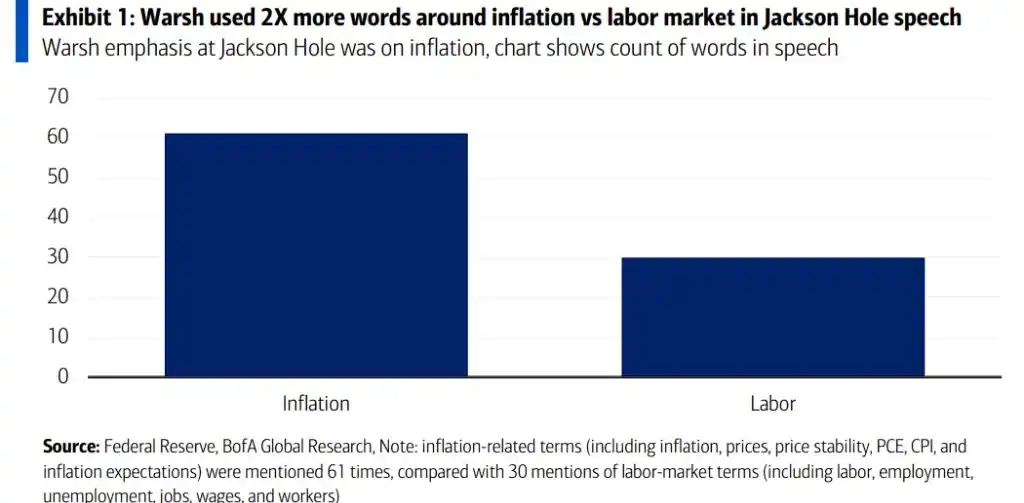
BofA said its analysts ran a word-count review of Warsh’s Jackson Hole speech. Inflation-related terms, including inflation, prices, price stability, PCE, CPI, and inflation expectations, appeared 61 times. Labor-market terms, including labor, employment, unemployment, jobs, wages, and workers, appeared 30 times.
In the bank’s reading, that near 2-to-1 split shows the Fed is still putting inflation ahead of employment. The report said Warsh described the labor market as close to full employment and focused more on steady jobless claims and a stable unemployment rate than on weak headline payroll gains as the main risk signal.
That leaves BofA with the view that even a soft August payrolls reading would not do much on its own to derail expectations for a September hike.
Payrolls come before the blackout, CPI comes during it
BofA described payrolls as the opening act and next week’s CPI as the main event for the September Federal Open Market Committee meeting.
The bank highlighted a timing issue as well. The August payrolls release is the last major data point before Fed officials enter their blackout period. That means policymakers will still have a short window after payrolls to comment publicly on what the labor-market data means for policy. By the time CPI is released next week, officials will already be in blackout and unable to give the market fresh guidance.
Because of that, BofA said any Fed commentary after payrolls could carry unusual weight in shaping how markets interpret CPI and build expectations for September.
BofA sees asymmetric risk in Treasuries
The bank’s core rates-market call is that the payoff profile around payrolls is clearly asymmetric. In its view, a weaker-than-expected report would produce a larger Treasury rally than a stronger-than-expected report would produce in a selloff.
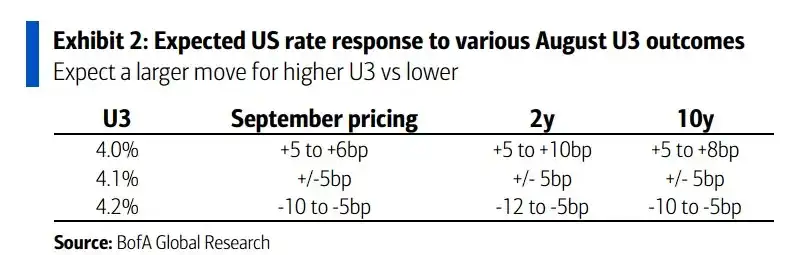
- If the unemployment rate rises to 4.2%, BofA expects the 2-year Treasury yield to fall by 5 to 12 basis points and the 10-year yield to fall by 5 to 10 basis points.
- If the unemployment rate drops to 4.0%, it expects the 2-year yield to rise by 5 to 6 basis points and the 10-year yield to rise by 5 to 8 basis points.
- If the unemployment rate stays at 4.1%, it expects two-way moves of about 5 basis points across maturities.
BofA gave two reasons for that asymmetry. First, commodity trading advisors, or CTAs, and active bond funds are still carrying relatively short duration exposure, which makes short covering more likely if the data disappoints. Second, even strong payrolls would not fully lock in a September hike because uncertainty would remain until CPI is released.
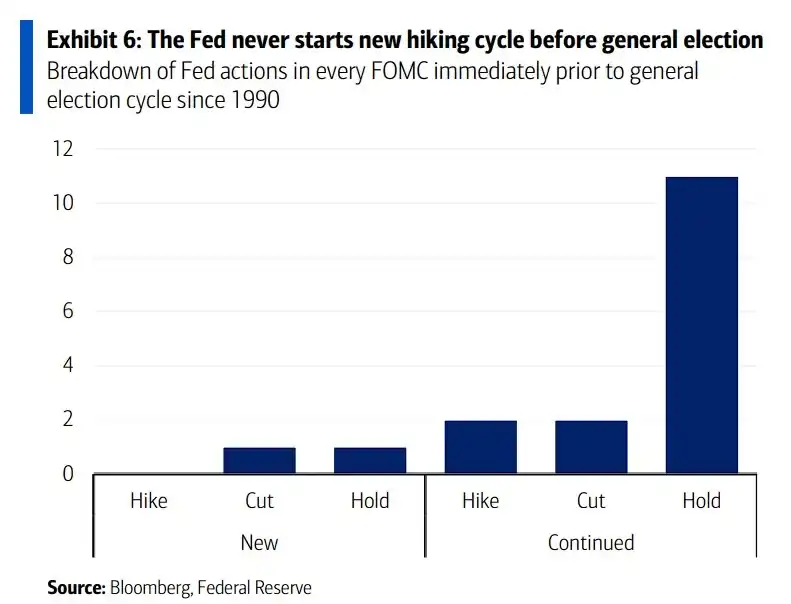
The report also pointed to the political calendar. BofA said the Fed has not started a new hiking cycle at an FOMC meeting held close to a national election since 1990. If the Fed does not hike in September, the next active meeting window may be December, because the October meeting is too close to the midterm elections.
Trade ideas: long 5-year Treasuries, tactically short the dollar
Based on that setup, BofA recommended going long 5-year Treasuries and putting on a 5s/30s Treasury curve steepener. The bank said weak payrolls would likely produce a bull steepening move, while strong data would point to a bear flattening move.
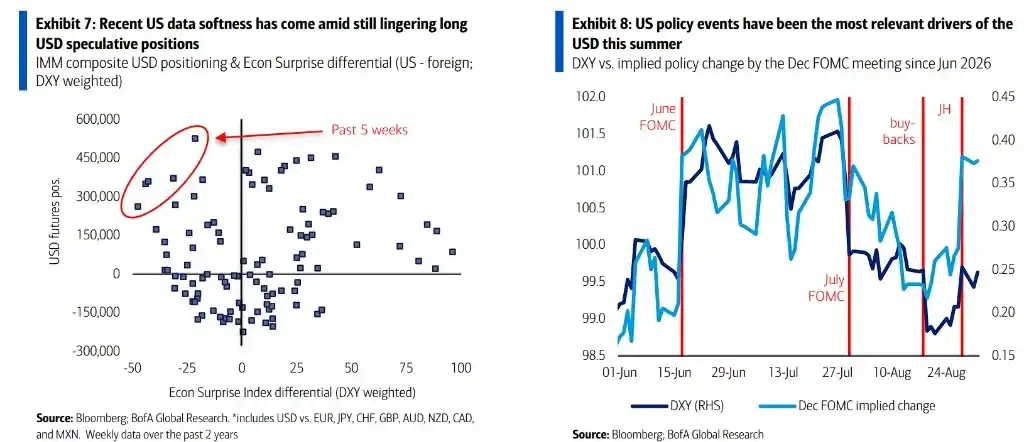
Its FX view follows the same logic. BofA said the U.S. dollar also faces asymmetric risk, with downside larger than upside when the degree of surprise is similar on the strong and weak sides of the data.
The report said markets are pricing roughly a 70% chance of a September hike, while IMM positioning still shows speculative net-long dollar exposure. At the same time, recent U.S. economic data has continued to soften. BofA added that this summer’s dollar moves were driven more by U.S. policy events than by the hard data itself.
BofA also said the dollar has lagged in its post-Jackson Hole repricing, which may reflect lingering bearish sentiment tied to an unexpected sovereign buyback announcement in late August.
If the Fed ultimately delivers a rate hike, the bank said that would curb the market narrative around dollar depreciation. If policymakers repeat what BofA described as the dovish outcome of the July FOMC meeting, the credibility rebuilt at Jackson Hole could fade quickly, with the dollar weakening in response.